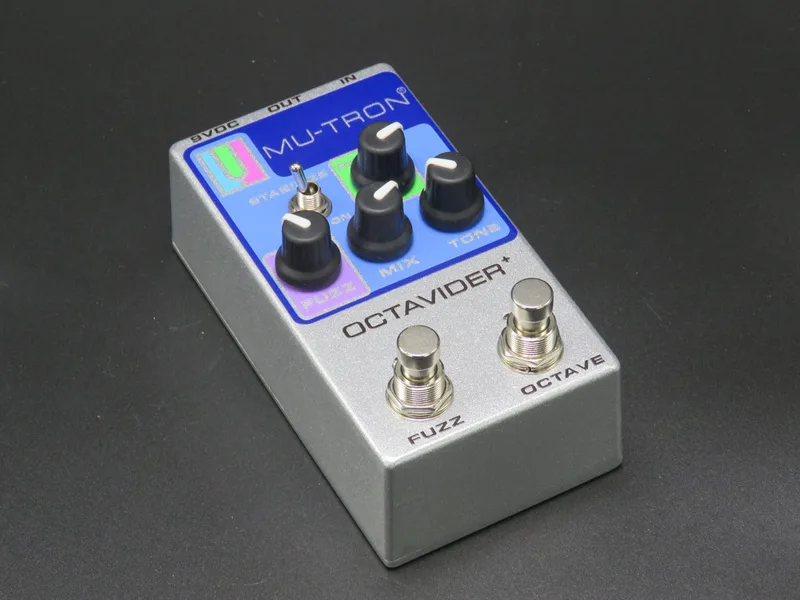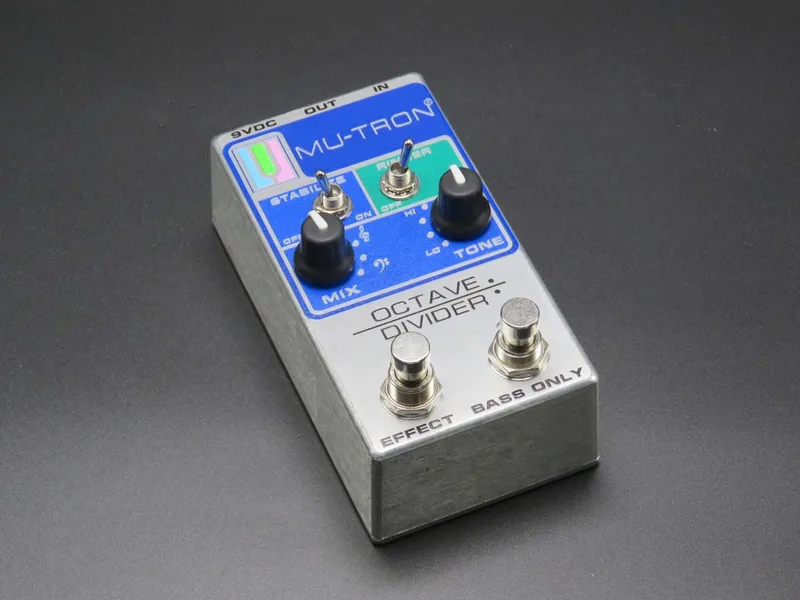


The Mu-Tron Octavider+ Analog Octave Fuzz is a pedal that combines fuzz and octave effects in one box, described by Pedal of the Day as "the newest reincarnation of the classic Octave Divider that Mu-Tron produced in the 1970's"1. It sits in the octave and pitch and fuzz territory: the octave side uses newly developed circuitry that analyzes your original signal and pairs it with the note one octave below, matching tone color and dynamics over an exceptionally wide range, while the fuzz side is an independent, hi-voltage, high-fidelity fuzz circuit that adds harmonic overdrive tones1.
Controls
| Control | What it does |
|---|---|
| Fuzz knob | Adds harmonic overdrive tones; turning it down decreases both the fuzz and the output1 |
| Ringer knob | Provides multiple effects of distortion, extra note generation, and a kind of "octave up" effect1 |
| Stabilize toggle switch | Activates a circuit that enables the Octavider+ to lock into the musical tone and sound a simultaneous sub-octave with accuracy1 |
The Stabilize switch is the pedal's distinguishing control. Mu-Tron's claim, as reported in the review, is that it lets the Octavider+ lock into the musical tone and sound a simultaneous sub-octave "with accuracy that is not found in any other device"1. For a player, that addresses the usual weakness of octave effects, which is losing the sub-octave when the tracking slips.
Tracking and instruments
The Octavider+ tracks steady on guitar, bass, keyboards and horns, and the review says it will turn your instrument into a fat monophonic synthesizer1. Bass players looking at bass pedals can run it as they would on guitar, and keyboard or horn players can use the same sub-octave pairing.
How it relates to the original
The Octavider+ carries the Mu-Tron Octave Divider name into a new design, pairing the newly developed octave circuitry with an independent hi-voltage fuzz side, which the reviewer called "a warm, tasty circuit you want to keep loud and strong if you can"1. Together, the maker says the two will "turn your instrument into a fat monophonic synthesizer"1.
What reviewers said
Pedal of the Day's 2020 review concluded that the combination of fuzz and octave makes it "an all-around powerhouse for any musical genre"1.
Videos
Mu Tron
Mu Tron
Pedal of the Day
Questions
What does the Stabilize switch do on the Octavider+?
The Stabilize toggle switch activates a circuit that lets the Octavider+ lock into the musical tone and sound a simultaneous sub-octave with accuracy. Mu-Tron describes this tracking accuracy as not found in any other device, and it is the pedal's answer to the tracking problems that plague many octave effects.
Does the Mu-Tron Octavider+ work with bass?
Yes. Pedal of the Day reports that the Octavider+ tracks steady on guitar, bass, keyboards and horns, turning the instrument into what the reviewer called a fat monophonic synthesizer. Bass players get the same sub-octave pairing and fuzz circuitry as guitar players.
Is the Octavider+ monophonic?
The octave effect is built around a monophonic synthesizer-style result: the circuit analyzes the original signal and pairs it with the note one octave below, matching tone color and dynamics. Played with single notes it produces a fat monophonic synthesizer sound, per the Pedal of the Day review.
What does the Ringer knob do?
The Ringer knob provides multiple effects of distortion, extra note generation, and a kind of octave up effect, according to Pedal of the Day. It works alongside the Stabilize switch and the Fuzz knob to shape the octave and fuzz character.
How is the Octavider+ different from the original Octave Divider?
The Octavider+ is a modern reincarnation of the classic Octave Divider that Mu-Tron produced in the 1970s. It adds newly developed circuitry that analyzes the original signal and pairs it with the note one octave below, matching tone color and dynamics over an exceptionally wide range, alongside an independent hi-voltage fuzz circuit.
Sources (1)
- Mu-Tron Octavider+ Analog Octave Fuzz, Pedal of the Day, 2020-07-02