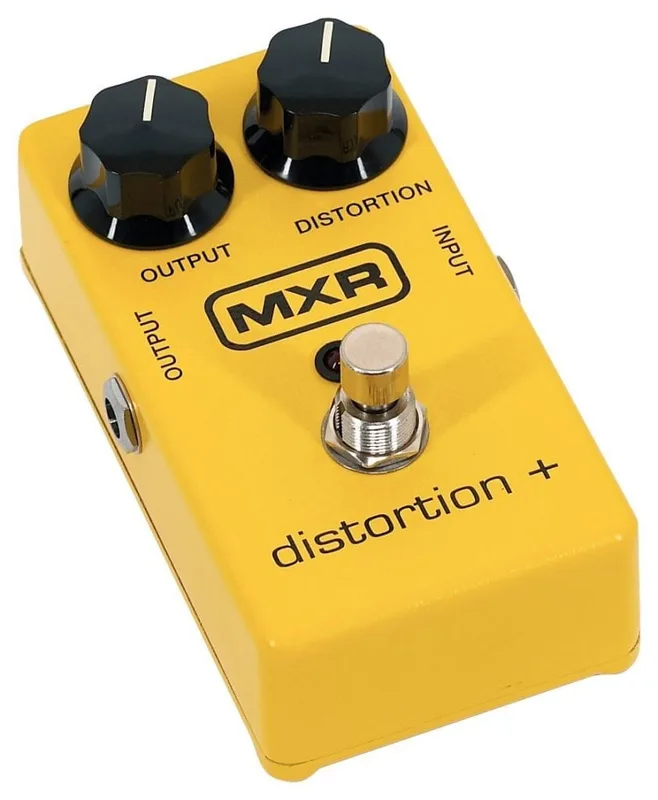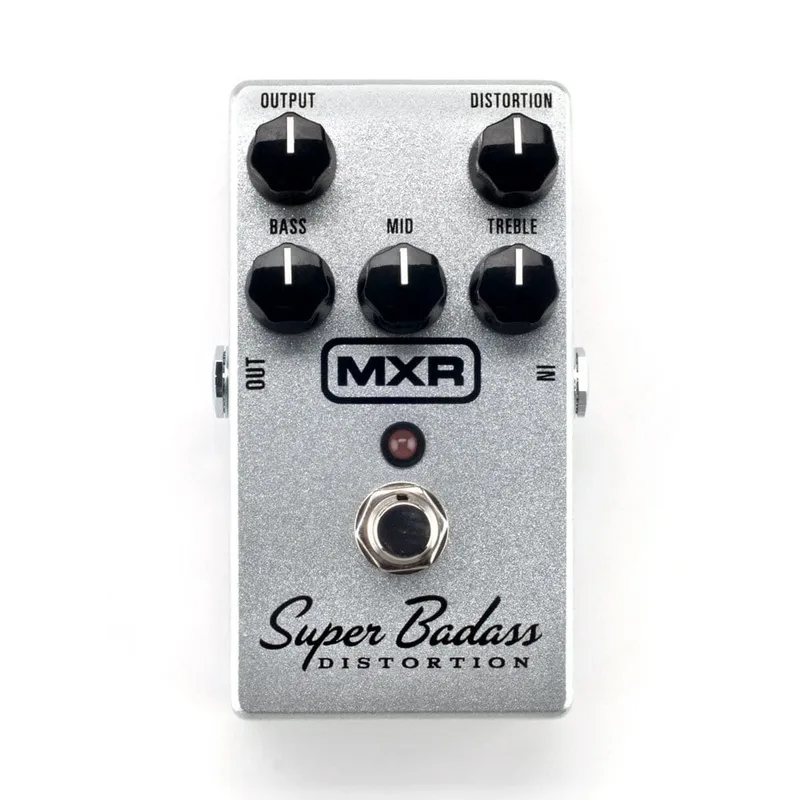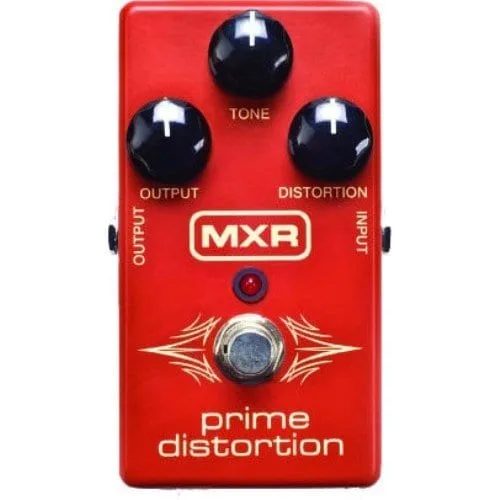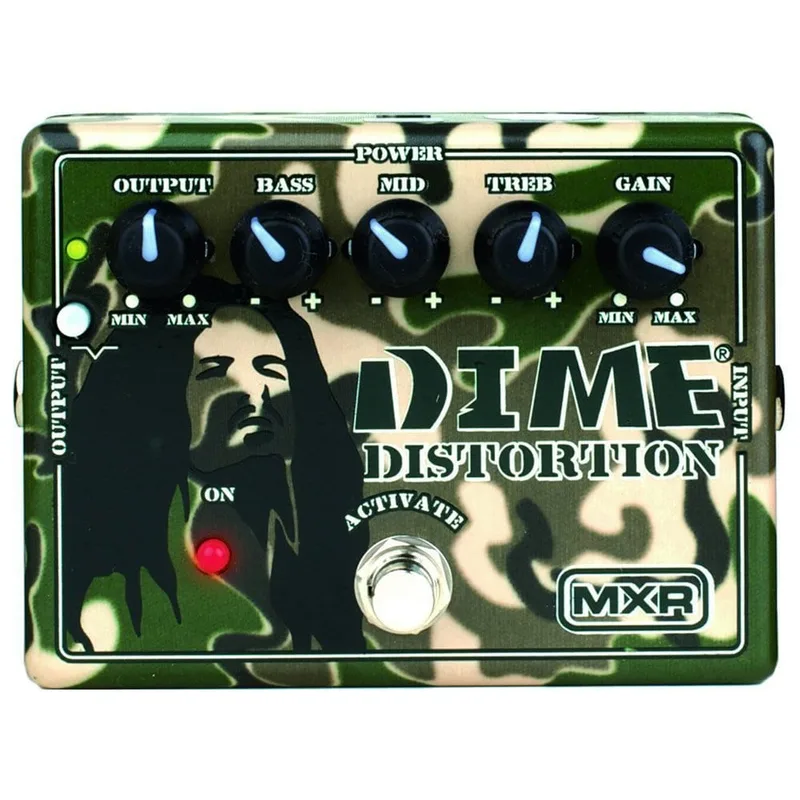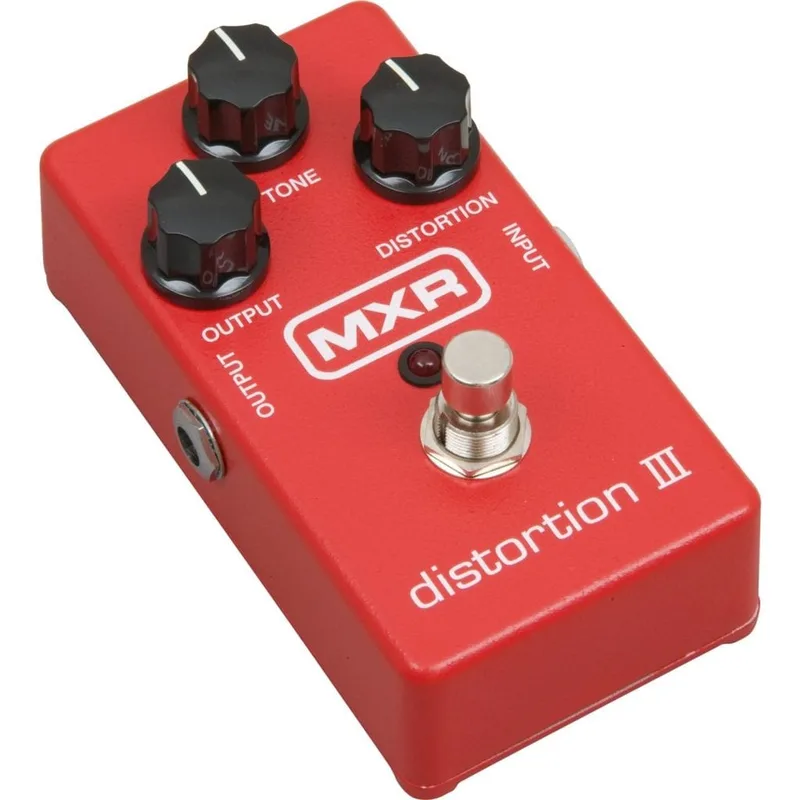


The MXR Distortion III (model M115) is a distortion pedal made by MXR, the effects line of Dunlop Manufacturing, Inc. It sits in the long MXR distortion family alongside the MXR Distortion + and the MXR Super Badass Distortion, and it takes the straightforward route: three knobs, one footswitch, one red LED1.
Dunlop describes the pedal's character through its manual: a proprietary circuit design that delivers rich harmonics, a dynamic, touch-sensitive response, and a large output range. In practical terms, that means the pedal is built to respond to how hard you pick and to give you enough level at the Output control to push an amplifier1.
The controls: Distortion, Tone and Output
The pedal keeps everything on the face of the box. Each knob has one job, and the manual describes them plainly.
| Control | What it does |
|---|---|
| DISTORTION | Sets the amount of distortion; clockwise increases it, counterclockwise decreases it1 |
| TONE | Sets the color of the overdrive signal; clockwise is brighter, counterclockwise is darker1 |
| OUTPUT | Sets the overall effect volume1 |
The Tone control is not a vague tilt: the manual specifies its range as ±6.5 dB at 3 kHz, so it is a cut-or-boost around a fixed center frequency1. That makes it a practical tool for matching the pedal to a bright amp or a dark one.
The DISTORTION control has a wide sweep. The manual gives the distortion gain as 22 dB to 50 dB measured at 1 kHz, with a maximum output level of +3 dBV1. The bottom of that range sits in overdrive territory, and the top reaches saturated distortion. To help players find their footing, the manual includes three sample settings: Smooth Overdrive, Crunchy Rhythm and Singing Sustain1. Those three names map neatly onto the gain range, from light drive at the low end to sustained lead tones at the top.
The manual also lists a noise floor of 84 dBV, A-weighted, measured with the Distortion and Tone controls at their mid positions and the Output control at its maximum clockwise position1. That is the worst-case condition for noise, since a fully open Output control amplifies everything, and it gives a player a sense of how quiet the pedal is when pushed.
A single footswitch toggles the effect on and off, with a red LED indicating when the effect is on1.
Power and connections
Setting the pedal up takes two cables: one from the guitar to the INPUT jack, and one from the OUTPUT jack to the amplifier1. The 1 MΩ input impedance is the standard value for a guitar pedal, so the pedal presents a normal load to passive pickups1.
For power, Dunlop gives several options. The pedal can run on a 9-volt battery, a Dunlop ECB003 9-volt adapter, or the DC Brick, Iso-Brick and Mini Iso-Brick power supplies3. The current draw is 3.5 mA1, which is low by the standards of any pedalboard supply, so it shares a multi-output supply without straining it.
The manual lists the bypass as True Hardwire1, Dunlop's term for its hardwire switching. The red LED on the footswitch shows when the effect is engaged1.
Where it sits in the MXR distortion line
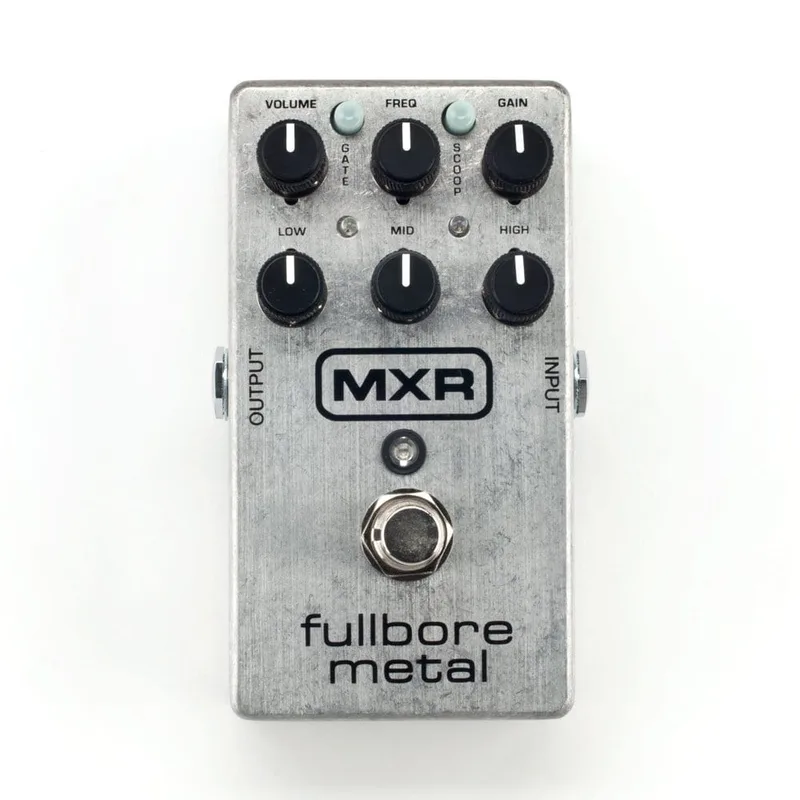
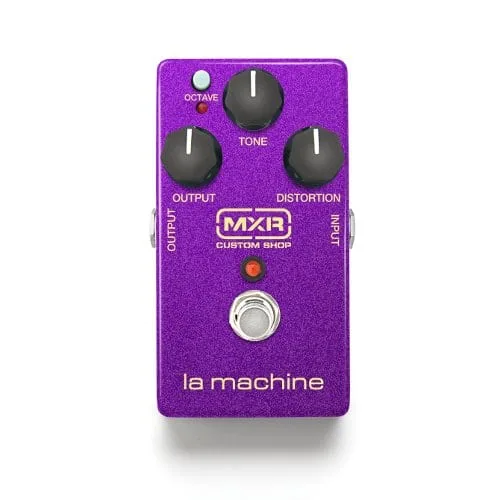
The Distortion III is one of several MXR distortions a player can choose from. The MXR Distortion + is the older, simpler two-knob design, while the MXR Super Badass Distortion offers more control. Others in the range include the MXR Prime Distortion, the MXR Dime Distortion, the MXR Fullbore Metal and the MXR La Machine. The Distortion III's place in that lineup is the middle ground: three knobs, a wide gain range and a touch-sensitive response, without the extra controls of the higher-gain models1.
Videos
ProGuitarShopDemos
Robert Baker
tunnelvisionmusic
Questions
Does the MXR Distortion III take a battery?
Yes. Dunlop says the pedal can be powered by a 9-volt battery, a Dunlop ECB003 9-volt adapter, or the DC Brick, Iso-Brick and Mini Iso-Brick power supplies. The battery route makes it usable on a board without a power supply, though an adapter avoids the chore of swapping batteries.
Is the MXR Distortion III true bypass?
The manual lists the bypass as True Hardwire, which is Dunlop's switching design for keeping the bypassed signal path direct. A red LED on the footswitch shows when the effect is engaged, so you can see the pedal's state on a dark stage at a glance.
How much gain does the MXR Distortion III have?
The manual gives a distortion gain range of 22 dB to 50 dB measured at 1 kHz. That spans light overdrive through heavy distortion, and the manual's sample settings cover Smooth Overdrive, Crunchy Rhythm and Singing Sustain, so the range is meant to be usable across styles.
What power supply does the MXR Distortion III use?
It runs on 9 volts and draws 3.5 mA, which is low enough for most multi-output pedalboard supplies. Dunlop names its own ECB003 9-volt adapter plus the DC Brick, Iso-Brick and Mini Iso-Brick as compatible, and a 9-volt battery also works.
Sources (3)
- M115.pdf, Jim Dunlop, 2019
- MXR® SUPER BADASS® DISTORTION, Dunlop (jimdunlop.com)
- MXR® DISTORTION III, Dunlop (www.jimdunlop.com)