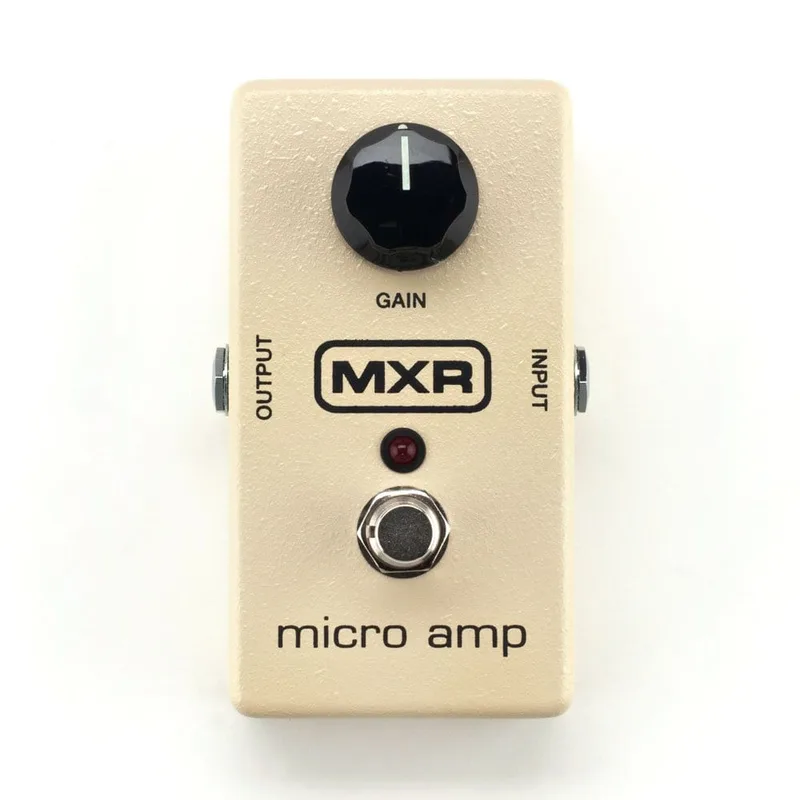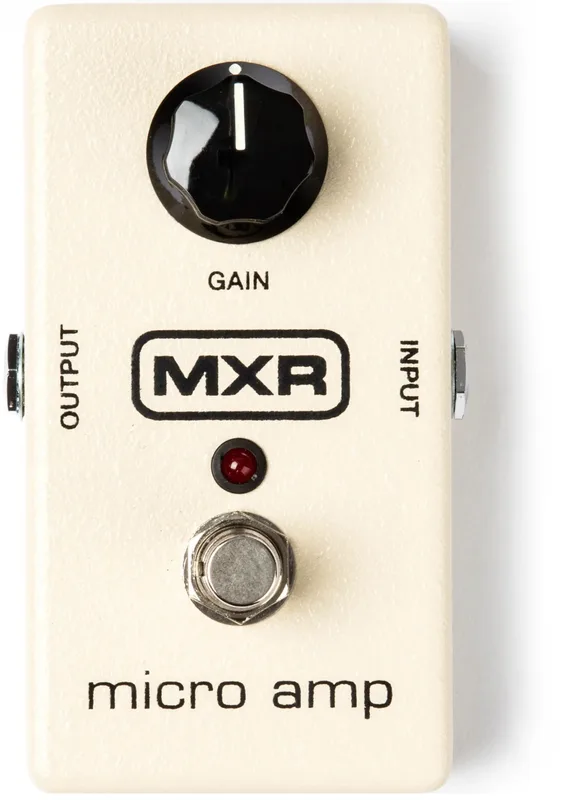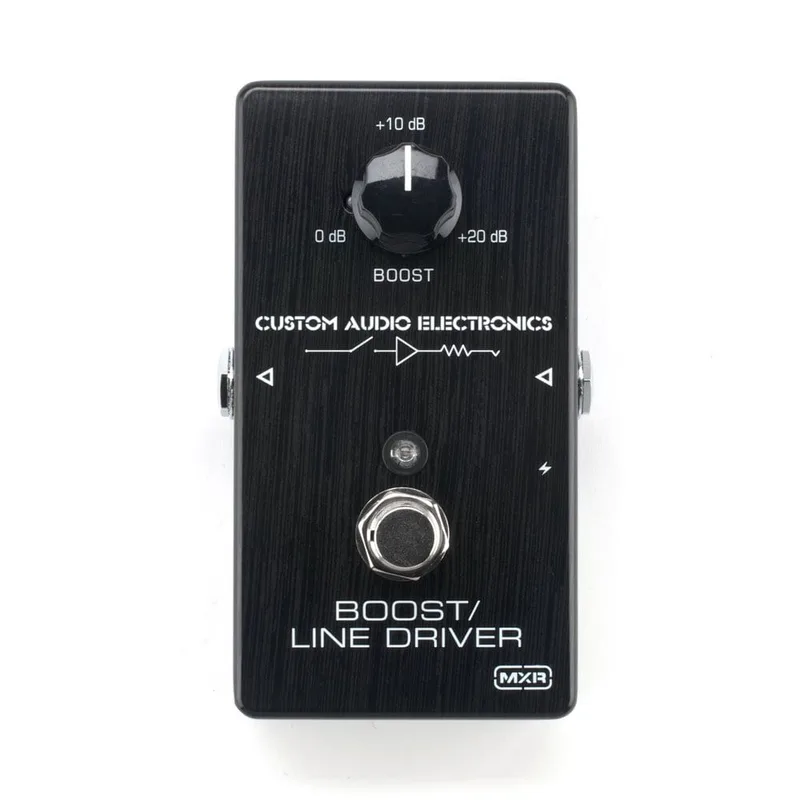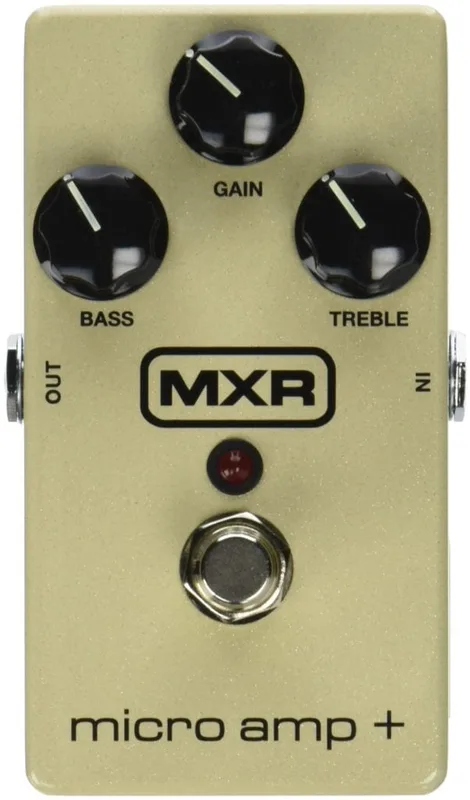


The MXR Micro Amp + is a clean boost pedal from MXR, made by Dunlop Manufacturing. It takes the idea behind the company's long-running Micro Amp, a simple one-knob volume boost, and adds a two-band EQ so you can shape the boosted signal as well as raise its level. The Gain control delivers up to +26 dB of clean signal boost, enough to push an amp into saturation on its own or to lift a solo above the band123.
MXR describes it as building on the classic pedal with EQ controls and other upgrades, and the manual sums up the design goal: "The Micro Amp + builds on the classic M233 with EQ controls so you can finely sculpt your boosted signal"4.
What it does to your sound
The Micro Amp + is a clean boost: its circuit is a simple op-amp with enough headroom to give a large boost of signal without adding clipping of its own7. What happens next depends on where you put it. Into a clean amp it raises your volume substantially; into an amp that is already dirty, it can pummel the front end into heavier saturation. As Premier Guitar's tone advice puts it:
"Hit the front end of your clean amp with it and it'll raise your volume substantially. Hit the front of an already dirty amplifier and you can pummel your amp into submission!"
It also solves a practical problem: like the original, it can provide a permanent boost in a long effects chain where signal drop-off is a problem, and it is useful for matching levels when switching between guitars with different output1. Flea of the Red Hot Chili Peppers uses an MXR Micro Amp as a clean boost for slapping and leads9, and Jack White has used the original as his go-to boost since around 199710.
The controls: Gain, Bass and Treble
Three knobs do all the work. The manual's setup directions are straightforward4:
| Control | What it does | Range |
|---|---|---|
| GAIN | Controls the overall amount of signal boost; clockwise for more, counterclockwise for less | +0.5 dB to +26 dB4 |
| BASS | Boosts or cuts low frequencies | ±14 dB at 33 Hz4 |
| TREBLE | Cuts or boosts high frequencies | ±11 dB at 8.4 kHz4 |
For the classic Micro Amp sound, MXR says to set the Bass and Treble controls to noon, which leaves the EQ flat and gives you the plain boost of the original11. From there you can thicken the lows or add top-end bite to the boosted signal. The frequency response is specified at 20 Hz to 20 kHz within ±0.75 dB, so with the EQ at noon the pedal is close to flat across the full audio range4.
Power and connections
The Micro Amp + runs on 9V DC and draws only 6.5 mA, which makes it easy on a pedalboard power supply4. Dunlop's product page specifies a Dunlop ECB003 9-volt adapter for the pedal11. The original Micro Amp, by contrast, can also run on a 9-volt battery installed under the bottom plate, along with the ECB003 adapter or Dunlop's DC Brick and Iso-Brick supplies1.
The original Micro Amp was first issued without an on/off LED or any means to accept an external power supply; those came later in its life12.
Micro Amp vs Micro Amp+
The original M133 Micro Amp has a single knob: turn it clockwise for up to +26 dB of gain, counterclockwise for less3. The Micro Amp + keeps that boost range but adds a clean, active two-band EQ for extra shaping7. Gearnews also notes that MXR upgraded the circuit with low-noise op-amps and true-bypass switching, where the original uses a hardwire bypass5. MusicRadar describes the update the same way:
"The most recent Micro Amp+ adds EQ and a lower-noise circuit to this already classic design."
In short, the differences are:
- Controls: one Gain knob (original) versus Gain, Bass and Treble (Micro Amp +)43
- Circuit: low-noise op-amps in the Micro Amp +5
- Bypass: hardwire (original) versus true bypass (Micro Amp +)53
- Current draw: 2.5 mA (original) versus 6.5 mA (Micro Amp +)41
Where the Micro Amp came from
The Micro Amp dates to MXR's early years. MusicRadar places its release in the early 70s as part of MXR's Reference Series, a close non-distorting cousin of the MXR Distortion+12. Guitar World's boost pedal guide gives a firmer date, saying the first M133 Micro Amp pedal arrived in 19783, while TONEHOME's page on the vintage unit dates it to 1980, made in Rochester, New York13.
The original circuit is a simple op-amp design built around a TL061, chosen for its low current draw, and it shares its basic circuit with the MXR Distortion+ and DOD 250121415. GuitarPCB's technical analysis describes it as "a transparent clean volume booster; it does not color or modify the guitar tone"16. Gearnews calls the original "famous for its simple one-knob boost sound," a studio and live favorite5, and Premier Guitar has called it a "legendary boost circuit"17.
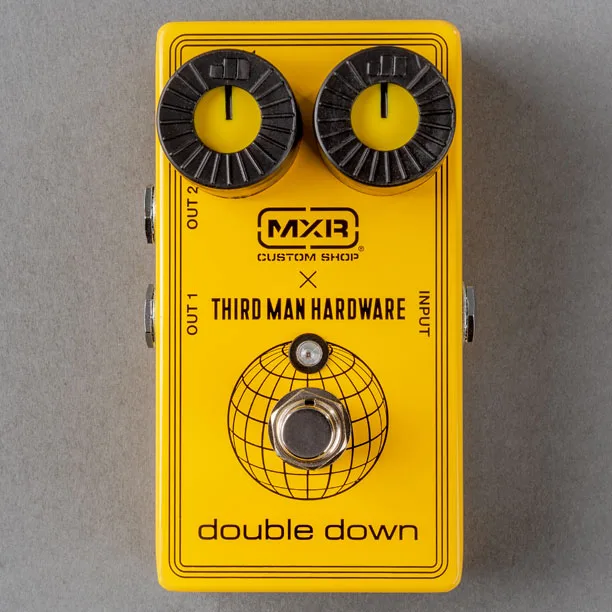
The Micro Amp + was shown at the Jim Dunlop booth at NAMM 201418. The circuit has since traveled further: the Third Man Hardware Double Down, a stereo two-channel pedal built with Jack White's company, contains two Micro Amp circuits19.
What reviewers make of it
Gearnews named the Micro Amp Plus among its seven best boost pedals of 2026, crediting the active Bass and Treble controls and the upgraded circuit5. Guitar.com's boost pedal explainer notes the Micro Amp+ variant "adds a clean, active two-band EQ for extra shaping"7. Reviewers of the original Micro Amp circuit, which the Micro Amp + carries forward, note it is great for coaxing extra saturation from a fuzz or getting leads to jump out in a band mix3.
Videos
ProGuitarShopDemos
Andertons Music Co
jimdunlopusa
Questions
What is the difference between the MXR Micro Amp and Micro Amp+?
The original Micro Amp has a single Gain knob and a hardwire bypass. The Micro Amp+ keeps the same boost function but adds active Bass and Treble controls, low-noise op-amps, and true-bypass switching, so you can shape the boosted signal as well as raise its level.
Is the Micro Amp+ quieter than the original Micro Amp?
Yes. MXR upgraded the circuit with low-noise op-amps, and MusicRadar describes the Micro Amp+ as adding a lower-noise circuit to the classic design. The original was built around a TL061 op-amp chosen mainly for its low current draw rather than its noise performance.
How much boost does the Micro Amp+ give?
The Gain control covers a range of +0.5 dB to +26 dB, matching the maximum boost of the original Micro Amp. At the lowest setting it still adds a small amount of gain rather than acting as a pure volume cut.
Can the Micro Amp+ be used on bass?
Yes. The Bass control is specified at plus or minus 14 dB centered at 33 Hz, which sits right in a bass guitar's low register, so low frequencies can be cut or boosted meaningfully on a five-string or standard-tuned bass.
Sources (19)
- M133.pdf, Dunlop Manufacturing, Inc., 2019
- MXR® MICRO AMP, Dunlop (www.jimdunlop.com)
- Best boost pedals 2026: including the best clean boost pedals for guitar, Guitar World, 2020-07-01
- M233.pdf, Dunlop Manufacturing, Inc., 2019
- The 7 Best Boost Pedals of 2026: Make it Louder Better!, www.gearnews.com, 2026-05-11
- "This pedal excels at delivering a completely clean volume boost, MusicRadar, 2025-11-14
- Need a lift in signal? Boost pedals explained, Guitar.com, 2025-08-28
- Guide to Overdrives, Distortions, and Boost Pedals, Premier Guitar, 2016-02-22
- Rig Rundown, Premier Guitar, 2012-06-03
- Jack White delivers a pedal demo for the ages as Third Man Hardware partners with MXR for the Double Down, Guitar World, 2022-12-09
- MXR® MICRO AMP+, Jim Dunlop (jimdunlop.com)
- Meet your maker: MXR at 40, MusicRadar, 2014-12-04
- TONEHOME, TONEHOME, 1982
- MXR™ MicroAmp™ Clone: DIY Boost Pedal Kit, PCB & Schematic, General Guitar Gadgets, 2014-05-12
- Pedal Review: VFE Distortion3, Delicious Audio, 2012-08-02
- MXR MicroAmp Analysis, GuitarPCB (guitarpcb.com)
- Quick Hit: MXR Booster Mini Review, Premier Guitar, 2017-12-28
- NAMM 2014 Video: Jim Dunlop Pedals -MXR Phase 99, Micro Amp Plus, La Machine, Way Huge Swollen Pickle, Fuzz Face Mini and More, Guitar World, 2014-02-03
- Jack White & MXR Unveil Double Down Preamp, Premier Guitar, 2022-12-09