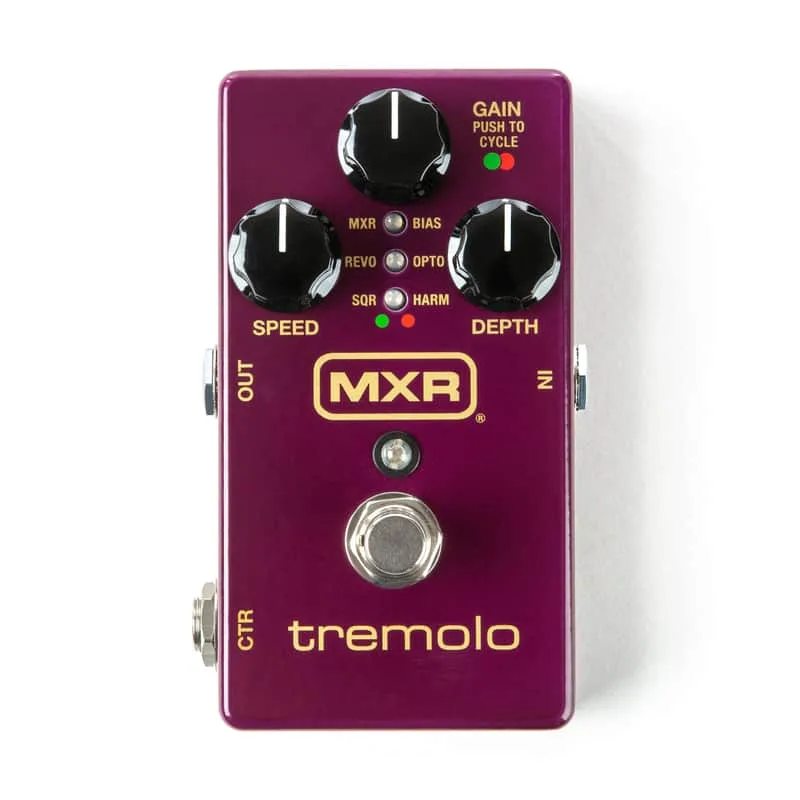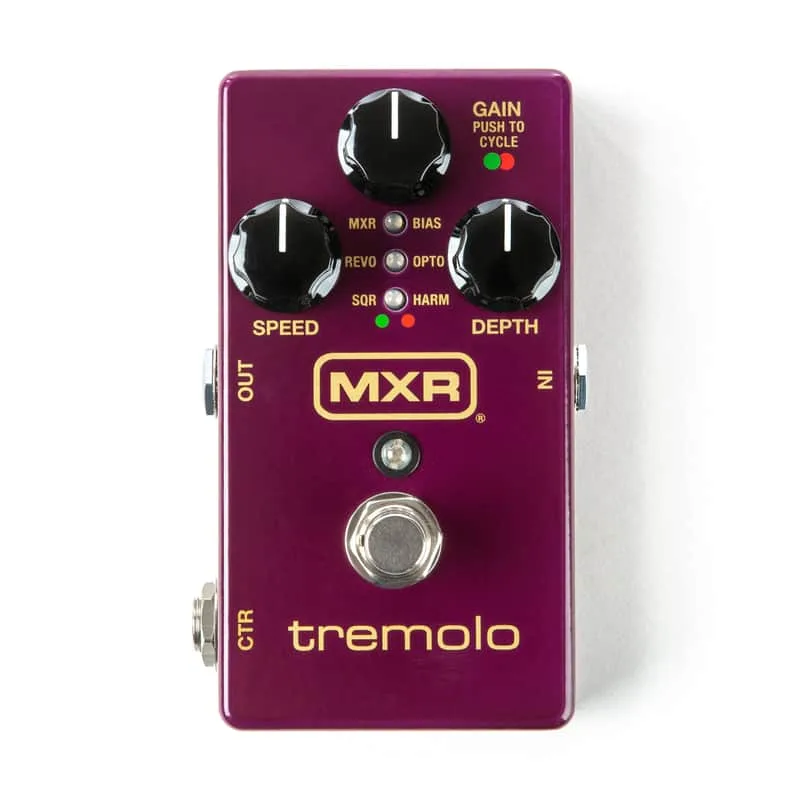
The MXR Tremolo is a compact tremolo effects pedal from MXR that puts six different tremolo waveforms in one standard-size MXR housing. Jim Dunlop describes it as a return of the tremolo effect to the MXR line, combining "a full historical range of masterfully tuned tremolo styles with a host of features to satisfy the performance needs of today's discerning players"1. Beyond the six styles, it offers stereo operation, tap tempo, expression pedal control and a hidden envelope mode that reacts to your picking2.
GuitarPlayer's reviewer Art Thompson called it "one powerful modulation box, with six tremolo styles" in a compact form3. Premier Guitar noted it is a digital pedal, which is what allows all of those waveforms and features to fit in one small box4.
Six tremolo styles in one pedal
The six waveforms cover both vintage amp-style tremolo and sounds MXR developed for this pedal. Jim Dunlop says they "represent classic and iconic sources of the effect as well as new sounds concocted" for it2. Switching between them is done by pushing the Gain knob2.
| Style | What it does |
|---|---|
| MXR | Recreates the organic sound and pulse of the M159 MXR Stereo Tremolo, a sine wave trem26 |
| Bias | Takes after the lush, power-soaked compression of tremolo circuits in early 1960s tube amplifiers2 |
| Revo | An original innovation: turns the optical tremolo waveform backwards for more exaggerated peaks and valleys2 |
| Opto | Emulates the smooth pulsating tremolo generated by photo cells in many popular amplifiers2 |
| SQR | Inspired by an iconic outboard effect, produces choppy, super pronounced tremolo2 |
| Harm | Recreates the trippy, phase-like tremolo produced by certain rare vintage amplifiers2 |
GuitarPlayer's review lists the same six with LED colors: MXR and Revo show a green LED, Bias and Opto show red3. The Harm style is the odd one out for players who want something beyond standard amplitude tremolo, since MXR describes it as phase-like2.
The controls
The pedal keeps MXR's usual three-knob layout. Jim Dunlop describes the core controls plainly: "Speed, Gain, and Depth controls set the rate, volume, and intensity of the selected tremolo effect"2.
| Control | What it does |
|---|---|
| Speed | Sets the rate of the selected tremolo effect2 |
| Gain | Sets the volume of the selected effect; push it to cycle through the six styles2 |
| Depth | Sets the intensity of the selected effect2 |
| CTR switch | Selects the function of the side control jack6 |
| Internal stereo/mono switch | Sets the output configuration6 |
| Bypass footswitch | Engages and bypasses the effect6 |
The Gain knob does double duty. A push cycles through the six styles2, and pressing and holding it for three seconds enters Envelope mode3. In Envelope mode, the Speed and Depth knobs change jobs: Speed sets the maximum rate of the effect and Depth sets the sensitivity, meaning the picking strength needed to trigger it38.
Guitar World's reviewer Trevor Curwen highlighted what Envelope mode sounds like in practice, calling it "a very cool envelope mode" that allows tremolo speed to be determined by the intensity of your playing, and describing "a trem that slows right down as a chord fades out"6.
Stereo, tap tempo and expression
The side CTR (control) jack is the pedal's gateway to its performance features. Depending on how the internal switch is set, GuitarPlayer's review notes three available stereo (TRS) modes: Stereo Input, Stereo Output, and a mode for panning the tremolo effect from one output to another3. The output jack can be operated in mono or stereo using a TRS cable and a splitter4, and the manual describes the Stereo Mode as panning the tremolo from one audio output to another8.
The same jack handles tap tempo and expression pedal functionality2. Delicious Audio's coverage lists the full feature set as "stereo operation to tap tempo and expression pedal functionality to envelope tremolo"29.
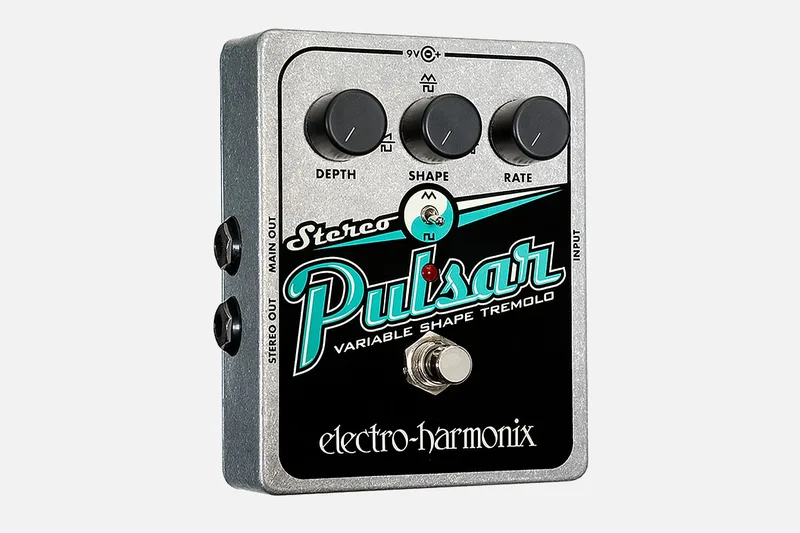
For comparison, the Electro-Harmonix Super Pulsar Stereo Tap Tremolo offers stereo ins and outs, tap tempo, tap divide and expression control in a larger double-footswitch enclosure10. The MXR packs stereo, tap and expression into a single standard MXR box.
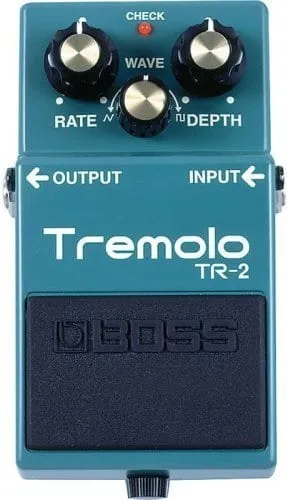
The MXR Tremolo cannot be powered by a battery2. It needs the Dunlop ECB003 9-volt adapter or an MXR Brick Series power supply2, and at 180mA (190mA per the manual) it draws far more current than a simple analog tremolo like the Boss TR-2 at 25mA2811, so budget a proper 9V output for it.
History: from the M159 to the M305
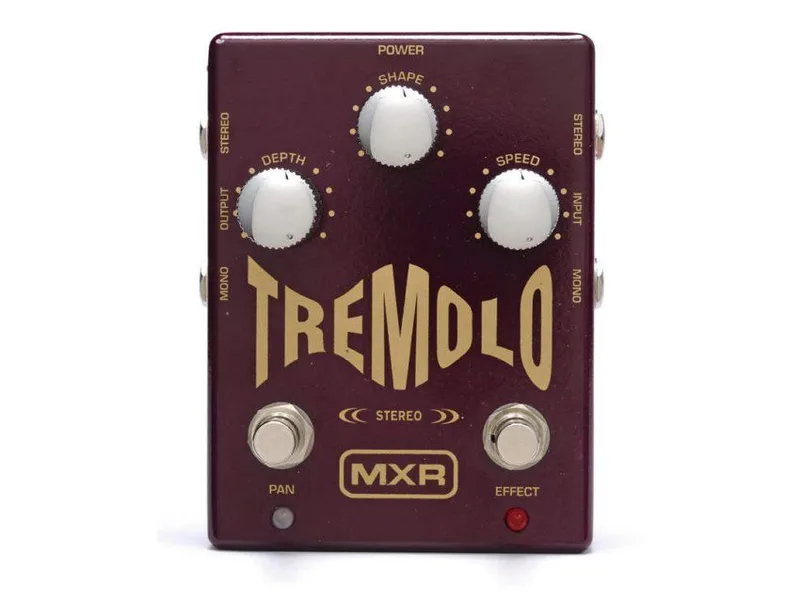
The MXR Tremolo's story runs through an earlier pedal. The M159 Stereo Tremolo retained the sounds and the intensity, shape and speed controls of the original Dunlop TS-1122. That lineage carries into the current pedal: its MXR mode is listed as delivering classic MXR M159 sounds3.
Guitar World called the M159 "the tremolo pedal MXR is best known for"5. Premier Guitar's John Bohlinger went further, writing that the M159, "a derivative of the Dunlop TS-1 Stereo Tremolo, was underrated," that "it sounded great, with a strong, throbbing quality," and that its stereo pan feature made it an excellent alternative for shoegaze and dream-pop players4.
The M305 Tremolo is described by MXR as brand new, a return of the tremolo effect to the MXR line1. Its MXR mode carries the family sound forward, delivering classic MXR M159 sounds6. Delicious Audio likewise covered it as the return of the tremolo effect to the MXR line1.
What reviewers said
Published reviewers were positive across the board.
"The many modes of the MXR Tremolo allied to its compact form make it one of the finest tremolo pedals on the market."
GuitarPlayer awarded it an Editors' Pick, citing an excellent range of tremolo sounds, flexibility and controllability, good value, and a compact size that will not hog pedalboard real estate3. Guitar World's Trevor Curwen concluded it offers "a pretty comprehensive set of tremolo sounds in a compact footprint with plenty of performance options"6. Premier Guitar's take was that the new digital MXR Tremolo "will appeal to players that prefer smaller stomps"4.
Questions
Can the MXR Tremolo run on a battery?
No. Jim Dunlop states plainly that the pedal cannot be powered by a battery, and the M305 manual confirms it runs on 9 volts DC from an adapter only. You can use the Dunlop ECB003 9-volt adapter or an MXR Brick Series power supply. The older M159 Stereo Tremolo was different, running on two PP3 batteries under a lid on its base.
Is the MXR Tremolo true bypass?
Yes, by default. The M305 manual describes a true bypass relay that shuts off the effect and hardwire bypasses the signal when the pedal is off. GuitarPlayer's review adds that the pedal can be switched from true bypass, the default setting, to buffered bypass, so you can choose whichever suits your pedalboard.
Is the MXR Tremolo analog or digital?
It is digital. Premier Guitar described the pedal as "the new, digital MXR Tremolo" in its review. That is what lets one compact box hold six different tremolo waveforms plus envelope, tap tempo and stereo features. Many other tremolos on the market, such as the Boss TR-2 and the ZVex Tremolo Probe, are analog.
How do you get the envelope mode on the MXR M305 Tremolo?
Press and hold the Gain knob for three seconds. In Envelope mode the tremolo speed responds to the intensity of your picking: the Speed knob sets the maximum rate and the Depth knob sets the sensitivity, meaning how hard you have to pick to trigger the effect. Guitar World found it useful for a trem that slows down as a chord fades out.
How much current does the MXR Tremolo draw?
Jim Dunlop's product page lists 9 volts at 180mA, while the M305 manual lists a 190mA current draw, so the two maker documents disagree slightly. Either figure is well above a simple analog tremolo like the Boss TR-2 at 25mA, so plan an isolated 9V output rather than a small daisy chain.
What is the difference between the MXR M159 and M305 Tremolo?
The M159 Stereo Tremolo launched in 2008 as a derivative of the Dunlop TS-1, with two inputs, two PP3 batteries and an 18-volt adapter option. The M305, announced in October 2020, replaces the discontinued M159 in a smaller single MXR housing, adds six tremolo styles, tap tempo, an expression input and a hidden envelope mode, and runs on 9 volts.
Sources (12)
- MXR M305 Tremolo, Delicious Audio, 2023-03-17
- MXR® TREMOLO, Jim Dunlop (jimdunlop.com)
- MXR Tremolo Review, GuitarPlayer, 2021-03-11
- MXR Tremolo Review, Premier Guitar, 2020-12-24
- MXR unveils versatile six-mode Tremolo pedal, Guitar World, 2020-10-02
- MXR M305 Tremolo review, Guitar World, 2021-04-07
- MXR® SIX BAND EQ, Dunlop (jimdunlop.com)
- M305.pdf, Jim Dunlop, 2020
- MXR M305 Tremolo, Delicious Audio, 2020-11-18
- Electro-Harmonix Super Pulsar Stereo Tap Tremolo review, guitar.com, 2015-10-14
- TR-2 Tremolo by BOSS, RockBoard PedalPedia, 2026
- New analogue delay and tremolo pedals from MXR, MusicRadar, 2008-02-01