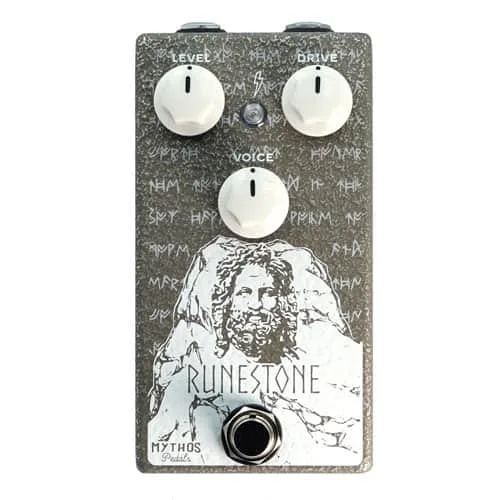


The Mythos Runestone is a low-gain, transparent overdrive pedal from Mythos Pedals, first released in January 2019 as a collaboration with the retailer Riff City Guitar1. It is an evolution of the classic Marshall Bluesbreaker circuit, voiced as what That Pedal Show called "that kind of medium to low gain transparently type overdrive"2. In other words, it is the kind of pedal you leave on to push an already-working amp tone harder, rather than a pedal that takes over your sound.
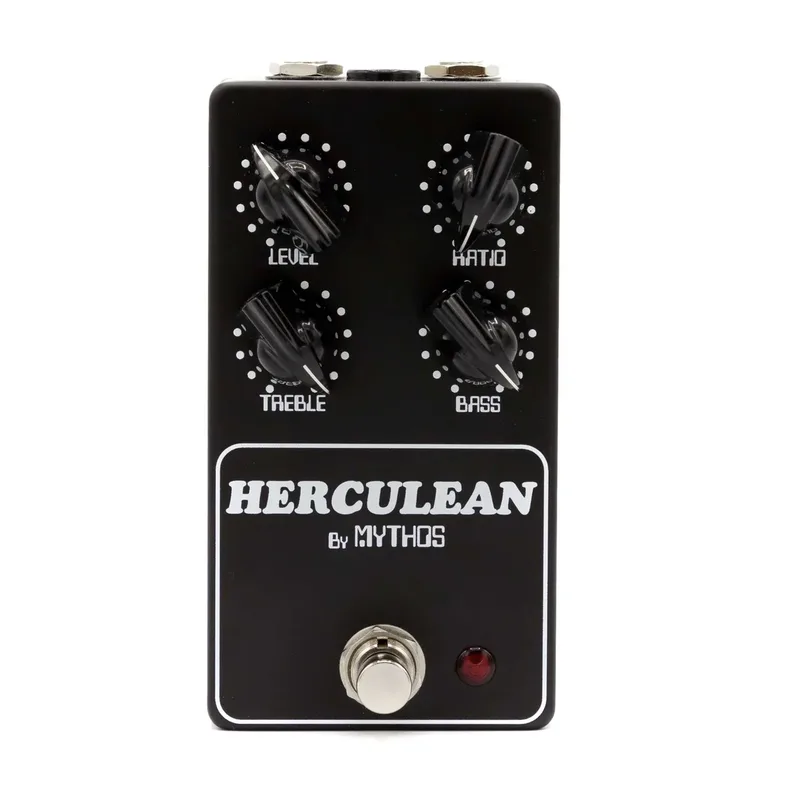
The Runestone is also a reimagining of the discontinued Mythos Daedalus, carrying that circuit forward with more output and a more natural voicing1. Its circuit later reappeared, further updated, as one side of the Mythos Herculean Deluxe dual overdrive released in February 20243.
A Bluesbreaker-style low-gain overdrive
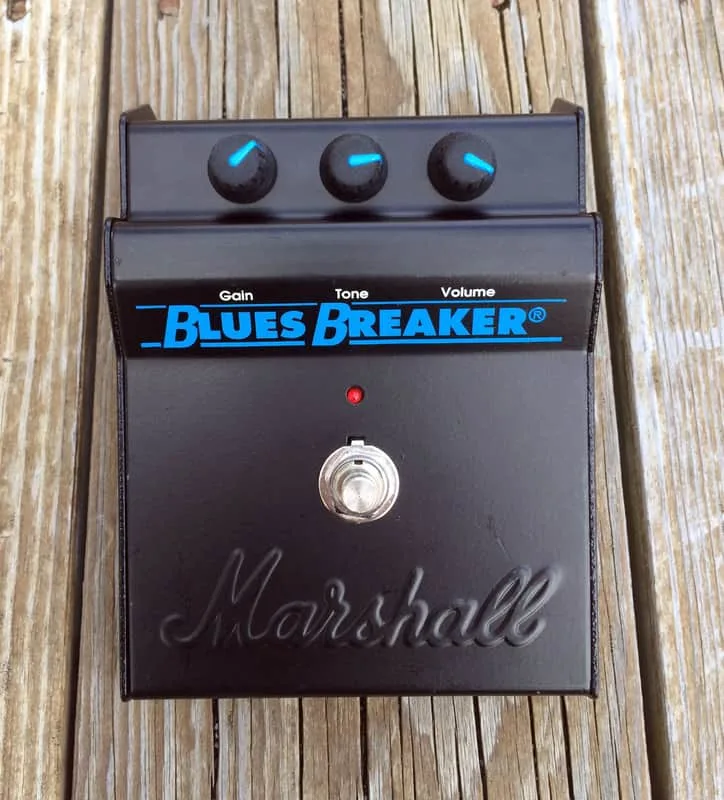
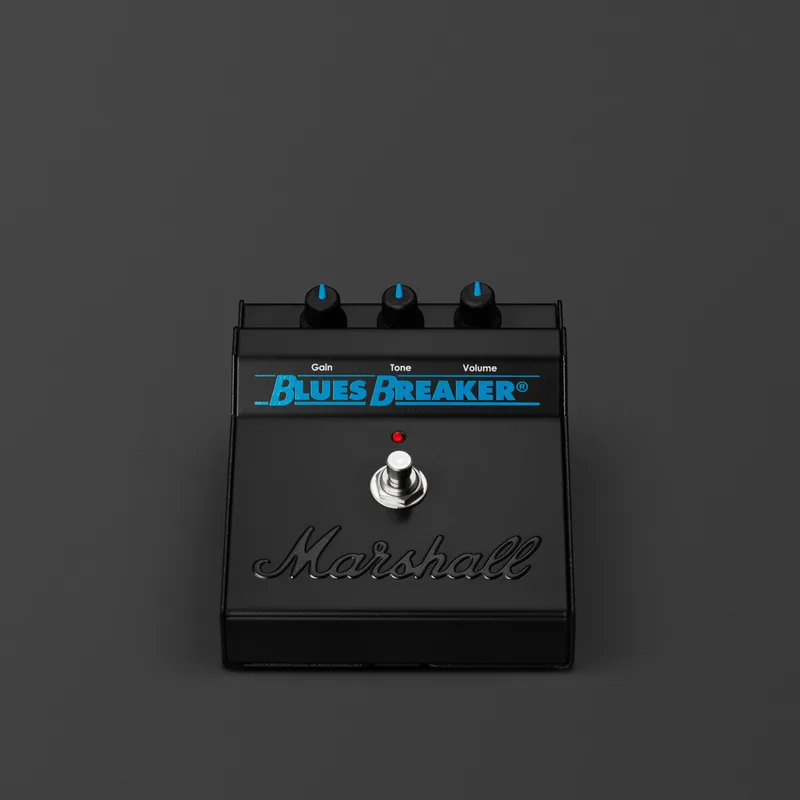
The Marshall Bluesbreaker, dating to 1992, is a low-gain drive pedal that Marshall itself describes as a "classic low-gain drive pedal"5. Reviewers have long placed it at the transparent, low-gain end of the overdrive spectrum: guitar.com's Richard Purvis called it "a much lower-gain overdrive than the Guv'nor"6. That family of circuits, often just called "Bluesbreaker-style," is prized by players who want grit and push without the midrange hump of a Tube Screamer.
The Runestone sits squarely in that family. Premier Guitar's announcement stated plainly that "The Runestone, like its predecessor, is an evolution of that classic 'Bluesbreaker' circuit"1, and Delicious Audio described it as having "that classic 'bluesbreaker' drive sound"4. Where it departs from a straight copy is in the details:
- More output, to push an amplifier or other pedals with ease1
- Asymmetrical clipping, for a dynamic and responsive feel1
- Less brittle highs, adjustable internally3
- Full-size through-hole components, rather than surface-mount parts14
The controls: Level, Voice and Drive
The Runestone keeps it to three knobs: Level, Voice and Drive. Premier Guitar described them as "very interactive and allow you fine tune this stomp box to any setup"1, and Delicious Audio noted the controls were reworked relative to the Daedalus4. The Voice control is the tone-shaping knob of the three; when the circuit was updated for the Herculean Deluxe, gearnews reported that "the voice control also gives users far more flexibility"3.
| Control | What it does |
|---|---|
| Level | Sets the output volume, with increased output on tap to push an amp or other pedals1 |
| Voice | Shapes the tonal voicing; described as giving far more flexibility3 |
| Drive | Sets the amount of gain, in the medium-to-low transparent range2 |
In the 2024 Herculean Deluxe version, the Runestone side also gained internal DIP switches offering both soft and hard clipping options3, and Mythos's Zach Broyles promised a wider range of gain and a revoiced tone circuit compared to the original Runestone7.
Runestone versus the Daedalus and the original Bluesbreaker
Versus the Daedalus. The Daedalus, now discontinued, was the Runestone's direct predecessor. Premier Guitar reported that "The Runestone has been tweaked so that it's voicing is more natural, the drive is more useful and there's way more volume on tap to push your amplifier"1. Delicious Audio framed it as "a more modern and flexible reinterpretation of the company's now discontinued Daedalus"4.
Versus an original Marshall Bluesbreaker. The Runestone is a development of the circuit, not a clone. Gearnews, reviewing the Runestone side of the Herculean Deluxe, wrote that "Improvements over the original circuit include a decent portion of output, less brittle highs (which can be adjusted int[ernally])"3. For the 2024 update, Broyles revoiced the tone circuit "to be a little more centred", taking out some of the top end and giving it more beef in the bass, which MusicRadar described as making it more neutral and transparent7. Players who want the original circuit in current production can look at Marshall's own Bluesbreaker Vintage Reissue Pedal5.
Stacking and what reviewers said
The Runestone was pitched from the start as a team player. Delicious Audio called it "the perfect first stage overdrive and plays well with other gain pedals"4, and the increased output was explicitly intended to push other pedals1.
On That Pedal Show in March 2019, Dan and Mick demoed the Runestone as part of a look at Mythos pedals, placing it in that medium-to-low-gain transparent category2. Mick's verdict on stacking:
"the clarity of it is I mean have a play with that storm with a couple of things is I think that's awesome"2
Mick, That Pedal Show2
That clarity when stacked into high-headroom amps was the standout point of the demo2.
Where it came from and where it went
The Mythos Runestone carried a street price of $179.001. Inside, its clipping is configurable: the Runestone side features both soft and hard clipping options, selected by internal DIP switches3. On That Pedal Show, Mick found its clarity stood out when stacked with the Storm into high headroom amps2.
The original standalone Runestone was a retailer exclusive from 2019. If you are buying used, the circuit you are most likely to find new today is the updated Runestone side of the Herculean Deluxe, which has a wider gain range, a revoiced tone circuit and switchable soft or hard clipping73.
Videos
Mythos Pedals
Questions
Is the Mythos Runestone true bypass?
Yes. Both the original 2019 announcement and later coverage list true bypass switching on the Runestone. When the circuit reappeared in the Herculean Deluxe in 2024, it also gained internal DIP switches for soft or hard clipping, so the switching and clipping behavior can be tailored to your board.
What is the difference between the Runestone and the Daedalus?
The Runestone is a reimagining of the discontinued Mythos Daedalus. Premier Guitar reported that the voicing is more natural, the drive is more useful, and there is more volume on tap to push an amplifier. Delicious Audio called it a more modern and flexible reinterpretation of the Daedalus.
How is the Runestone different from an original Marshall Bluesbreaker pedal?
The Runestone is an evolution of the Bluesbreaker circuit rather than a copy. Reported improvements over the original circuit include more output and less brittle highs, which can be adjusted internally, plus asymmetrical clipping for a dynamic, responsive feel.
Where is the Mythos Runestone made?
The original Runestone was assembled by hand in Nashville, Tennessee, according to the 2019 announcement. It was built with full-size through-hole components rather than surface-mount parts.
Was there a Riff City Guitar exclusive Runestone?
Yes. The Runestone launched in January 2019 as a collaboration between Mythos Pedals and Riff City Guitar, released as a Riff City Guitar exclusive with a street price of $179.00.
Does the Runestone stack well with other drive pedals?
Yes. Delicious Audio described it as the perfect first-stage overdrive that plays well with other gain pedals, and Mythos cited increased output to push your amplifier or other pedals. On That Pedal Show, Mick praised its clarity when stacked with the Storm into high-headroom amps.
Sources (7)
- Mythos Pedals Unveils the Runestone, Premier Guitar, 2019-01-22
- Mythos Runestone, 3 Leaf Audio Chromatron, Walrus Audio Lillian, SoloDallas Storm, That Pedal Show (YouTube), 2019-03-05
- Mythos Pedals Herculean Dual Overdrive, gearnews.com, 2024-02-02
- Mythos Pedals Runestone Overdrive, Delicious Audio, 2019-02-02
- The Bluesbreaker pedal offers smooth tones and full character, Marshall (www.marshall.com)
- Marshall BluesBreaker: can it pick up right where it left off?, guitar.com, 2023-08-18
- “This is your drive section”: Mythos unveils the heroic Herculean Deluxe Overdrive, offering Dumble-style and modded Blues Breaker drive sounds in one pedal, MusicRadar, 2024-02-23