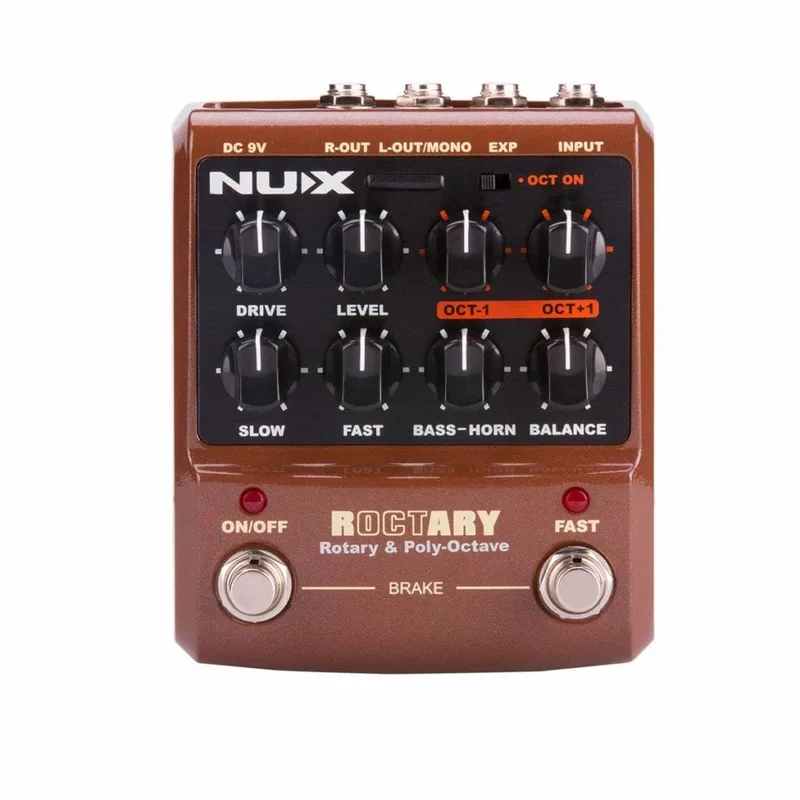


The NUX Roctary is a digital pedal from NUX that puts a rotary speaker effect and a polyphonic octave effect in one box, along with overdrive and a cabinet simulation1. RockBoard's PedalPedia says it "delivers authentic sounding rotary speaker effect and super accurate polyphonic octave effect," and that it "even captures the subtle effect changes when the motors ramp up and down," the speed sweep a real rotary speaker makes when it changes between slow and fast1.
The name is a straightforward combination: RockBoard's PedalPedia describes "Roctary" as a blend of "Rotary" and "Octave," the pedal's two headline effects1.
The controls
In a roundup of rotary pedals, Delicious Audio's Christopher Scapelliti described the control set: "It features two-speed knobs, a dedicated ramp footswitch, a Bass-Horn control, and the always useful Blend knob"2.
| Control | What it does |
|---|---|
| Two speed knobs | Set the slow and fast rotary speeds |
| Ramp footswitch | Switches between speeds, with the motor ramp behavior modeled |
| Bass-Horn | Balances the low rotor against the high horn |
| Blend | Mixes the effected signal with your dry signal |
The ramp footswitch is the piece that addresses the behavior of a real rotary speaker, where the motors take time to spin up and down rather than changing speed instantly. RockBoard's PedalPedia says the pedal captures those subtle changes as the motors ramp1.
Octave and organ sounds
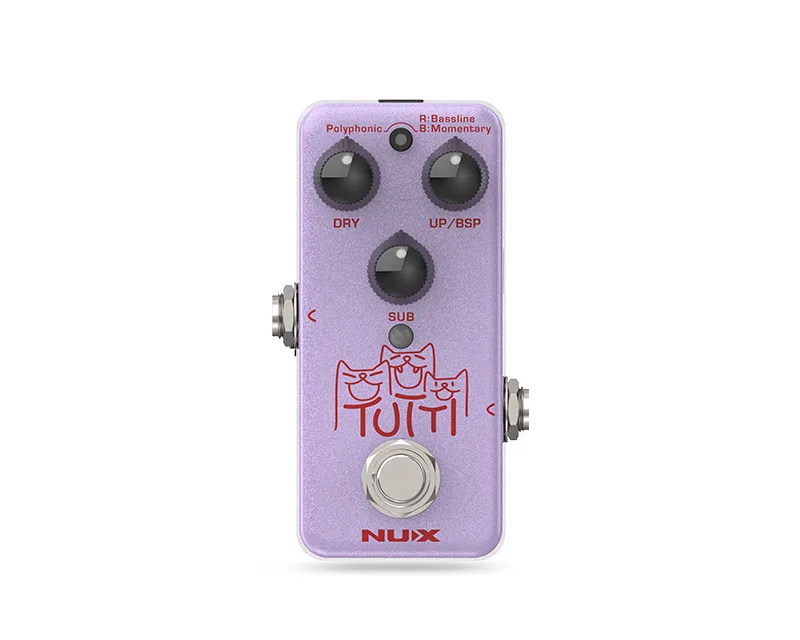
The octave side is polyphonic, meaning it tracks chords as well as single notes. RockBoard's PedalPedia says you can add a +1 octave and a -1 octave to the signal, and that stacking both makes a guitar sound like an organ1. Players looking for a dedicated polyphonic octaver from the same maker can also look at the NUX NPO-2 Tutti Polyphonic Octave, or browse octave and pitch pedals more broadly.
Power
The Roctary runs on 9V DC with a center negative plug and draws 200mA1.
At 200mA, the Roctary draws more current than many compact analog pedals. A pedalboard power supply with isolated or high-current outputs is a better match than a low-current daisy chain.
Roctary Force
NUX also lists a related product, the Roctary Force, on its own site, marked as a Legacy Product, with an English user manual available from NUX3.
Videos
NUX
Mike Hermans
葉宇峻彈吉他(葉宇峻彈吉他)
Questions
Where does the name Roctary come from?
The name is a combination of the words Rotary and Octave, the pedal's two main effects. NUX describes it that way on its product page, and the name reflects the pairing of a rotary speaker emulation with a polyphonic octave effect in one unit.
Can the NUX Roctary make a guitar sound like an organ?
Yes. NUX says that with the polyphonic octave effects you can add a +1 octave and a -1 octave to make your guitar sound like an organ. Both octave layers are polyphonic, so chords as well as single notes track.
What power supply does the NUX Roctary need?
It runs on 9V DC with a center negative plug, drawing 200mA. That current draw is on the high side for a compact pedal, so a dedicated output from a pedalboard power supply is a safer choice than a small daisy chain.
Is the NUX Roctary analog or digital?
It is a digital pedal. NUX lists the circuit type as digital, which is what allows it to combine a rotary speaker emulation, a polyphonic octaver, overdrive and a cabinet simulation in one box.
Sources (3)
- Roctary by NUX, RockBoard PedalPedia, 2026
- Best Rotary Pedals & Leslie Simulators In 2023: Compare Price And Features, Delicious Audio, 2023-02-13
- Roctary Force, NUX Audio, 2025-11-26