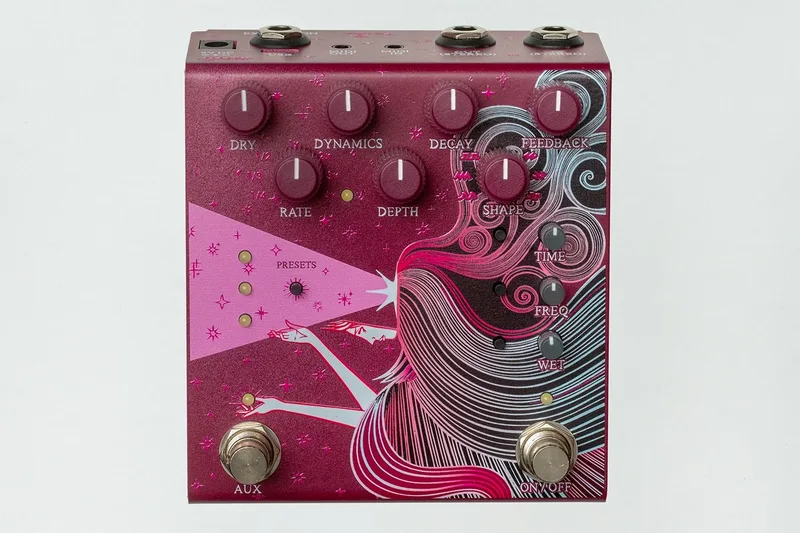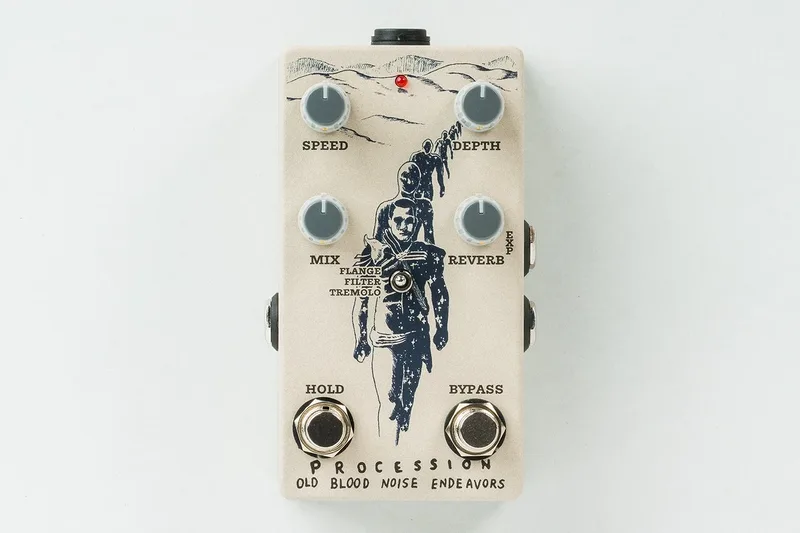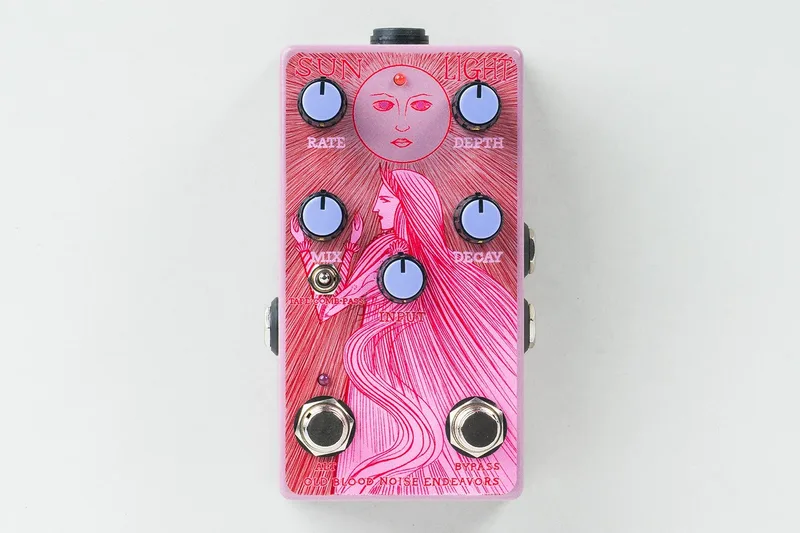


The Old Blood Noise Endeavors Sunlight Stereo is a reverb pedal focused on motion and dynamics: a dynamic hold reverb designed to create evolving ambient textures12. Where a conventional reverb pedal gives you a static tail, the Sunlight Stereo puts a delay, a filter and a volume control after the reverb, and all three can be modulated by an onboard LFO (low-frequency oscillator). Old Blood Noise says this lets you craft flanger, chorus, moving filter or tremolo effects inside the reverb itself1. Delicious Audio describes it as a full stereo evolution of the original mono Sunlight, combining elements of the Sunlight and Procession pedals into a lush modulated stereo reverb3.
The pedal is hand-made in Oklahoma, USA, and the enclosure art is by Jon Carling4. It lists at $329.001.
What the Sunlight Stereo does
The core idea is a reverb whose tail is never still. After the reverb itself, the signal passes through a delay, a filter and a volume stage, and the LFO can be pointed at any of them: modulating the post-reverb delay time gives chorus or flanger sounds, modulating the filter frequency gives a moving filter, and modulating the wet volume gives tremolo13. A Dynamics knob lets you either create dynamically held trails, where your playing holds the reverb, or enveloping LFO rates that respond to your touch1.
Old Blood Noise positions the pedal as a companion piece rather than a standalone1:
"This counterpoint to Dark Star brings lightness and excitement, and sits perfectly on a pedalboard alongside it."1
The controls
The knob set covers the reverb and everything after it. RockBoard's PedalPedia entry summarizes the reverb-shaping side as controls for decay, input, filter and rate2.
| Control | What it does |
|---|---|
| Dry | Sets dry volume1 |
| Wet | Sets overall wet volume1 |
| Decay | Shapes the reverb character2 |
| Dynamics | Sets either the reverb input threshold or rate envelope sensitivity1 |
| Time | Sets the post-reverb delay time1 |
| Freq | Sets the post-delay filter cutoff1 |
| Rate | Sets LFO rate, with settings 1/4, 1/3, 1/2, 1x, 2x, 3x and 4x4 |
| Feedback | Sets feedback on the post-reverb delay4 |
Beyond the knobs:
- Expression control over every knob1
- Onboard presets, plus full control via MIDI4
- Four post-reverb filter modes: Low Pass, High Pass, Band Pass and Band Reject, for sculpting the texture of the tails3
- Soft-touch On/Off footswitch with relay switching for minimal switch noise1
- Assignable aux footswitch for tap tempo, indefinite reverb hold, or preset switching143
Power and connections
The Sunlight Stereo requires a 9V DC center negative power supply with a 2.1mm jack, capable of 350mA, and the supply is not included1. Guitar Pedal X lists the same requirement, around 350mA current draw4.
At 350mA this pedal draws a substantial amount of current, and it has no battery option. Plan for an isolated or high-current 9V output on your power supply.
Connections are TRS stereo in and TRS stereo out, with the option of mono or mono-in/stereo-out routing, and analog dry through keeps your dry signal untouched14. MIDI in and out carry MIDI clock in both directions for external syncing, plus control over everything in the pedal, and a USB-C port and expression input round out the rear panel14.
Versions and where it came from
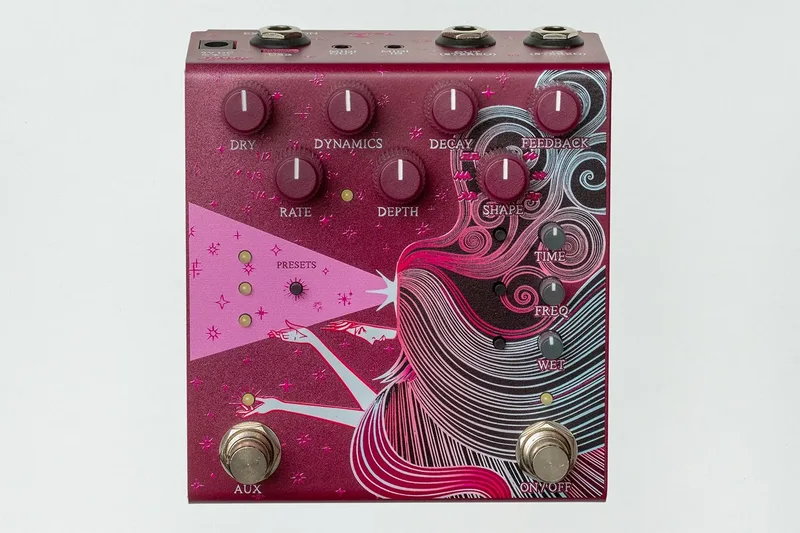
The Sunlight Stereo expands on the original Sunlight, a mono reverb, adding true stereo processing and additional control over modulation and filtering2. It comes in several finishes: the standard model is maroon4, with black and yellow editions also documented25.
For more on the delay side of the pedal's post-reverb delay line, see the site's coverage of delay pedals, and for the effect family it belongs to, reverb pedals.
Videos
Old Blood Noise Endeavors
The Pedal Zone
Mark Johnston
Questions
What is the difference between the Sunlight and the Sunlight Stereo?
The Sunlight Stereo is a full stereo evolution of the original mono Sunlight reverb. It adds true stereo processing with stereo in and out, plus additional control over modulation and filtering, onboard presets, and MIDI and expression control over every parameter.
Is the Old Blood Noise Sunlight Stereo true bypass?
It offers selectable switching: you can run it in true bypass mode or in buffered trails mode, so the reverb tail continues after you switch the pedal off. The On/Off footswitch is a soft-touch switch with relay switching for minimal switch noise.
Does the Sunlight Stereo have tap tempo?
Yes. An assignable aux footswitch can be used to tap in tempo, to hold the reverb trails indefinitely, or to switch between presets. Tempo can also be synced externally, since the pedal accepts and sends MIDI clock.
What filter modes does the Sunlight Stereo have?
It has four post-reverb filter modes for shaping the texture of the tails: Low Pass, High Pass, Band Pass and Band Reject. The Freq knob sets the post-delay filter cutoff, and the filter frequency can be modulated by the onboard LFO.
Does the Sunlight Stereo send MIDI clock?
Yes. The pedal has MIDI in and out with MIDI clock in both directions, so it can sync to external gear or act as a clock source. MIDI also gives control over everything in the pedal, including all parameters and presets.
How does the Sunlight Stereo pair with the Dark Star?
Old Blood Noise describes the Sunlight Stereo as a counterpoint to the Dark Star, saying it brings lightness and excitement and sits perfectly on a pedalboard alongside it. The two are positioned as companion reverbs with contrasting characters.
Sources (5)
- Old Blood Noise Endeavors, Old Blood Noise Endeavors
- Sunlight Stereo (Yellow) by Old Blood Noise Endeavors, RockBoard PedalPedia, 2026
- Old Blood Noise Sunlight Stereo, Delicious Audio, 2025-11-19
- Guitar Pedal X, Guitar Pedal X, 2025-10-21
- Sunlight Stereo (Black) by Old Blood Noise Endeavors, RockBoard PedalPedia, 2026