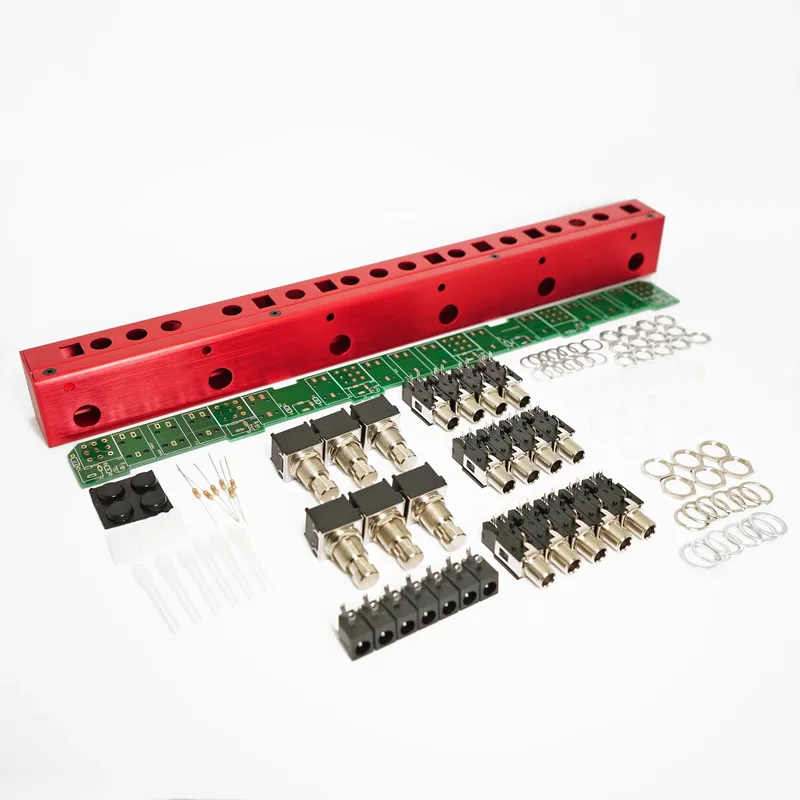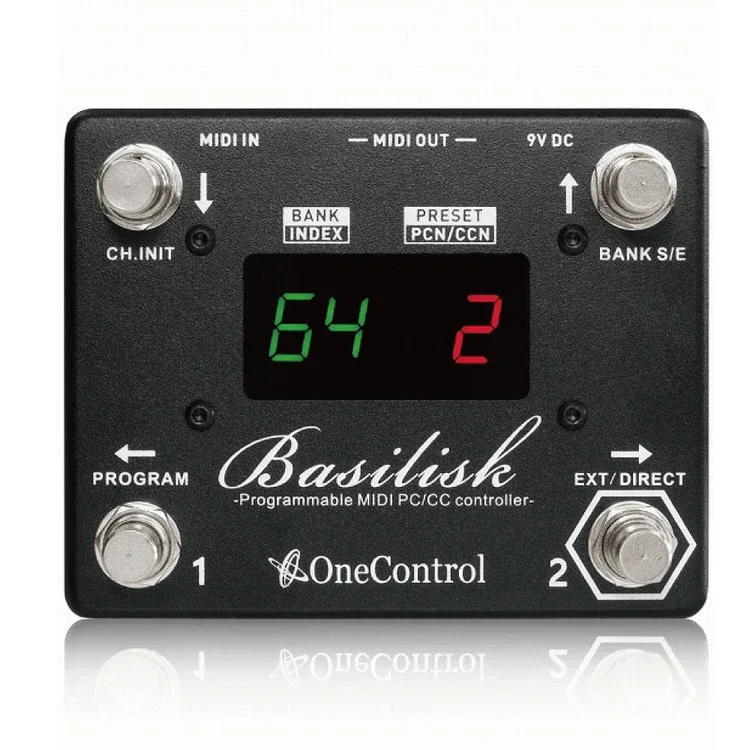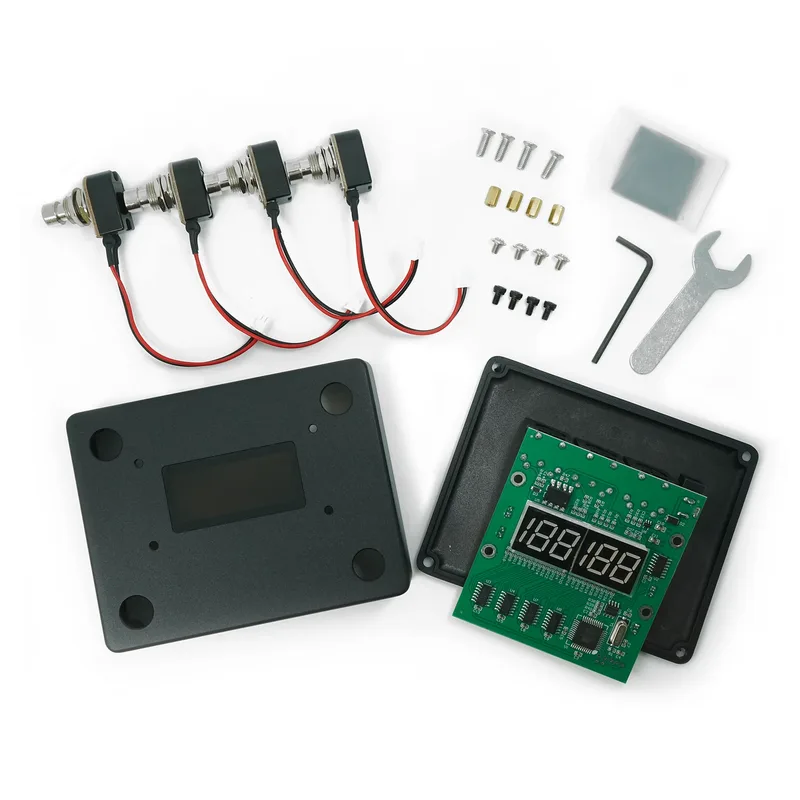


The One Control LWP Series Basilisk Kit is a compact MIDI foot controller that you build yourself. One Control describes it as "a compact MIDI controller you build yourself," and unlike most of the company's LWP Series kits, it needs no soldering: it assembles with the included tools and a standard Phillips screwdriver1. Once built, it works as a preset controller for MIDI-equipped pedals, amplifiers and switchers, sending up to five Program Change (PC) messages and five Control Change (CC) messages at the same time through two MIDI outputs1.
As of late October 2026, One Control lists the Basilisk Kit as sold out on its product page1. The other LWP Series kits are in the same state, so finding one may take some searching on the used market.
What the Basilisk Kit does
At its core, the Basilisk Kit is a four-footswitch MIDI transmitter. Each of its up to 128 internal presets can carry a bundle of MIDI messages, and pressing a footswitch sends that bundle out immediately. Because a preset transmits five PC messages and five CC messages simultaneously, one press can switch programs on several devices at once: an amp channel, a delay preset and a loop switcher state, for example1.
The two MIDI OUT connections both carry the same signal, so two separate MIDI devices can be driven directly without a MIDI thru box or a merger in between1.
The three operating modes
One Control gives the Basilisk three ways to organize and reach those 128 presets, and the mode you choose shapes how the four footswitches behave1.
| Mode | How it works |
|---|---|
| Normal Recall | Upper footswitches select a bank, lower footswitches select a preset within it1 |
| Direct Access | Changing banks with the upper footswitches transmits the corresponding MIDI signal immediately, without waiting for a lower footswitch press1 |
| Flash Access | Presets are assigned directly to individual footswitches for immediate access1 |
Normal Recall Mode is the bank-and-preset structure familiar from most MIDI footcontrollers: you pick a bank with the upper switches, then a preset with the lower ones. Direct Access Mode speeds that up by sending the MIDI for the bank's preset as soon as you change banks, rather than waiting for a second press1.
Flash Access Mode is the most direct of the three. One Control states that it "allows presets to be directly assigned to individual footswitches"1. It is enabled automatically when Normal Recall Mode is configured to use only a single bank, and in that configuration the four footswitches give immediate access to four presets: two from the selected bank and two from the following bank1.
"Flash Access Mode allows presets to be directly assigned to individual footswitches."
Building it: no soldering required
The Basilisk Kit's place in the LWP Series rests on its assembly. One Control states plainly: "No soldering is required. The kit can be assembled easily using the included tools and a standard Phillips screwdriver"1. For a player who has never built anything electronic, that removes the main barrier, since no iron, solder or cutters are needed.
That is not true of the whole LWP line. The series mixes solder-free kits with kits that require a full soldering setup123:
| LWP Series kit | Build requirement |
|---|---|
| Basilisk Kit (MIDI controller) | No soldering; included tools plus a Phillips screwdriver1 |
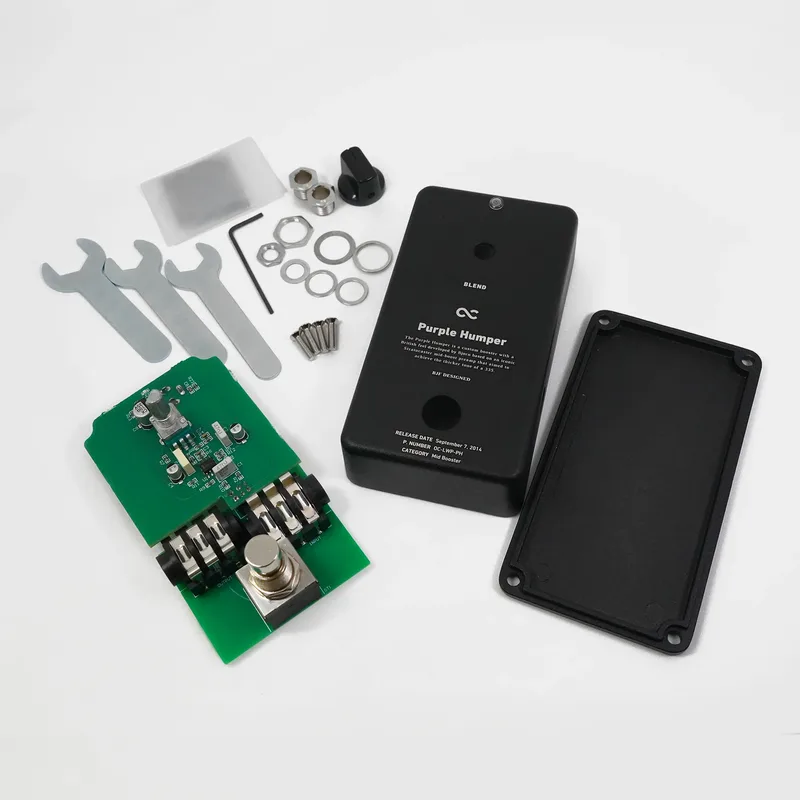
| Purple Humper (mid-boost pedal) | All components and tools included, no soldering4 |
| Jubilee Red AIAB (overdrive pedal) | Solder-free; assembly time 15 to 30 minutes5 |
| AB Box Kit | Solder, soldering iron, screwdriver and diagonal cutters; about 20 minutes2 |
| Junction Box Kit | Solder, soldering iron and screwdriver; about 15 minutes3 |
| 1Loop Box Kit | Solder, soldering iron, screwdriver and diagonal cutter2 |
| 5Loop Switcher with Tuner Out Kit | Solder, soldering iron and diagonal cutters6 |
So within the series, the Basilisk Kit sits with the solder-free pedal kits rather than the passive switching kits, which are the ones that call for an iron. The solder-free pedal kits in the line include the Purple Humper, a mid-boost kit based on a rare BJFE model4, and the Jubilee Red, an Amplifier In A Box kit that One Control says emulates the mid-range character of a well-known 50W/100W amplifier5.
Power and placement on a board
The Basilisk Kit runs on a standard center-negative 9V DC adapter and draws a maximum of 30 mA1. Battery power is not supported1, so it needs an output from a pedalboard power supply or a dedicated adapter. At 119 (W) × 94 (D) × 53 (H) mm and 380 g, it is a compact unit by footcontroller standards, sized to sit on a board alongside the pedals it controls1.
The 30 mA maximum draw is modest, but the center-negative 9V requirement and lack of battery support mean the Basilisk Kit must have a powered output available. It cannot share a battery like some compact pedals, and it is not a passive device.
How it fits with One Control's other MIDI gear
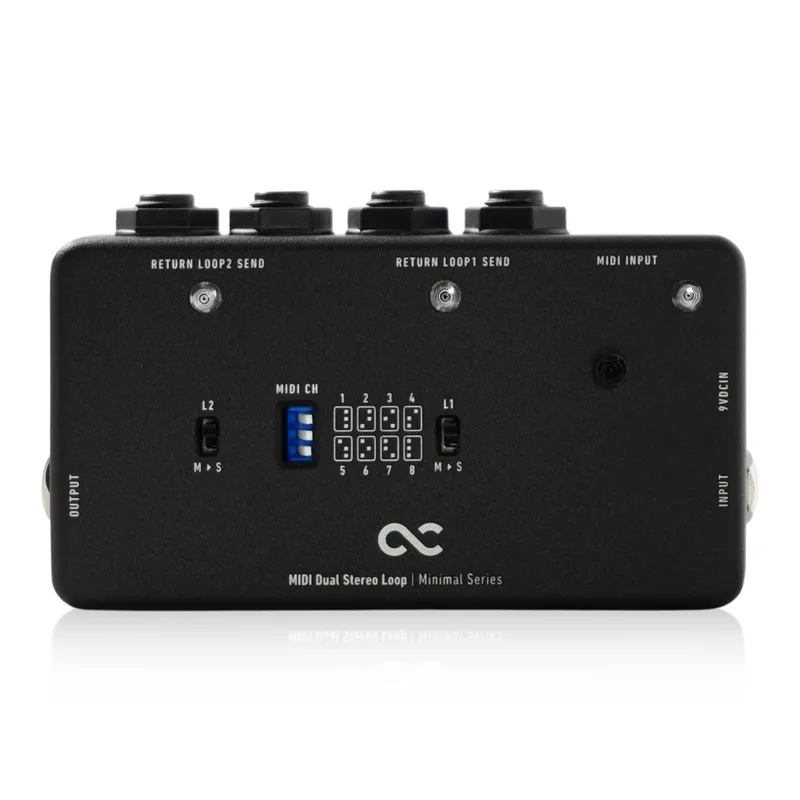
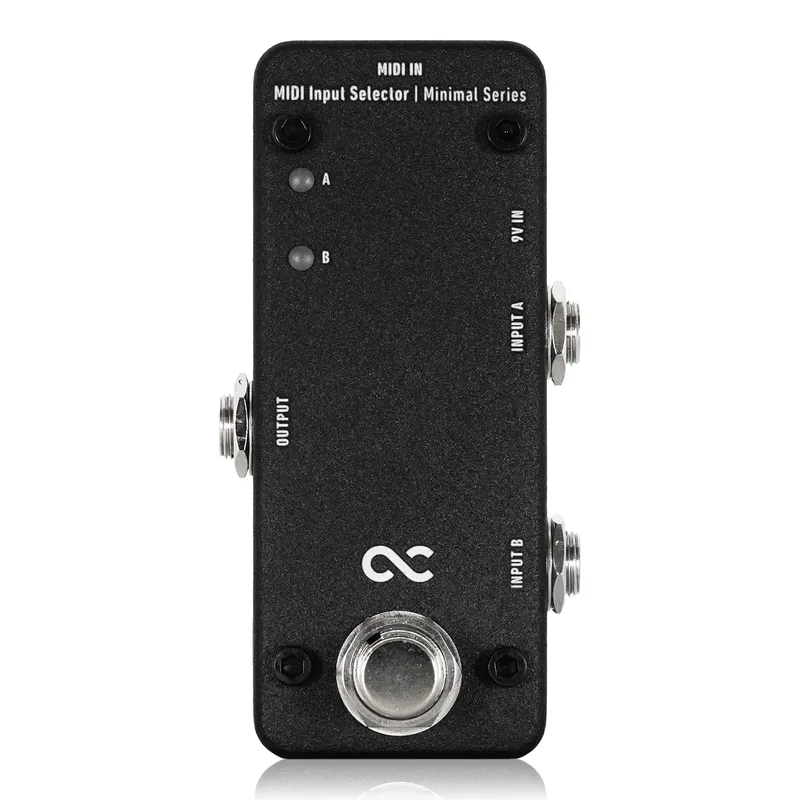
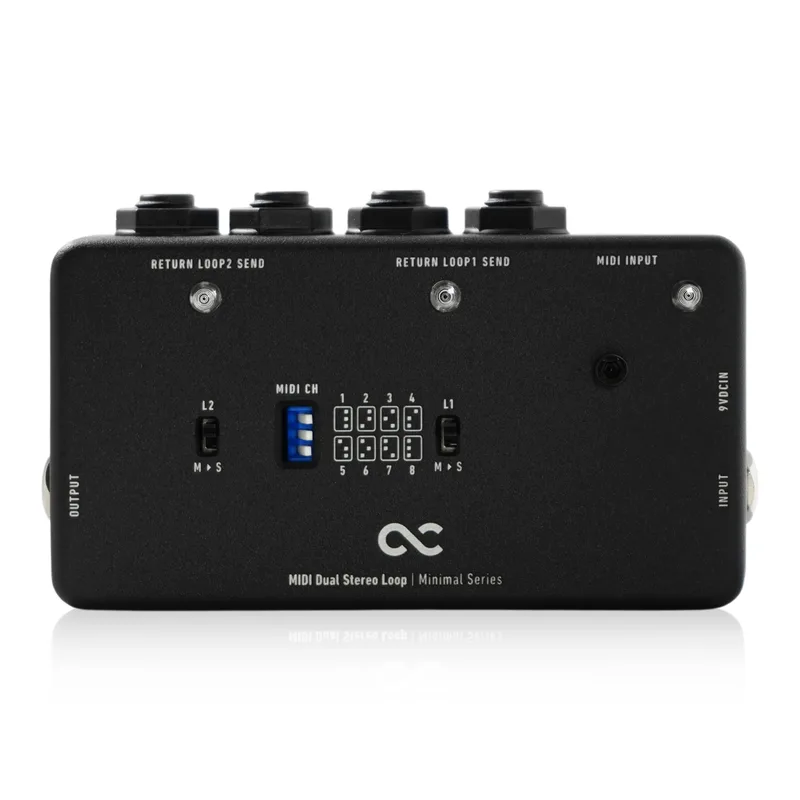
One Control also makes the ready-built Basilisk, the controller this kit is named after, along with MIDI switching products such as the Minimal Series MIDI Dual Stereo Loop, the Minimal Series MIDI Input Selector, the Minimal Series MIDI Solo Stereo Loop and the Gecko MkIII. The kit version covers the same job as a preset-based MIDI controller, with the difference that you assemble it yourself and it carries the LWP Series' lower kit price of $139.99 USD1.
Videos
mgoldcha
Stephen Toback
Questions
Does the One Control Basilisk Kit need soldering?
No. One Control states that no soldering is required, and the kit can be assembled with the included tools plus a standard Phillips screwdriver. That sets it apart from most of the other LWP Series kits, such as the AB Box and Junction Box kits, which call for solder, a soldering iron and cutters.
Can the Basilisk Kit run on a battery?
No. One Control lists battery power as not supported. The kit runs on a standard center-negative 9V DC adapter, drawing a maximum of 30 mA, so it needs a spot on a pedalboard power supply.
How many presets does the Basilisk Kit store?
Up to 128 complete presets are stored internally. Each preset can transmit five Program Change messages and five Control Change messages simultaneously, so one footswitch press can reconfigure several MIDI-equipped pedals or amps at once.
How many MIDI outputs does the Basilisk Kit have?
Two MIDI OUT connections, and both transmit the same MIDI signal at the same time. That lets you drive two separate MIDI devices, for example a switcher and a multi-effects unit, without needing a MIDI thru box.
What is Flash Access Mode on the Basilisk Kit?
Flash Access Mode lets you assign presets directly to individual footswitches. It is enabled automatically when Normal Recall Mode is configured to use only a single bank, and the four footswitches then give immediate access to four presets, two from the selected bank and two from the following bank.
Is the One Control Basilisk Kit still available?
As of late October 2026, One Control's product page lists the Basilisk Kit as sold out. The other kits in the LWP Series, including the AB Box, Junction Box, 1Loop Box, Jubilee Red AIAB and 5Loop Switcher kits, are also listed as sold out.
Sources (6)
- LWP Series Basilisk Kit (OC-LWP-BAS), One Control USA
- LWP Series AB Box Kit (OC-LWP-LWPAB), One Control USA
- LWP Series Junction Box Kit (OC-LWP-LWPJB), One Control USA
- LWP Series Purple Humper Solder Free Pedal Kit (OC-LWP-PH), One Control USA
- LWP Series Jubilee Red AIAB Solder Free Pedal Kit (OC-LWP-JRAIAB), One Control USA
- LWP Series 5Loop Switcher with Tuner Out Kit (OC-LWP-LWP5L), One Control USA