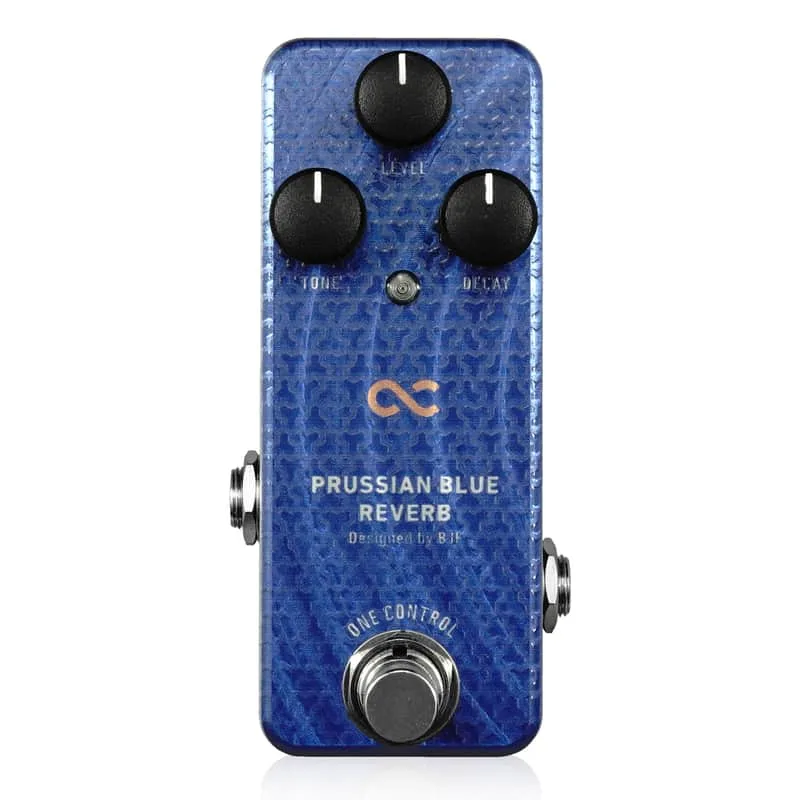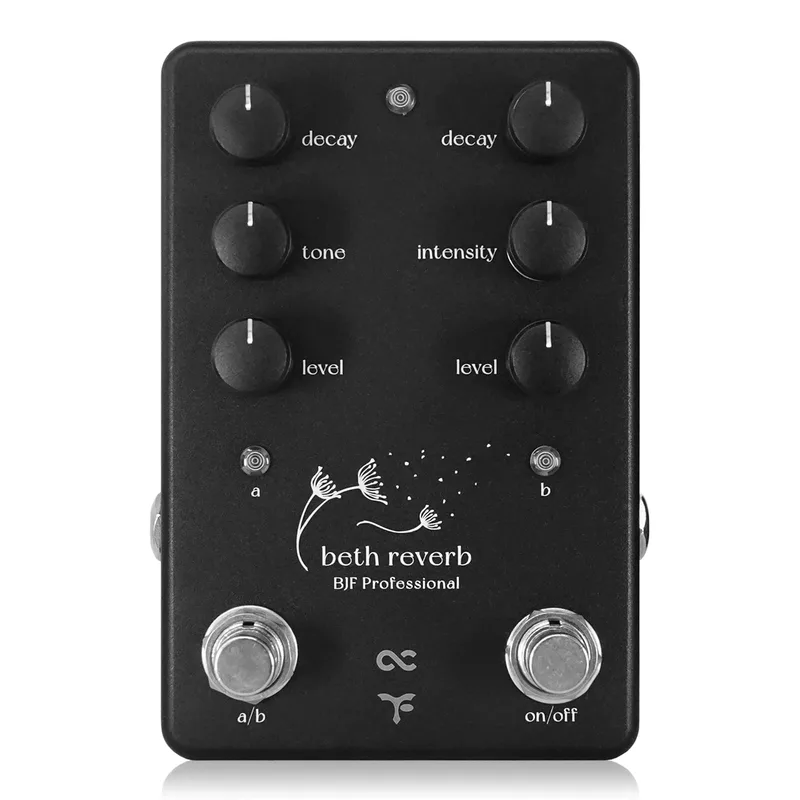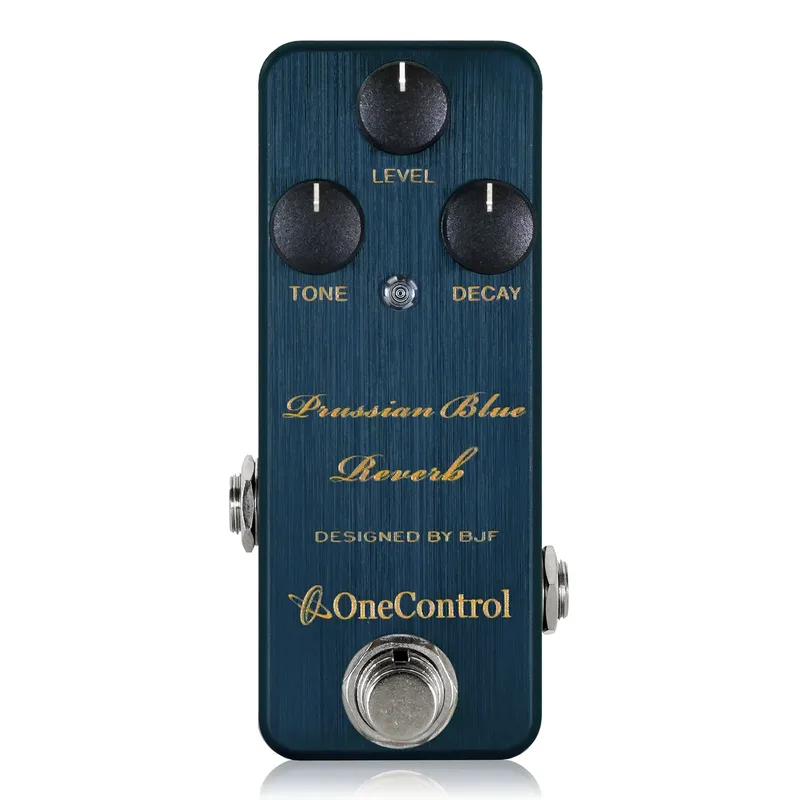
The One Control Prussian Blue Reverb Revival 15th Anniversary is a limited edition reverb pedal built to mark the 15th anniversary of One Control. It reissues the original Prussian Blue Reverb, a design by Bjorn Juhl, in a compact aluminum mini enclosure1.
The pedal is a hybrid design: the reverb is generated by 24-bit digital processing, while the dry signal passes through an analog dry-through circuit and is never converted to digital2. One Control positions the sound as sitting between two classic reverb flavors, describing it as a tone that lies somewhere between spring and hall reverb, rich but not overpowering, ambient but clear1.
The Revival 15th Anniversary is a limited edition and is listed as sold out by One Control. It carried a list price of $212.99 USD, shown at $169.99 USD, as of October 20261.
A reverb between spring and hall
A reverb effect simulates the mild reverberation created when a sound is reflected in a space, and One Control says the Prussian Blue Reverb is designed to replicate this ideal echo with clarity, subtlety, and spatial depth1.
On the original Prussian Blue Reverb page, Bjorn Juhl describes the character in more detail. In his words:
"it's closer to the hall tone than to spring but not as bright as hall reverb"2
Juhl describes the pedal as a mixture of spring, hall and room strengths, and says the Prussian Blue Reverb has a dynamic range five times larger than a general spring reverb2. For a player, that points to a reverb that can sit behind the note without swallowing it: the maker's own framing is "rich but not overpowering, ambient but clear"1.
The controls: Level, Tone, Decay and Kill Dry
The Revival keeps the control set small, with three knobs and one switch1.
| Control | What it does |
|---|---|
| LEVEL | Adjusts the volume of the reverb effect1 |
| TONE | Adjusts the brightness of the reverb1 |
| DECAY | Controls the duration of the reverb from two milliseconds to two seconds1 |
| KILL DRY | Mutes the dry signal for parallel routing or creative effects1 |
The Decay range matches the original Prussian Blue Reverb, whose decay time can be set from 2ms to 2s2. That spread covers everything from a short, room-like blur to a full two-second tail.
Kill Dry is the routing tool of the group. With it engaged, only the wet reverb leaves the pedal, which is what you want when running parallel effects: split your signal, send one side through the pedal with the dry signal muted, and blend the reverb back in at the mixer or a second amp1.
Power and connections
The pedal runs on a 9V center minus (center negative) adapter or a 9V battery, which is not included1. Operating voltage is 8 to 12 volts, and current consumption is 32 milliamps1. That draw is modest by reverb pedal standards and leaves room on most isolated power supplies.
- Input impedance: 500 K ohms1
- Output impedance: 2 K ohms1
- Signal to noise ratio: -96 decibels1
- Dimensions: 39 mm x 100 mm x 31 mm (W x D x H) without protrusions; 47 mm x 100 mm x 48 mm with protrusions1
- Weight: approximately 160 grams, about 200 grams with a battery inserted1
The input and output impedance figures match the original Prussian Blue Reverb, which lists 500 K input, 2K output, 8 to 12 V drive voltage and the same 32 mA consumption2.
Analog dry, digital wet
The Revival's signal architecture follows the original. The custom reverb program is recorded on a 24-bit digital chip, while the dry signal stays analog and is not converted to digital2. The Revival 15th Anniversary carries this forward with its analog dry-through circuit for a pure signal path1.
Both the Revival and the original use true bypass switching, so when the pedal is disengaged the signal passes through untouched12.
Questions
Can the One Control Prussian Blue Reverb Revival run on a battery?
Yes. The pedal takes a 9V battery, which is not included, or a 9V center minus (center negative) adapter. Operating voltage is 8 to 12 volts, and current draw is 32 milliamps. Weight rises from about 160 grams to about 200 grams with a battery inserted.
Is the Prussian Blue Reverb Revival true bypass?
Yes. One Control lists true bypass switching for the Revival 15th Anniversary, and the original Prussian Blue Reverb carried the same true bypass specification. When the pedal is off, the signal passes through without active circuitry in the path.
What does the Kill Dry switch do?
Kill Dry mutes the dry, unprocessed signal so only the reverb comes out of the pedal. One Control describes it as a tool for parallel routing or creative effects, for example when you split your signal and blend the reverb back in elsewhere rather than mixing it inside the pedal.
Who designed the One Control Prussian Blue Reverb?
Bjorn Juhl designed the original Prussian Blue Reverb, and the Revival 15th Anniversary reissues that design. One Control calls Juhl a legendary designer. The Revival is a limited edition built to commemorate the 15th anniversary of One Control.
Is the Prussian Blue Reverb Revival analog or digital?
It is a hybrid. The reverb itself uses 24-bit digital processing, but the dry signal runs through an analog dry-through circuit and is never converted to digital. Only the wet reverb path is digital, which keeps the unprocessed signal analog end to end.
Sources (2)
- Prussian Blue Reverb Revival 15th Anniversary (OC-PBR-15th), One Control USA
- PRUSSIAN BLUE REVERB (OC-PBRn), One Control USA