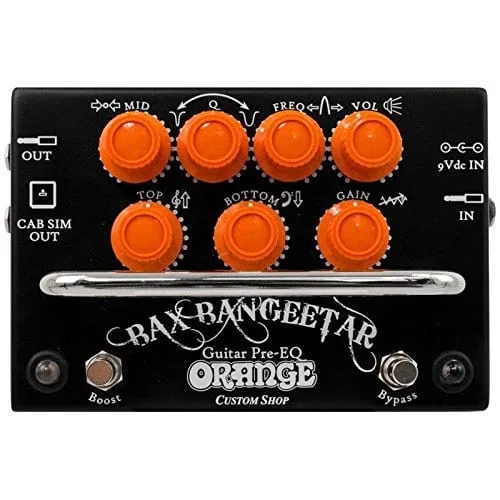


The Orange Bax Bangeetar is a preamp pedal from Orange: a Custom Shop grade Orange preamp coupled with a studio-style Baxandall active EQ in a stompbox enclosure1. Orange positions it as more than a drive pedal. It carries fully parametric mid controls, a regular output and a CabSim output, a clean boost function and a highly transparent buffered bypass1. It was Orange's first pedal in forty five years when it launched, according to Guitar.com2, and Orange's own page dates the finished design to 2015, calling it the company's first pedal since the 1960s1.
For a player, the appeal is flexibility. Orange says you can plug it straight into the front of an amp as a standalone overdrive or distortion pedal, or into the FX Return to make the donor amp disappear, effectively replacing the amp's preamp with an Orange one1. The CabSim output adds a third option: go straight to a mixer, PA or recording interface with a speaker-filtered sound1. Pedal of the Day found it works as "an awesome clean boost or low gain driver" as well as a full preamp3.
A preamp, drive and EQ in one pedal
The Bax Bangeetar came out of a long development. Orange says that in 2015 the company "finally settled on a design of which we were truly proud", its first pedal since the 1960s1. Guitar.com reported it at NAMM 2016 as Orange's first pedal in forty five years2. It is handmade in the Orange Custom Shop5 and built on an analog circuit4.
The circuit is unusual for a gain pedal. Guitar Interactive Magazine's launch coverage noted that it uses "none of the back-to-back diode circuitry commonly found in drive pedals"7. Instead of diode clipping, the drive comes from the preamp circuit itself, which Orange says lets you "dial in an enormous range of overdriven and distorted tones, delivered with a feel and responsiveness rarely found in pedals"1. Guitar Interactive reported that increasing the drive level yields "a wealth of outrageous modern tones, with genuinely insane amounts of distortion on offer"7.
Pedal of the Day's 2020 review summed up the pedal's character:
"boasts a unique and hugely versatile gain structure with extensive EQ controls"3
The controls: parametric mids, Baxandall EQ and boost
The front panel carries seven controls: Volume, Frequency, Q, Mid, Gain, Bottom and Top1. They break into three groups: a gain and output section, a parametric mid section, and a Baxandall treble and bass section.
| Control | What it does |
|---|---|
| Gain | Sets the drive level, from clean boost through low gain drive to distortion13 |
| Volume | Sets the output level; also determines how much the boost adds3 |
| Frequency | Sets the center frequency of the parametric mid band17 |
| Q | Sets the width of the parametric mid band17 |
| Mid | Cuts or boosts the midrange at the selected frequency13 |
| Bottom | Sets the low end of the base EQ13 |
| Top | Sets the high end of the base EQ13 |
The mid section is fully parametric, with controls for Q, center frequency and cut/boost, including a bell curve response57. Guitar Interactive's take on what that means for a player:
"With controls for Q, centre frequency and cut/boost, the midrange response is literally infinite"7
That is the practical difference from a fixed two- or three-band EQ: instead of boosting or cutting a fixed frequency, you choose where the mid band sits and how wide it is, which lets you scoop, hump or notch any point in the midrange.
The Top and Bottom controls are a Baxandall EQ, the treble and bass arrangement long used in hi-fi and studio equipment, which is where the pedal's name comes from1. Pedal of the Day describes them simply: "Top" and "Bottom" set your base EQ3.
The clean Boost is footswitchable. Orange's page says it adds 6dB1, while Delicious Audio and Guitar Interactive Magazine both report 5dB57. Pedal of the Day notes a behavior worth knowing: "the amount of boost is determined by where the Volume knob is set, and automatically reduces when the volume starts to get too high"3. In practice, the louder you run the pedal, the less headroom the boost has to add.
Power and connections: amp output and CabSim output
The pedal runs on a 9V battery or a 9V to 12V DC adapter, with a maximum current draw of 81mA1. That draw is modest by modern standards but higher than a simple analog overdrive, so a fresh battery or a properly rated supply is the safer bet for a gig.
- Amp output: the regular output for feeding the front of an amp or its FX Return13.
- CabSim output: passes the sound through Orange's CabSim circuit, recreating the frequency response of a mic'd Orange 4x12 cab, for direct recording or connecting to a PA1.
The CabSim output is what makes the pedal work as a complete rig on its own. Pedal of the Day notes it "allows you to plug directly into mixers, PAs, recording consoles" without needing an amp or cabinet3. Both Delicious Audio and Guitar Interactive Magazine identify the modeled cabinet specifically: Orange's 40th Anniversary PPC412 loaded with Celestion G12H 30 speakers57.
The two outputs serve different destinations. The Amp output is for a real guitar amp; the CabSim output is for mixers, PAs and recorders, where the speaker filtering replaces the sound of a mic'd cabinet. Feeding the CabSim output into a real guitar cab on top of a real amp is not what the circuit is designed for.
Where it sits in Orange's pedal line
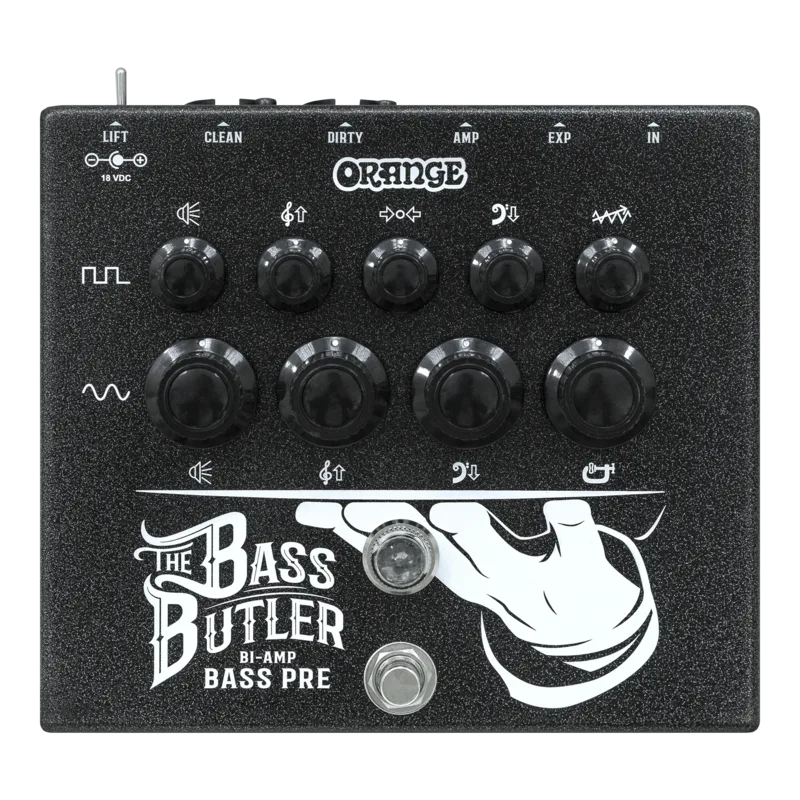
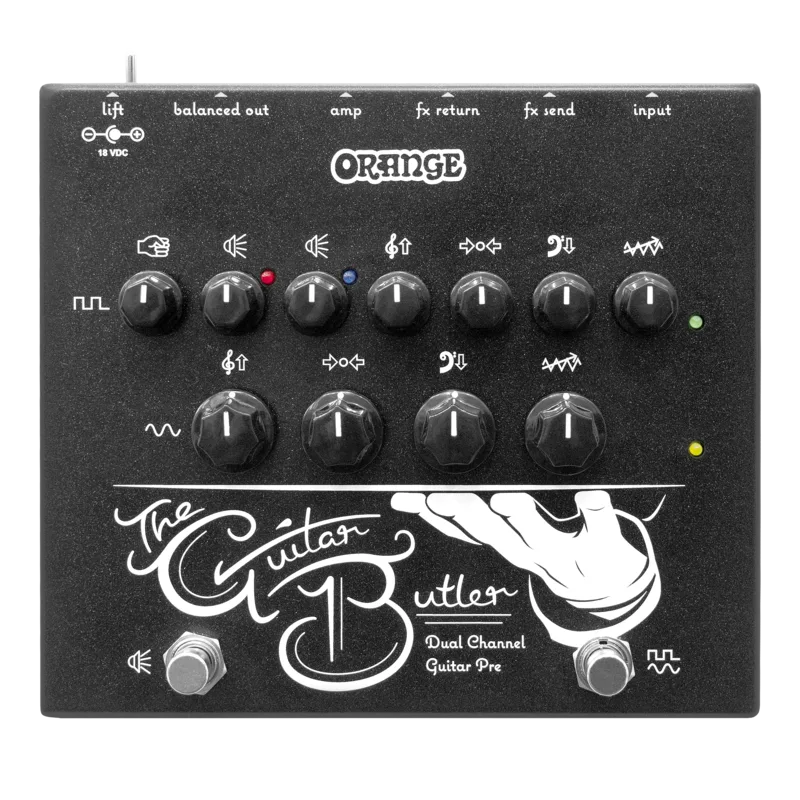
The Bax Bangeetar was Orange's return to pedals after decades away from them12. The company later expanded into preamp pedals with the Bass Butler for bass and the Guitar Butler for guitar.
Videos
ProGuitarShopDemos
Pete Thorn
Orange Amps
Questions
Is the Orange Bax Bangeetar true bypass?
No. Orange describes it as having a highly transparent buffered bypass, so the pedal's buffer stays in the signal path when it is switched off. Players who want to keep long cable runs sounding consistent may see that as a plus rather than a drawback.
What cab does the Bax Bangeetar CabSim output emulate?
The CabSim output recreates the frequency response of a mic'd Orange 4x12 cabinet. Delicious Audio and Guitar Interactive Magazine both identify the modeled cab as Orange's 40th Anniversary PPC412 loaded with Celestion G12H 30 speakers. It is intended for direct recording or feeding a PA.
Can I plug the Bax Bangeetar into my amp's effects return?
Yes. Orange says you can plug it straight into the front of an amp as a standalone drive pedal, or into the FX Return, which the maker describes as making the donor amp disappear. Into the effects return the pedal's preamp and EQ effectively replace the amp's own preamp section.
How much does the Bax Bangeetar boost add?
Orange's product page says the clean Boost adds 6dB, while Delicious Audio and Guitar Interactive Magazine both report 5dB. Pedal of the Day notes the boost amount depends on where the Volume knob is set, and automatically reduces when the volume gets too high, so the exact figure varies in use.
Sources (7)
- Bax Bangeetar, Orange Music Electronic Co Ltd
- NAMM 2016: Orange launch two new pedals, Guitar.com, 2016-01-21
- Orange Amps Bax Bangeetar Guitar Pre-EQ, Pedal of the Day, 2020-05-05
- Bax Bangeetar by Orange, RockBoard PedalPedia, 2026
- Orange Bax Bangeetar Pre-EQ, Delicious Audio, 2018-04-19
- KMA Machines Logan Transcend Drive review, Guitar World, 2020-04-01
- Orange Amplification Launch Bax Bangeetar Guitar Pedal, Guitar Interactive Magazine, 2015-04-15