The controls
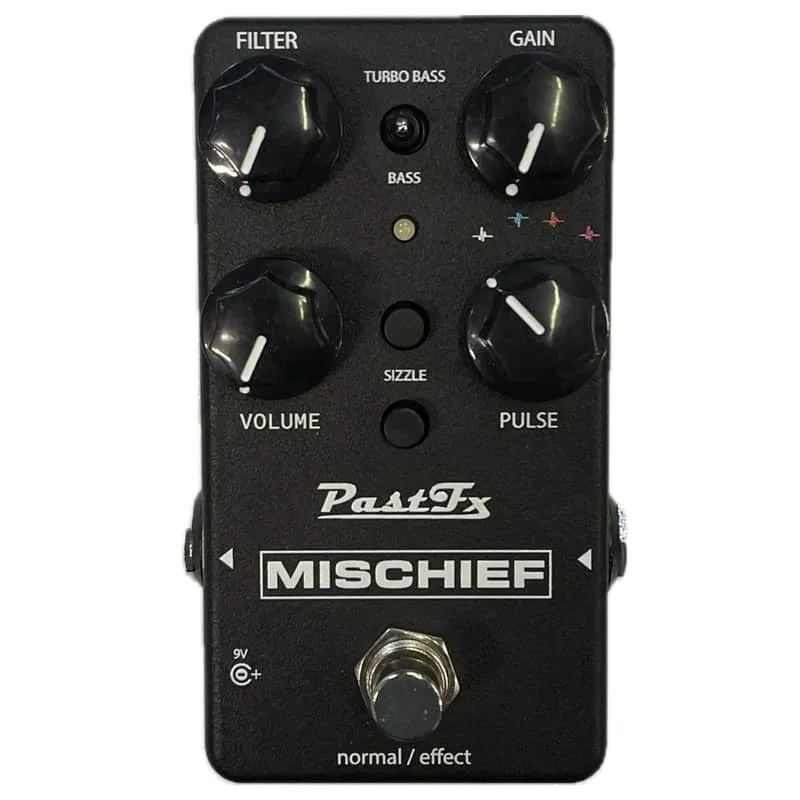
The Mischief packs a lot of switching into its small enclosure. PastFX describes the following controls1:
| Control | What it does |
|---|---|
| "Pulse" rotary clipping switch (4-way) | Selects the clipping configuration, each with a corresponding colored LED indicator |
| Bass toggle (3-way) | Stock in the center; the Bass and Turbo Bass positions engage an extra circuit boosting those frequencies |
| "Sizzle" pushbutton | Pushbutton for extra bite |
| Pushbutton below Sizzle | Disengages the "Pulse" switch; the LED changes to green |
The four Pulse positions give the pedal four distinct clipping characters1:
- White: stock symmetrical clipping
- Blue: asymmetrical clipping
- Red: LED clipping
- Pink: a unique clipping configuration using several components, including germanium diodes
The pushbutton below the Sizzle switch bypasses the Pulse clipping selector entirely, with the LED turning green to confirm it. That gives you a quick way back to the pedal's base voicing without repositioning the rotary switch mid-song1.
Power and size
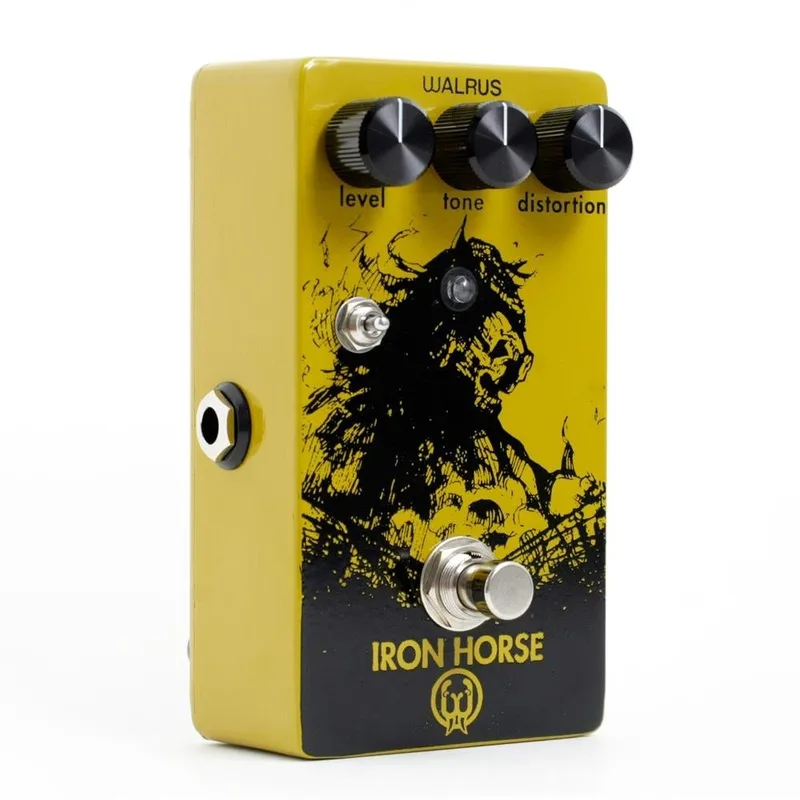
The Mischief operates on 9V DC and draws 50mA1. That figure matters on a shared power supply: many compact distortion pedals draw far less, and a daisy chain or a low-current output may not carry the Mischief comfortably. For comparison, the Walrus Audio Iron Horse LM308 Distortion, another LM308-based design, draws 10mA at 9V DC2.
At 112 x 60 x 31mm for the enclosure, the Mischief sits in compact-pedal territory1.
How it compares
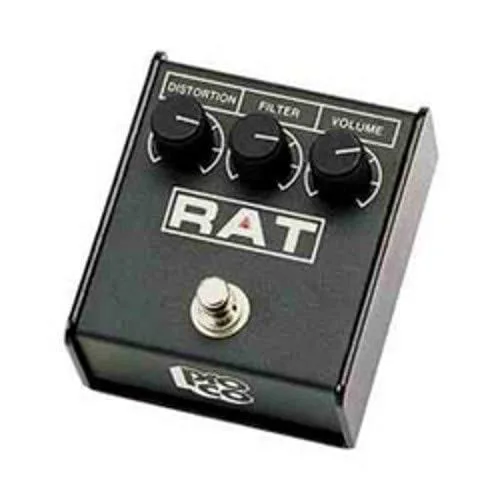
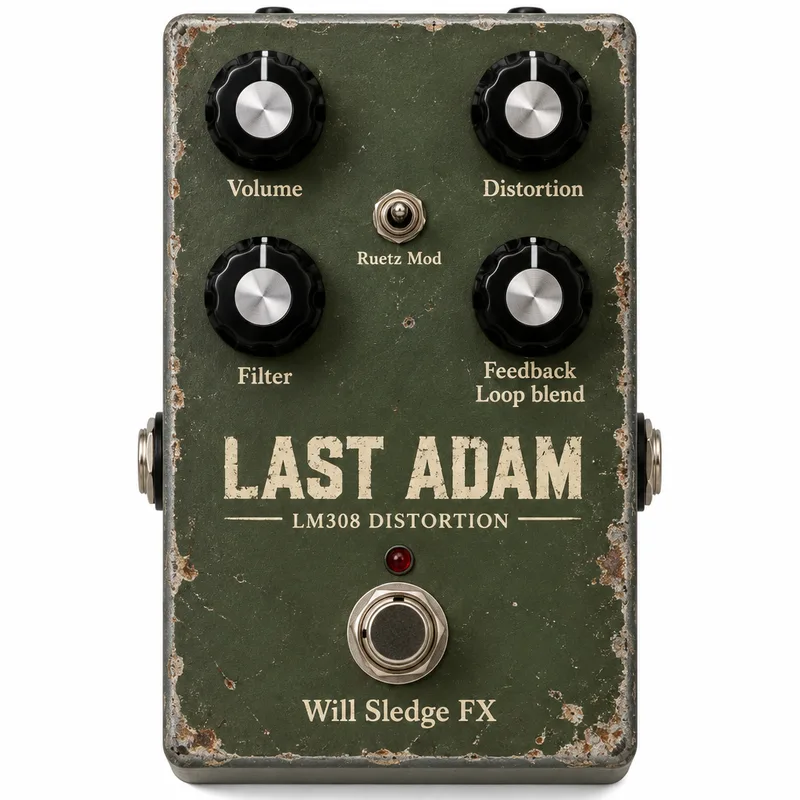
The LM308 chip ties the Mischief to a small family of Rat-inspired pedals. Guitar Player described the Walrus Audio Iron Horse LM308 Distortion as offering "distortion based around a LM308 chip as found in a Pro Co Rat"3. The Will Sledge FX Last Adam LM308 Distortion adds a Feedback Loop feature; Pedal of the Day's reviewer, Mike B, wrote that "you could basically just freak everyone out with a thick, dirty sound wall and feed it back over and over" in that mode4.
| Pedal | Chip/circuit | Standout feature | Power |
|---|---|---|---|
| PastFX Mischief LM308 Distortion | LM308 chip1 | 4-way Pulse clipping, Bass/Turbo Bass switch, Sizzle1 | 9V DC, 50mA1 |
| Walrus Audio Iron Horse LM308 Distortion | LM308-based, Rat-style3 | 4.77 x 2.9 x 2.3 inches, true bypass2 | 9V DC, 10mA2 |
| Will Sledge FX Last Adam LM308 Distortion | LM308-based | Feedback Loop4 |
Where the Iron Horse stays closer to a single Rat voicing, the Mischief's approach is to put several clipping options, a low-end switch and a bite button on one small board, which is what earned it a place in Guitar Pedal X's 2024 roundup of compact Rat-style pedals5.
If you are exploring this corner of the market more widely, the distortion pedals type page collects the broader field.
Questions
Is the PastFX Mischief LM308 Distortion true bypass?
Yes. PastFX lists the Mischief LM308 Distortion as true bypass, so when the pedal is off your guitar's signal passes through without loading the front of your amp or other pedals. A second pushbutton below the Sizzle button disengages the Pulse clipping switch, with the LED changing to green to show that mode is out of the circuit.
What power supply does the PastFX Mischief LM308 Distortion need?
The Mischief runs on 9V DC. PastFX specifies a current draw of 50mA, which is higher than many compact distortions, so a supply with enough spare current is worth having on a shared board.
How much current does the Mischief LM308 Distortion draw?
PastFX rates the current draw at 50mA at 9V DC. For comparison, the Walrus Audio Iron Horse LM308 Distortion draws 10mA at 9V DC, so the Mischief asks five times as much from your power supply.
What does the Sizzle pushbutton do?
The Sizzle pushbutton adds extra bite. It is a momentary or latching boost to the pedal's top end that you can stomp on top of the setting you have dialed in, alongside the Bass switch and the Pulse clipping selector.
What does the Bass switch's Turbo Bass position do?
The Bass switch is a three-way toggle with a Stock centre position. The Bass and Turbo Bass positions engage an extra circuit that boosts those low frequencies, so you can fatten the pedal up for darker amps, humbuckers or bass duty without touching the tone control.
How big is the Mischief LM308 Distortion?
PastFX gives the enclosure dimensions as 112 x 60 x 31mm, or 4.4 x 2.36 x 1.22 inches, enclosure only. That is a compact footprint that sits easily alongside standard mini and full-size pedals on a board.
Sources (5)
- Mischief LM308 Distortion, pastfx.com, 2026
- Iron Horse LM308 Distortion, Walrus Audio
- 10 New Gain Pedals You Need to Know About, GuitarPlayer (www.guitarplayer.com), 2022-03-03
- Will Sledge FX Last Adam LM308 Distortion, Pedal of the Day, 2015-03-26
- Guitar Pedal X, Guitar Pedal X, 2024-08-30