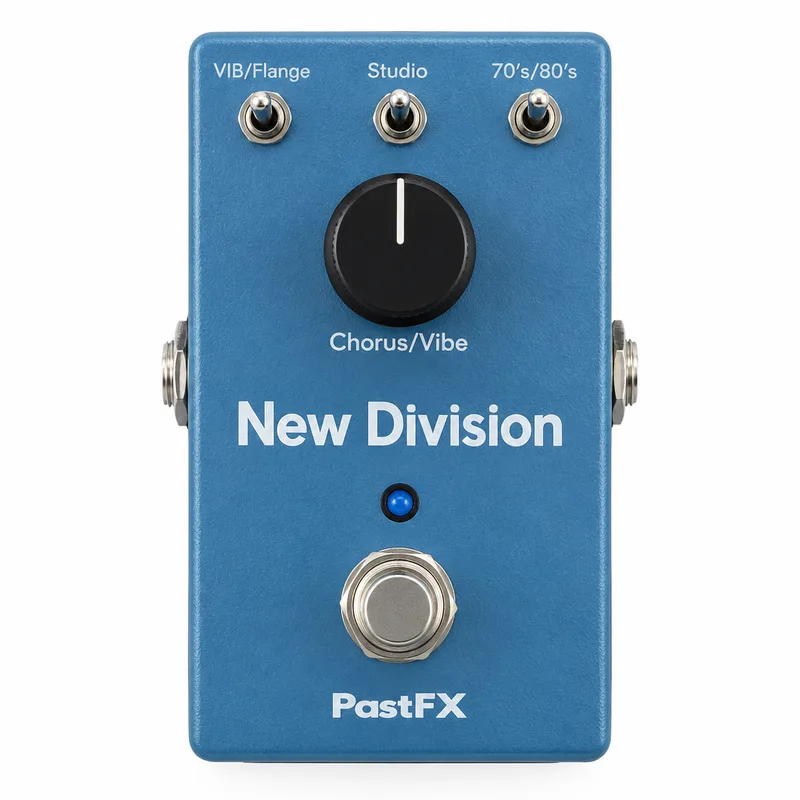


The PastFX New Division is an analog chorus, flanger and vibrato pedal in one box, built as a faithful recreation of the 1970's and 80's MN3007 versions of the Electro-Harmonix Clone Theory1. It uses NOS (new old stock) Panasonic MN3007 bucket brigade delay chips, the same BBD family PastFX uses across its vintage-inspired modulation range, and it adds modern practical touches the original lacked: true bypass, input and output level controls, and a Studio switch for noise reduction1.
RockBoard's PedalPedia describes the chorus as the heart of the pedal, with flanger and vibrato available through a mode switch2. Guitar Pedal X's Stefan Karlsson listed the New Division MN3007 version at $210 in his November 2024 survey of the PastFX range3.
A chorus, flanger and vibrato built on the MN3007
The New Division is a multi-mode modulation pedal: one circuit, three effects. In Chorus mode, the Chorus/Vibe knob works like a blend control. As the knob is turned clockwise, the effect begins to reduce the dry signal until a full vibrato effect is heard1. That means you can dial anything from a subtle doubled sound to pure pitch wobble without touching another control.
Flipping the VIB/Flange switch changes the character entirely. In VIB/Flange mode, the Chorus/Vibe control is bypassed and inverted feedback is added, which is what turns the delay-line modulation into a flanger rather than a chorus1. The LFO shapes stay analog throughout, and the whole signal path runs through the MN3007 BBD rather than a digital emulation1.
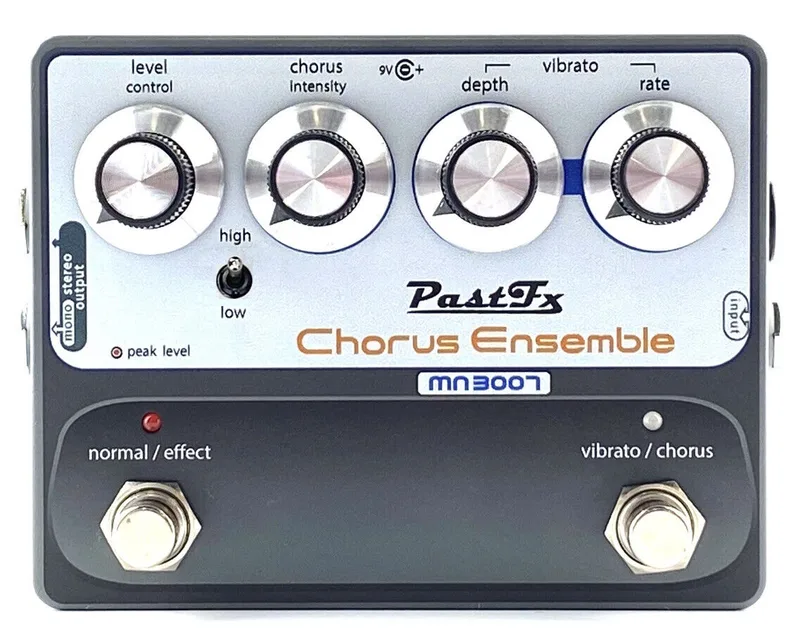
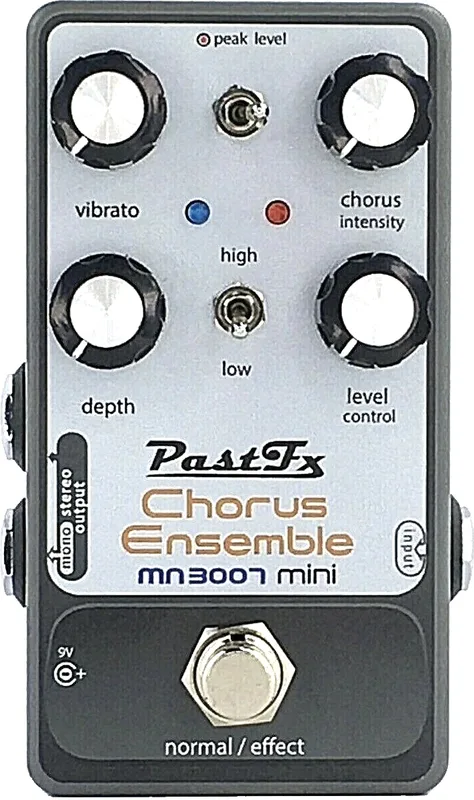
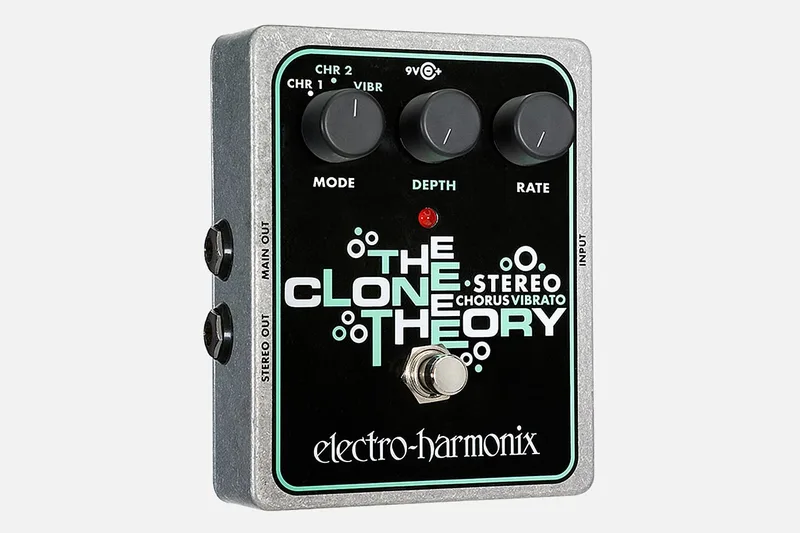
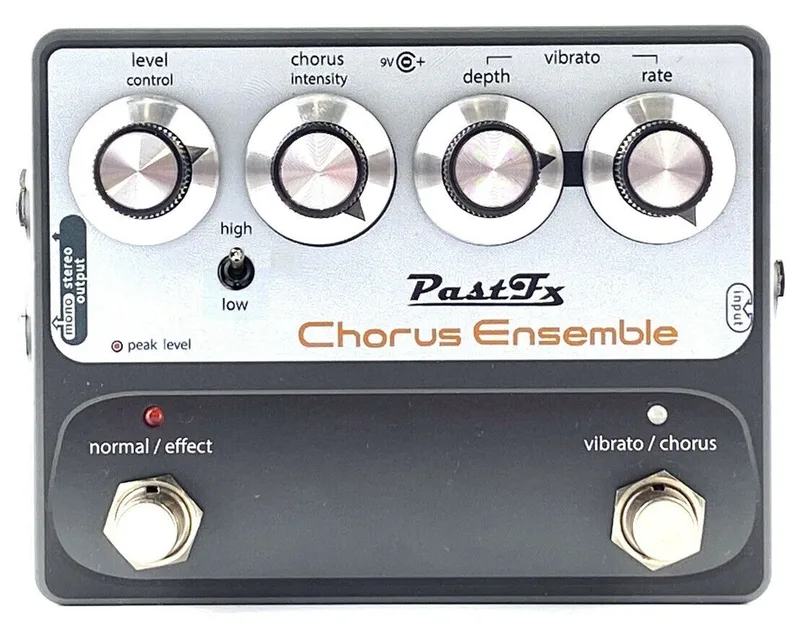
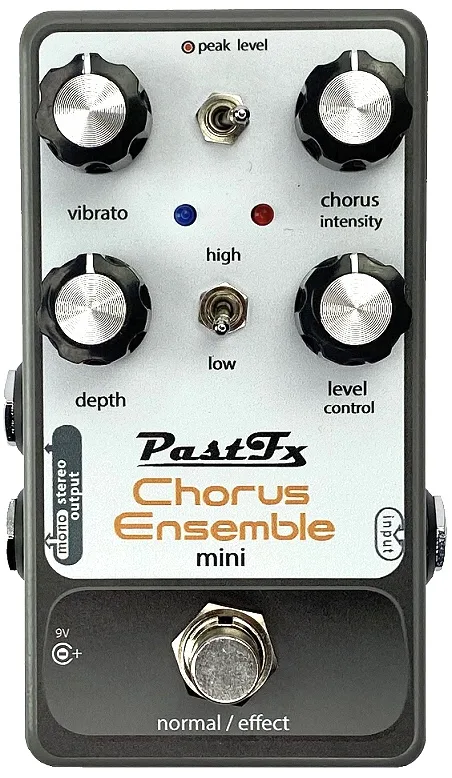
For players comparing PastFX options, the New Division sits alongside the PastFx Chorus Ensemble MN3007, which recreates the Boss CE-1 chorus and vibrato instead, and the smaller PastFx Chorus Ensemble MN3007 Mini. Where the Chorus Ensemble pedals cover chorus and vibrato only, the New Division adds flanger mode and the Clone Theory voicing451.
The controls
Guitar Pedal X lists the full control set as Rate, Mode (Chorus / Vibrato and Flange), Depth, Level, Input Gain, Wet Mix, a Studio switch, an Edge switch and a stereo out port3. PastFX's own page adds the detail on how the less obvious controls behave1.
| Control | What it does |
|---|---|
| Rate | Sets the speed of the modulation |
| Mode switch | Selects Chorus or VIB/Flange operation1 |
| Chorus/Vibe | Blends toward full vibrato as it turns clockwise in Chorus mode1 |
| Input and Output Level | Addresses the volume drop of the original Clone Theory and lets you set levels to prevent clipping with different guitars and basses1 |
| Studio switch | Engages a compander circuit to further reduce floor noise, Chorus mode only1 |
| Edge switch | Bright switch carried over from the 1970's SAD1024 version2 |
| 70's/80's slide switch | Internal switch selecting the tone filtering of the two early circuit versions1 |
The Input and Output Level controls are the most practical addition. PastFX says they address the volume drop found on the original Clone Theory, and they also allow signal level adjustments to prevent clipping on various types of guitars and bass guitars1. That makes the pedal easier to match with hot pickups or to place after a boost.
The Clone Theory and SAD1024 lineage
The original Electro-Harmonix Clone Theory went through early versions with different BBD chips, and the New Division follows that history. PastFX says the pedal is a faithful recreation of the 1970's / 80's MN3007 EHX Clone Theory, and that it has also incorporated some of the features of the first 1970's Reticon SAD1024 version1. The most visible of those is the "Edge" (Bright switch) that appeared on the SAD1024 version of the original circuit2.
The internal 70's/80's slide switch lets you choose between the subtle tone filtering options of the two early versions, the MN3007 (80's) and SAD1024 (70's)1. In PastFX's description, the 70's setting has slightly more mids and is a tad darker in high frequencies1.
PastFX credits community member Scruffie for assistance with the project1.
Power and setup notes
The New Division operates off 18V DC and does not have any internal voltage doubler circuit. Current draw is 150mA1.
Videos
Leon Todd
Pedal Experiments
The Pedal Picassos
Questions
Is the PastFX New Division true bypass?
Yes. PastFX lists true bypass among the New Division's features, so the pedal passes your dry signal untouched when it is switched off. It also has separate Effect and Dry outputs, which lets you run wet and dry paths in parallel.
Can the New Division run on a 9V supply?
No. The New Division operates off 18V DC and has no internal voltage doubler circuit, so a standard 9V supply will not power it correctly. You need an 18V supply, and its current draw is 150mA, which is high enough that a small isolated output should be checked for capacity.
What does the Studio switch do on the New Division?
The Studio switch engages a compander circuit that further reduces the floor noise of the effect. PastFX notes it is designed for the Chorus mode only, so it is mainly useful when you are running the pedal as a chorus and want a quieter background.
What is the difference between the 70's and 80's settings?
The internal 70's/80's slide switch selects the tone filtering of the two early versions of the original circuit, the SAD1024 (70's) and MN3007 (80's). PastFX says the 70's setting has slightly more mids and is a tad darker in high frequencies.
Does the New Division have a stereo output?
The New Division has Effect and Dry outputs rather than a conventional stereo pair. You can run both outputs to two amps for a wet/dry setup, but it is not a single-cable stereo output like some other chorus pedals.
Sources (5)
- New Division, PastFx, 2026
- New Division, RockBoard PedalPedia, 2026
- Guitar Pedal X, Guitar Pedal X, 2024-11-14
- Chorus Ensemble MN3007, pastfx.com
- Chorus Ensemble MN3007 Mini, PastFx