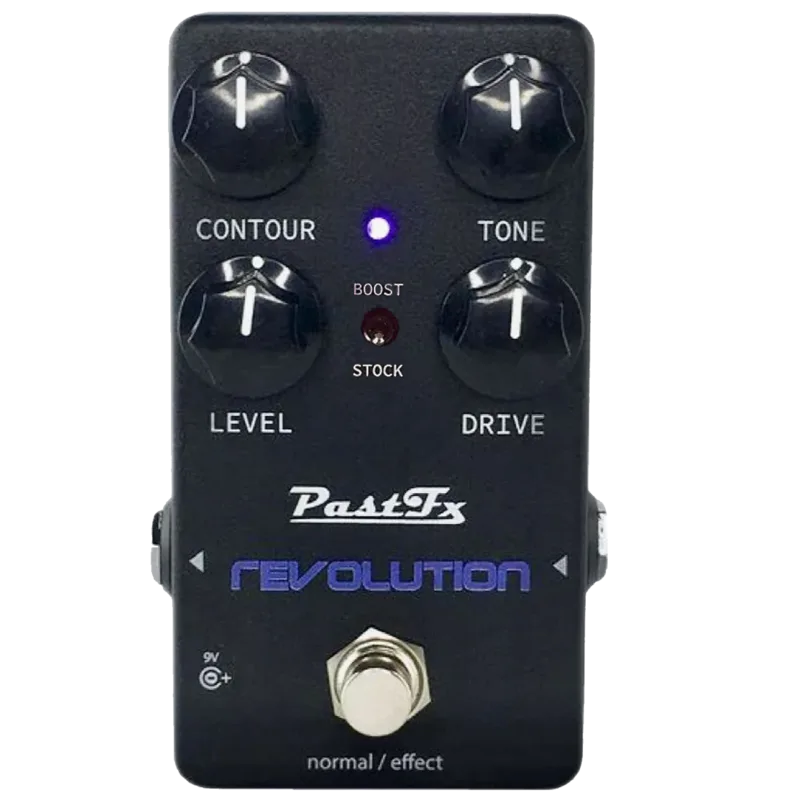


The PastFx Revolution is a four-stage medium to high gain overdrive and distortion from PastFX. PastFx voices it with a slightly dark disposition, saying it "broods with Plexi tinged angst" and spans crunchy overdrive, biting distortion and searing lead runs. It is a faithful recreation and expansion of the Buffalo FX Evolution, an effect originally inspired by the Pete Cornish G-2 distortion pedal1.
Controls and the Boost/Stock switch
The Revolution carries four knobs: Level, Drive, Tone and Contour, which PastFx describes as upper mids shaping, together covering what the maker calls an array of distorted tonescapes1.
| Control | What it does |
|---|---|
| Level | Output level |
| Drive | Amount of gain |
| Tone | Treble response |
| Contour | Upper mids shaping1 |
The pedal also has an external switch to select "Boost" or "Stock", the Stock position being the original circuit. PastFx says Boost mode "accentuates brighter tonal frequencies in the pedal's response for a more modern sound". This switch is an upgrade: the Boost option was previously an internal dip switch mod, and it now sits on the outside of the pedal1.
The LED indicator is dimmable and internally adjustable, so its brightness can be turned down if it is too bright on a dark stage1.
From the Pete Cornish G-2 to the Buffalo FX Evolution
The circuit's lineage runs through two earlier designs. The Pete Cornish G-2 was originally designed by Pete Cornish for Lou Reed in the 1990s2. One history of Cornish's pedals notes that after a debate began online about what constitutes a fuzz, muff, or distortion, Pete dropped the word fuzz from his pedal names3. The PastFx Revolution is described as an effect originally inspired by the Pete Cornish G-2 distortion pedal, and it is a faithful recreation and expansion of the Buffalo FX Evolution, a four-stage overdrive and distortion1.
Power, size and practicalities
PastFx specifies a 9v center negative power supply drawing under 10mA of current, which any standard isolated output on a pedalboard supply will handle. Input impedance is 1 MΩ, and the enclosure measures 112 x 60 x 31mm (4.4" x 2.36" x 1.22"), enclosure only1.
The Revolution runs on 9v center negative and draws under 10mA, so it fits a standard pedalboard supply output1.
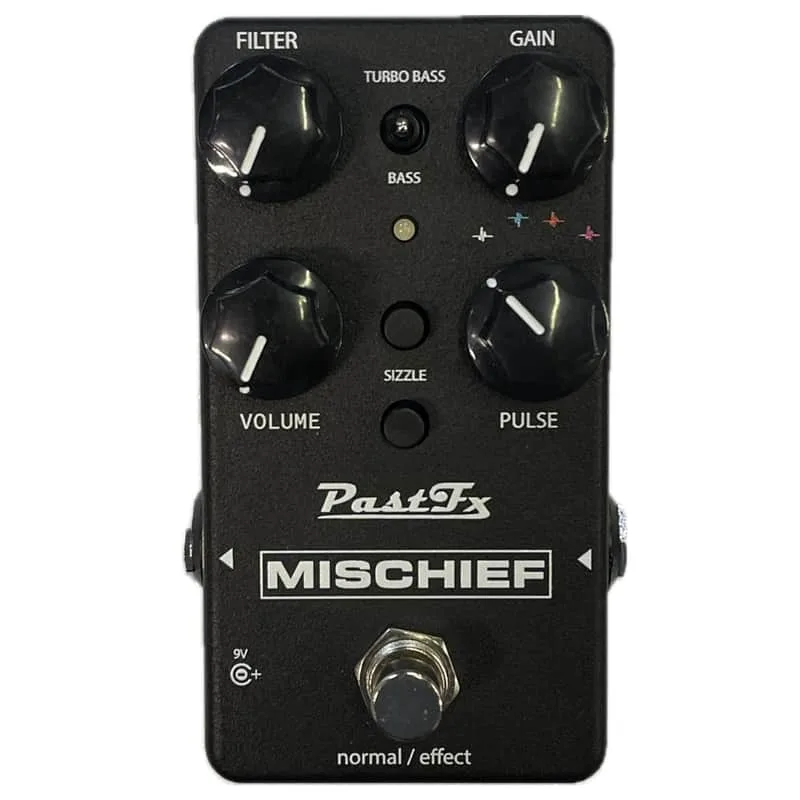
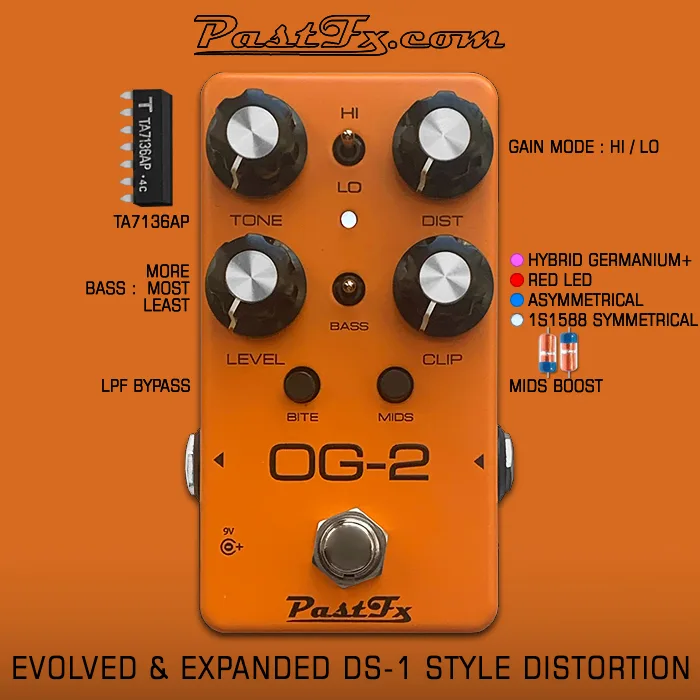
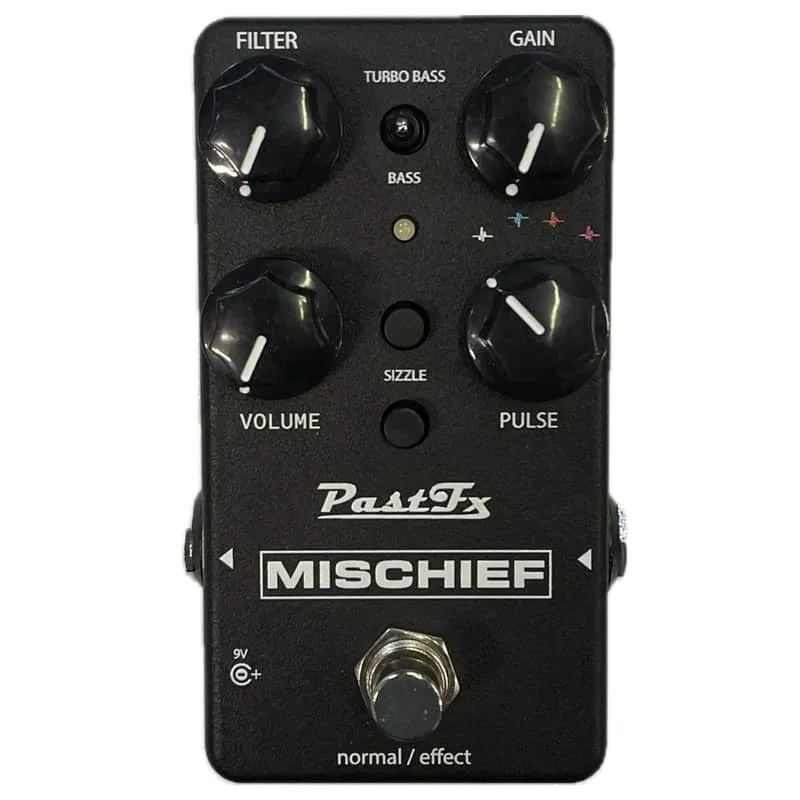
The Revolution sits in PastFX's Spectrum Collection alongside the maker's other expanded takes on classic circuits, such as the PastFX Mischief and the PastFX OG-2.
Videos
MustyGuitar
Middle Aged Gear Junkie
The Pedal Picassos
Questions
What is the PastFx Revolution based on?
PastFx describes the Revolution as a faithful recreation and expansion of the Buffalo FX Evolution, a four-stage overdrive and distortion. That circuit was itself originally inspired by the Pete Cornish G-2 distortion pedal, which Pete Cornish designed for Lou Reed in the 1990s.
What does the Boost/Stock switch do on the Revolution?
The external switch selects between Stock, the original circuit, and Boost mode. PastFx says Boost accentuates brighter tonal frequencies in the pedal's response for a more modern sound. The switch was previously an internal dip switch and has been moved to the outside of the pedal.
Is the PastFx Revolution true bypass?
Yes. PastFx lists true bypass operation for the Revolution.
What power does the PastFx Revolution need?
PastFx specifies a 9v centre negative power supply drawing under 10mA of current. That low draw means a standard pedalboard supply output will run it comfortably.
What does the Contour knob do?
PastFx describes the Contour control as upper mids shaping, sitting alongside Level, Drive and Tone to sculpt what the maker calls an array of distorted tonescapes.
Can the LED on the Revolution be dimmed?
Yes. The Revolution has a dimmable LED that is internally adjustable, so the indicator brightness can be set to suit the player.
Sources (3)
- Revolution Distortion, pastfx.com, 2026
- Tracing Journal: Cornish G-2 (two versions), Aion FX, 2024-08-02
- The Big Muffs of David Gilmour of Pink Floyd, Kit Rae, 2024-07