| Type | Analog distortion pedal4 |
| Maker | Pete Cornish, hand built in the UK by Pete and Lynda Cornish1 |
| Circuit | Four-stage overdriven discrete transistor Class A circuit with additional germanium components4 |
| Bypass | Buffered bypass with unity gain RFI rejecting input and bypass buffer1 |
| Power | 9V DC, center negative, 20 mA current draw4; 5.5/2.1 mm coax connector, center pin negative1 |
| Battery | 9V via a drawer, switched on when the IN/PWR jack is inserted; alkaline preferred1 |
| Dimensions | 171 x 121 x 55 mm1 |
| Price | 492.24 GBP excluding VAT, 590.57 GBP including VAT, as of March 20265 |
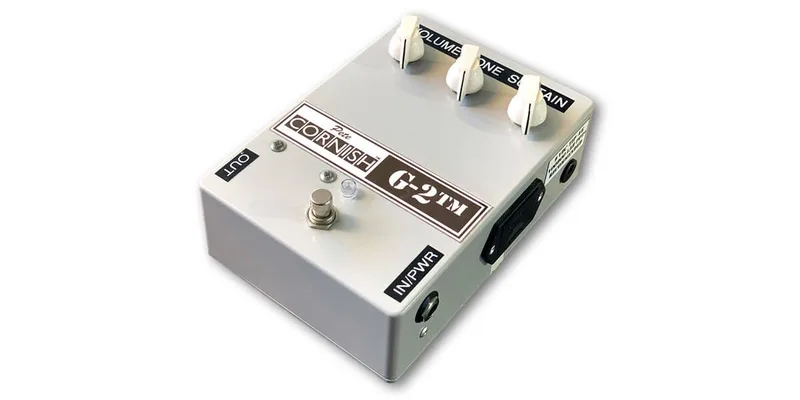
The Pete Cornish G-2 is a distortion pedal made in the UK by Pete Cornish, hand built, wired and tested by Pete and Lynda Cornish1. Cornish's own description calls it "the most original sounding distortion unit available to guitarists in the Rock Arena"1, and the maker's range page positions it, in its Deluxe form, as starting at around the rhythmic crunch stage of the SS-3 and continuing up to a rounded but dynamic lead2. It is an analog design, housed in a rugged die-cast box with "Chicken-Head" pointer knobs, measuring 171 x 121 x 55 mm1.
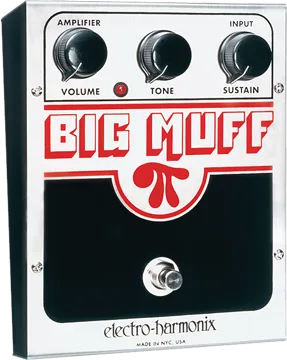
What makes the G-2 interesting to circuit watchers is what sits under the lid. Independent analysis by Aion FX, which traced two real G-2 units in 2024, describes it plainly: "It's a Big Muff with Cornish buffers and a simplified tone control"3. That makes it a member of the huge family of Big Muff derivatives, but one with germanium clipping diodes, Cornish's own buffering scheme, and a set of component values that, in Aion FX's judgment, push it well away from how a classic Big Muff sounds3.
Where the G-2 came from
The G-2 was not designed as a retail product for guitarists in general. Aion FX's tracing journal records its origin: "The G-2 was originally designed by Pete for Lou Reed in the 1990s"3. Like much of the Cornish line, it grew out of custom work built for a specific player, in this case a client whose name gave the design its early reputation, and it later became part of the Gray Series range sold through petecornish.co.uk36.
Each unit is built by Pete and Lynda Cornish themselves, and the maker backs it with a two-year warranty from date of purchase against original manufacturing faults, return post paid. The warranty is voided if the guarantee labels are damaged or removed, and it is not transferable1. The Gray Series listing prices the G-2 at 492.24 GBP excluding VAT, or 590.57 GBP including VAT, as of March 20265.
The range has since branched out. Alongside the standard Gray Series G-2, Pete Cornish has offered a Deluxe G-22, a G-2 Blended in the Gray Blend series273, and a Battery-Free version, which Aion FX notes was the form of the 2012 unit it traced3. Pete Cornish himself insists the Battery-Free series is nothing more than a compact version of the Gray Series3.
How the circuit works: a Muff derivative with germanium diodes
RockBoard's PedalPedia entry, drawing on the maker's information, describes the G-2 as "a four stage overdriven discrete transistor Class A circuit with additional Germanium components"4. That four-stage structure is the classic Big Muff recipe: an input stage, two clipping stages that generate the distortion, and an output recovery stage, with tone shaping between them. GuitarPCB's Big Muff documentation, for comparison, describes its own build as "based off of the Big Muff 2 circuit"8, the same foundational design the G-2 borrows its topology from.
Where the G-2 departs from a stock Big Muff is in three places, per Aion FX's trace3:
- Cornish buffers at the input and output, including the RFI rejecting input buffer and the unity gain bypass buffer the maker advertises1
- A simplified tone control, rather than the Big Muff's full tone stack3
- Germanium clipping diodes, which Aion FX identifies as the source of the "G" in the model name: "The 'G' designation is due to the germanium diodes"3
The result, in Aion FX's assessment, is a pedal that shares a schematic skeleton with the Big Muff but not its voice: "There are a number of other value tweaks throughout the circuit and the end result doesn't sound much like a classic Big Muff"3. RockBoard's entry echoes the maker's own framing of the sound, saying that within the huge tone the unit generates, the original guitar sound and dynamics remain present, creating a more musical effect4.
The germanium diode biasing problem
The germanium diodes that give the G-2 its name are also its most demanding component. Aion FX's analysis of the traced units found that the transistor biasing scheme depends on a very specific type of germanium diode, and that the second clipping stage is "very finicky and sometimes does not pass signal at all"3.
The measurements explain why. All six germanium diodes in the two traced units, four in the 2008 unit and two in the 2012 unit, measured between 0.36V and 0.4V forward voltage on a Peak Atlas DCA75 with a 5 mA test current3. Aion FX notes this is a fair amount higher than most germanium diodes, which more often fall in the 0.2V to 0.3V range3. The circuit is not tolerant of substitutes:
"If the diodes' forward voltage is too low or the leakage is too high, then it won't bias right and won't pass signal."
This is a practical warning for anyone building a G-2 clone or repairing an original: the diodes are not a generic part, and a set that measures outside the range the original units used can leave the pedal dead at the second clipping stage. It also explains why the design is sometimes described as temperamental, a reputation that traces back to the component itself rather than to construction quality3.
Differences between traced G-2 units
Aion FX published its two-unit comparison on August 2, 2024, tracing a 2008 Gray Series G-2 and a 2012 Battery-Free G-23. The two units are not the same circuit. In Aion FX's count, "there are nine differences between the 2008 and 2012 units, and the 2008 unit has seven further differences" from the original 2009 trace3. Both the 2008 unit and the 2006 unit from that original trace were Gray Series, while the newer 2012 unit was a black Battery-Free model3.
The most significant change is in the clipping diodes. In the 2012 unit, the D4-D5 second pair of clipping diodes was replaced with a BAT81S Schottky, so only the first stage uses germanium3. For a player comparing units or clones, this means a Battery-Free G-2 and a Gray Series G-2 from the late 2000s can differ in how their second clipping stage behaves, not just in enclosure and battery arrangement.
Aion FX also corrected the record on the original trace: it listed R39 as 50k, which Aion FX judges a transcription error, since 50k is a non-standard resistor value3. Looking at the pattern of changes, Aion FX hypothesizes that a newer Gray Series unit would have more in common with the 2012 unit than with the 2008 unit, though it notes this remains unconfirmed until a Gray Series from 2012 or later is taken apart3.
Controls, buffer and bypass
The G-2 uses a heavy duty all-metal footswitch with a Hi-Brite, low power consumption LED1. It is not true bypass. The maker specifies a high impedance RFI rejecting input and bypass buffer, a unity gain buffered bypass arrangement1, and Pete Cornish has addressed the question directly in a support article: "So the answer to your question re 'true bypass' is no, I do not use this system in my Effects Boards/Racks"9.
The buffer does more than drive the output. In the maker's words: "The Unity Gain Buffer also prevents 'Ghost Distortion' being audible in Bypass Mode"1. Ghost distortion, signal leaking into the effect path while the pedal is nominally off, is a known failure mode of unbuffered bypass switching, and the buffer is Cornish's answer to it.
The Blended versions add a wet/dry blend, and with it a setup step: the maker instructs the player to "adjust Volume to match bypassed signal level"10. The Gray Blend series also drops the battery entirely, because the space is used for the blend circuit10.
The standard Gray Series G-2 takes a 9V battery in a drawer, switched on when the IN/PWR jack is inserted, with alkaline the preferred type1. The Gray Blend and Battery-Free versions have no battery compartment310.
Power: 9V, 20mA
The G-2 runs on a 9V DC power supply, center negative, with a current draw of 20 mA4. The maker specifies the coax connector size as 5.5/2.1 mm with the center pin negative1. Pete Cornish's guidance on the Deluxe G-2, which shares the same power section, asks for an adapter that is noise free, fully stabilized at 9V DC and capable of supplying 20 mA2.
For pedalboard planning, 20 mA is a modest draw, comparable to other Cornish pedals such as the P-2, SS-2 and NG-2, which carry the same 20 mA figure on their product pages1112. The center negative, 5.5/2.1 mm arrangement matches the common standard used by most modern 9V supplies1.
The G-2 and the P-2
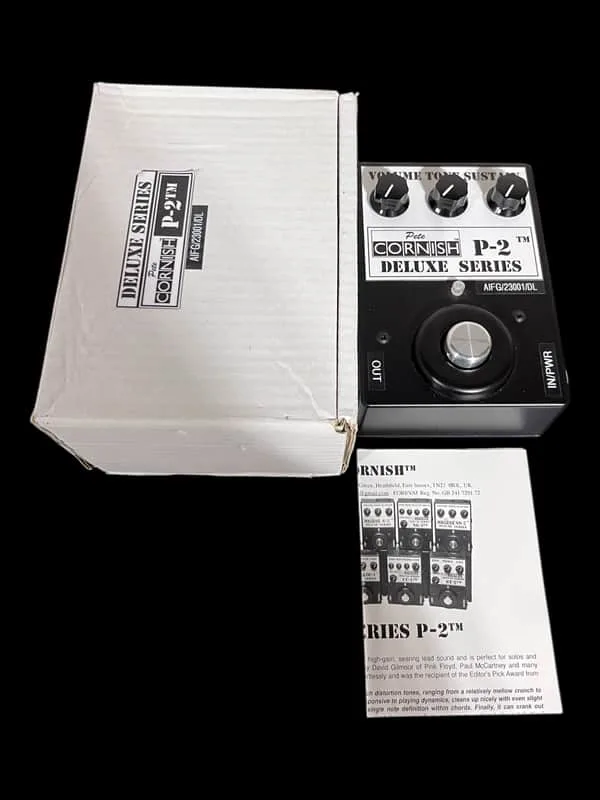
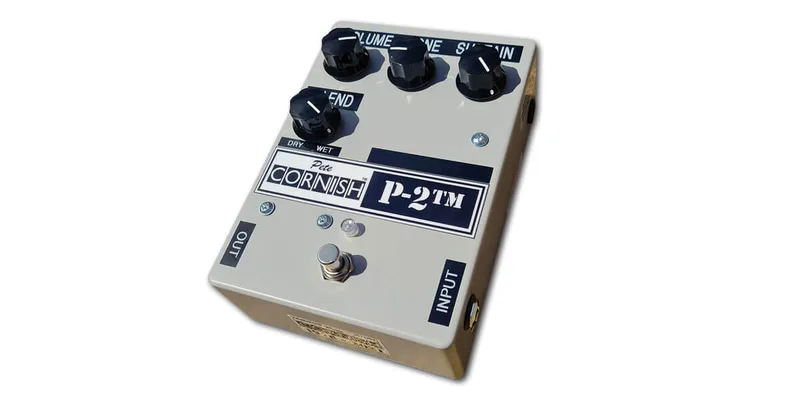
The G-2 is often mentioned alongside the Cornish P-2, and the two are distinct designs. The P-2 is the pedal Pete Cornish documents as the Gilmour connection: "This pedal is used prominently by David Gilmour of Pink Floyd and Paul McCartney"111. The G-2's own documented origin is Lou Reed in the 1990s3. Both share the Cornish house style, the RFI rejecting input and bypass buffer, the unity gain buffer that prevents ghost distortion in bypass mode, the 9V DC 20 mA power requirement and the battery drawer1211, but the G-2 is the germanium-diode, Big Muff-derived design, while the P-2 carries its own circuit.
In the maker's own range description, the Deluxe G-2 "with its warm Germanium qualities and higher gain starts at around the rhythmic crunch stage of the SS-3 and continues to a rounded but dynamic lead"2, which places it above the SS-2 and SS-3 soft sustain designs in Cornish's gain hierarchy.
Pedals on this page
Questions
Is the Pete Cornish G-2 based on a Big Muff?
Yes, in structure. Aion FX, which traced two G-2 units, describes it as a Big Muff variant with Cornish input and output buffers and a simplified tone control. However, the same analysis found enough value changes throughout the circuit that it does not sound much like a classic Big Muff, and the clipping diodes are germanium rather than silicon.
What distortion did David Gilmour use for the Comfortably Numb solo at Live 8?
The documented Cornish distortion in David Gilmour's rig is the P-2, not the G-2. Pete Cornish's own product page states the P-2 is used prominently by Gilmour of Pink Floyd, along with Paul McCartney. The G-2 was originally designed by Pete Cornish for Lou Reed in the 1990s.
Does the Pete Cornish G-2 take a battery?
Yes. The standard Grey Series G-2 has a battery drawer, and the battery switches on when the IN/PWR jack is inserted. Pete Cornish lists alkaline as the preferred type. The Battery-Free and Grey Blend versions drop the battery, the latter using the space for its blend circuit.
Is the Pete Cornish G-2 true bypass?
No. The G-2 uses a unity gain buffered bypass with an RFI rejecting input buffer, and Pete Cornish has stated he does not use true bypass in his effects boards and racks. The buffer also prevents what Cornish calls Ghost Distortion from being audible in bypass mode.
How is the G-2 different from the Cornish P-2?
Both are Cornish distortion pedals with the same buffered approach and 9V, 20mA power needs, but the G-2 is the germanium-diode design, originally built for Lou Reed, while the P-2 is the unit Pete Cornish documents as used prominently by David Gilmour and Paul McCartney. The G-2 sits at higher gain than the SS-3 in Cornish's own range description.
Is the Pete Cornish G-2 still made?
Pete Cornish's site lists the G-2 in its Grey Series range at 492.24 GBP excluding VAT, or 590.57 GBP including VAT, as of March 2026, with each unit hand built, wired and tested by Pete and Lynda Cornish in the UK.
Sources (12)
- Pete Cornish G-2, Pete Cornish, 2025
- Pete Cornish Deluxe G-2, Pete Cornish, 2025
- Tracing Journal: Cornish G-2 (two versions), Aion FX, 2024-08-02
- G-2 by Pete Cornish, RockBoard PedalPedia, 2026
- Grey Series Effects Pedals, petecornish.co.uk, 2026-03-31
- Tracing Journal: Cornish P-2, Aion FX, 2023-10-06
- Pete Cornish G-2 Blended, Pete Cornish, 2016
- EHX-Big-Muff-2-Build-Document.pdf, GuitarPCB, 2026-02
- FAQ-True Bypass, Boomerang Looper
- Pete Cornish Blended G-2, Pete Cornish, 2025
- Pete Cornish P-2, Pete Cornish, 2025
- Pete Cornish SS-2, Pete Cornish, 2025