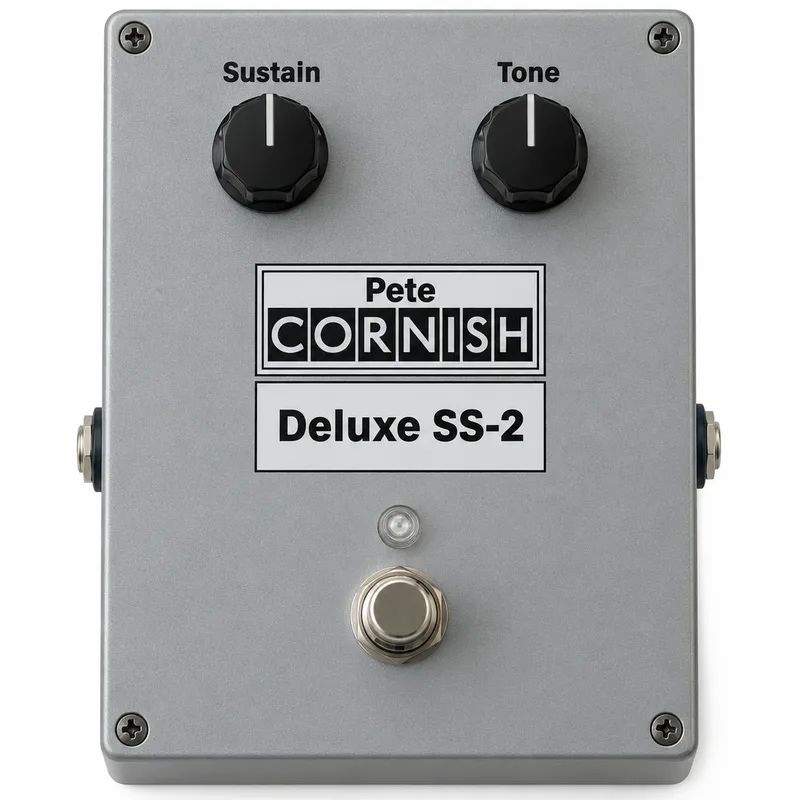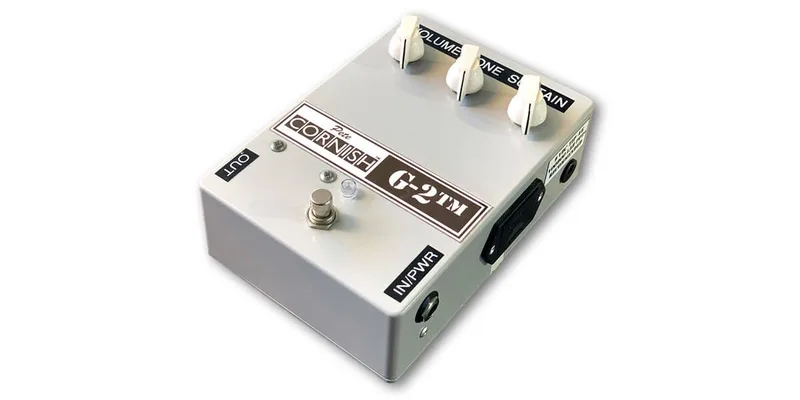


The Pete Cornish Deluxe G-2 is a distortion pedal hand built in the UK by Pete Cornish, the designer whose custom switching systems and pedals have served touring players for decades. Pete Cornish describes it as "the most original sounding distortion unit available to guitarists in the Rock Arena," and the company's own page for it carries the claim that it has been "hailed" as such1.
The circuit is what sets the G-2 apart from most distortion pedals. Pete Cornish says it "features a four stage overdriven discrete transistor Class A circuit with additional Germanium components"1. In other words, the gain comes from four discrete transistor stages running in Class A rather than from an op-amp, and germanium parts shape the clipping. The company says those germanium components "generate much warmer sounding harmonics than anything else on the market" and that "original guitar sound and dynamics are present within the tone"1.
Where the G-2 came from
The G-2 has a documented artist origin. Aion FX's technical analysis of traced units states that "The G-2 was originally designed by Pete for Lou Reed in the 1990s"5. That tracing work, published in 2024, examined two versions of the pedal: a 2008 Gray Series unit and a 2012 Battery-Free unit. Pete Cornish himself, per Aion FX, "insists that the Battery-Free series is nothing more than a compact version of the Grey Series"5.
The "G" in the name refers to the germanium clipping diodes. Aion FX notes that "The 'G' designation is due to the germanium diodes"5. Kit Rae's independent review of muff-inspired and related pedals adds a detail on the family: "The Germanium clipping diodes in the G-2 are a mix of Ge and Silicon in the DG-2"6.
The tracing also found small circuit differences between the two versions:
| Version | Year traced | Circuit differences found by Aion FX |
|---|---|---|
| Gray Series | 2008 | Emitter resistor of the second buffer stage (R14) increased from 8k2 to 10k, the same value used in the Pete Cornish P-25 |
| Battery-Free | 2012 | Second pair of clipping diodes replaced with BAT81S Schottky diodes, so "only the first stage uses germanium" in that version5 |
How it sounds, according to the maker
Pete Cornish's description of the G-2's character centers on the germanium components. The company says they generate "much warmer sounding harmonics than anything else on the market," and that the player's "original guitar sound and dynamics are present within the tone"1. That last point is the maker's way of saying the pedal is voiced to preserve the core character of the guitar rather than replace it.
"features a four stage overdriven discrete transistor Class A circuit with additional Germanium components"
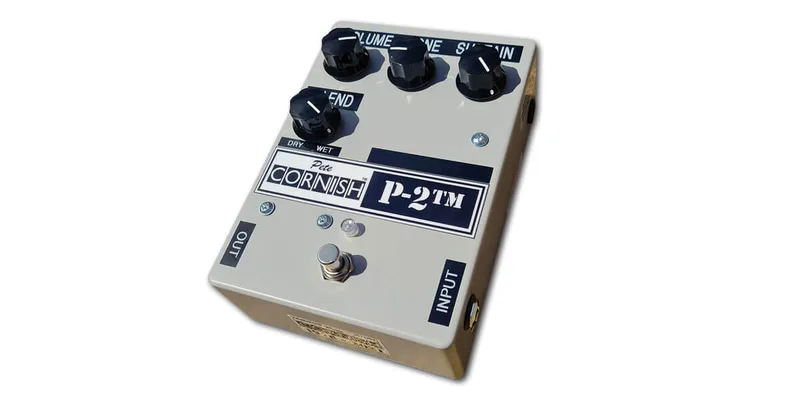
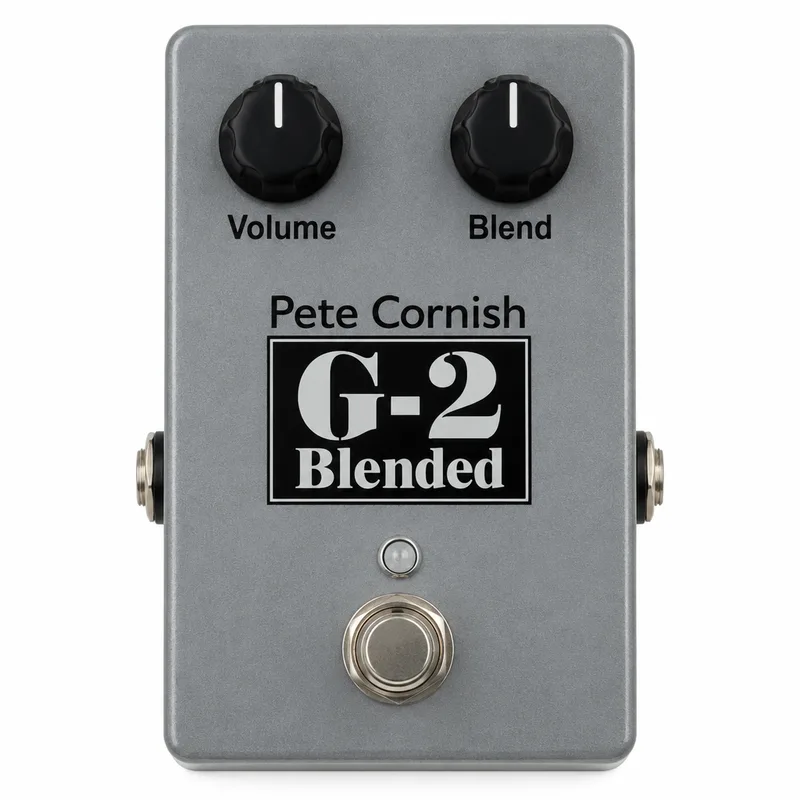
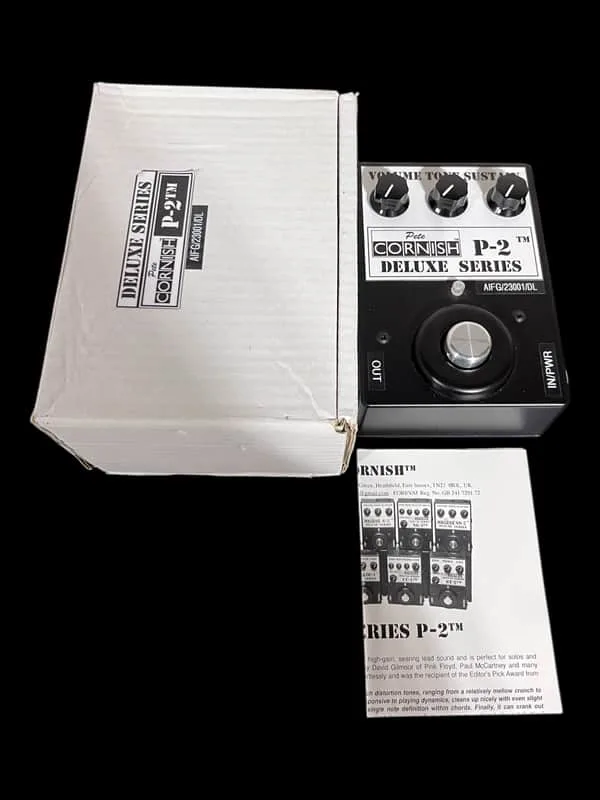
The G-2 sits in a Cornish lineup that includes the P-2, which Aion FX calls Pete Cornish's signature pedal7, and blended versions of the G-2 itself. The Pete Cornish G-2 Blended adds a blend control to the same basic distortion circuit, and shares the same 171 x 121 x 55 mm dimensions89.
The Unity Gain Buffer and bypass
The G-2 does not use true bypass. It has a "High Impedance RFI rejecting input and bypass buffer"4, and the Deluxe G-2's Unity Gain Buffer "also prevents 'Ghost Distortion' being audible in Bypass Mode"1. Ghost distortion is leakage from the distortion circuit that could otherwise bleed into your clean signal when the pedal is off; the buffer blocks it.
The buffer also serves the input. On the closely related DIY clone documentation for the same circuit, GuitarPCB describes a "High Impedance, Unity Gain, Buffer Preamp allowing the pickups to always operate at their optimum"10. For a player, this means the pedal presents a friendly load to passive pickups and keeps long cable runs from dulling the tone, whether the pedal is on or off.
Power and practical details
The Deluxe G-2 needs a clean, regulated supply. Pete Cornish specifies that "The adapter should be noise free, fully stabilised at 9V DC and capable of supplying 20mA," with a 5.5/2.1mm coax connector and a negative center pin1. The company recommends the Boss PSA series adapters (PSA-100/110/220 or 240, depending on local AC supply voltage)4.
| Specification | Value |
|---|---|
| Supply voltage | 9V DC, fully stabilised1 |
| Current requirement | 20mA1 |
| Connector | 5.5/2.1mm coax, center pin negative1 |
| Recommended adapter | Boss PSA series (PSA-100/110/220 or 240)4 |
| Dimensions | 171 x 121 x 55 mm (6.75 x 4.75 x 2.2 inches)1 |
| Battery | Battery drawer on the standard G-2, switched on when the IN/PWR jack is inserted; alkaline recommended4 |
The G-2's 5.5/2.1mm center negative connector matches the Boss standard, so most isolated pedalboard power supplies will run it. The standard G-2 also supports battery operation via a drawer, with the battery switched on when the IN/PWR jack is inserted; Pete Cornish recommends alkaline types4.
The build is aimed at professional stage use. The Deluxe G-2 is "Housed in a Rugged Die-cast box with lined control knobs," with a "Heavy Duty Custom made all-metal footswitch with large cap and protection ring plus Hi-Brite LED"1. Each unit is "hand built, wired and tested by Pete, Lynda and Mingus Cornish"1, and the company is a UK manufacturer3.
Its road-ready features include:
- Rugged die-cast housing with lined control knobs1
- Heavy duty custom made all-metal footswitch with large cap and protection ring1
- Hi-Brite LED for status indication1
- Hand built, wired and tested construction by Pete, Lynda and Mingus Cornish1
Videos
Simon Gotthelf Music
Simone Gianlorenzi
VJN Sound
Questions
What polarity does the Pete Cornish Deluxe G-2 use?
The Deluxe G-2 runs on a center negative power supply. The coax connector is 5.5/2.1mm and the centre pin is negative, so it matches the standard Boss-style 9V DC adapter wiring used by most pedalboard power supplies.
Does the Pete Cornish G-2 have a buffer?
Yes. The G-2 has a high impedance, RFI rejecting input and a bypass buffer. The Unity Gain Buffer at the input lets the pickups operate at their optimum and keeps the bypassed signal clean.
What does the Unity Gain Buffer do in bypass?
It prevents what Pete Cornish calls Ghost Distortion from being audible in bypass mode. Because the distortion circuit stays in the signal path behind the buffer, the buffer keeps any residual leakage from reaching your amp when the pedal is switched off.
How big is the Pete Cornish Deluxe G-2?
The Deluxe G-2 measures 171 x 121 x 55 mm, which is 6.75 x 4.75 x 2.2 inches. It is housed in a rugged die-cast box with lined control knobs, so it takes up a similar footprint to other full-size Cornish pedals.
Who builds Pete Cornish pedals?
Pete Cornish pedals are hand built in the UK. Each Deluxe G-2 unit is hand built, wired and tested by Pete, Lynda and Mingus Cornish, which is part of why the company's pedals carry their reputation for road-ready construction.
What power connector does the G-2 use?
It uses a 5.5/2.1mm coax connector with a negative centre pin, and needs a noise free, fully stabilised 9V DC adapter capable of supplying 20mA. Pete Cornish recommends the Boss PSA series adapters.
Sources (10)
- Pete Cornish Deluxe G-2, Pete Cornish, 2025
- G-2 by Pete Cornish, RockBoard PedalPedia, 2026
- Pete Cornish ST-2 EQ/Tone Shaping Pedal, Delicious Audio, 2017-10-10
- Pete Cornish G-2, Pete Cornish, 2025
- Tracing Journal: Cornish G-2 (two versions), Aion FX, 2024-08-02
- Big Muff Inspired Pedals and Clones, Kit Rae's Secret Guitar, Gear, and Music Page (kitrae.net), 2020
- Tracing Journal: Cornish P-2, Aion FX, 2023-10-06
- Pete Cornish G-2 Blended, Pete Cornish, 2016
- Pete Cornish Blended G-2, Pete Cornish, 2025
- BD_G-02-Animal-2021.pdf, GuitarPCB, 2021-05