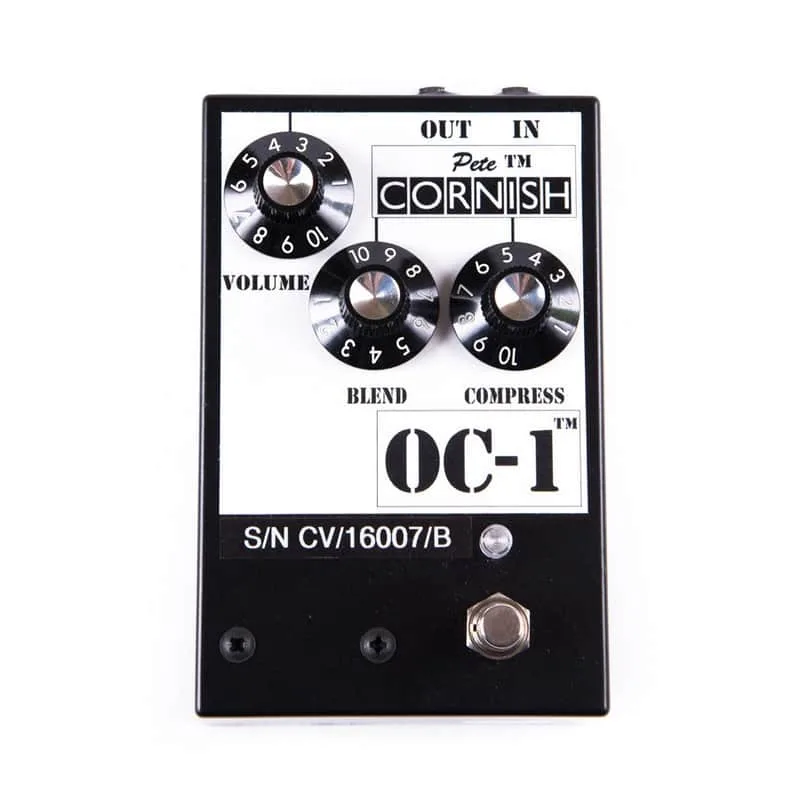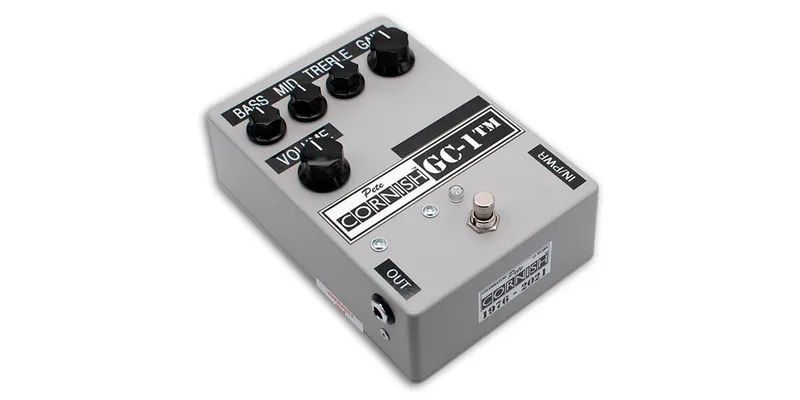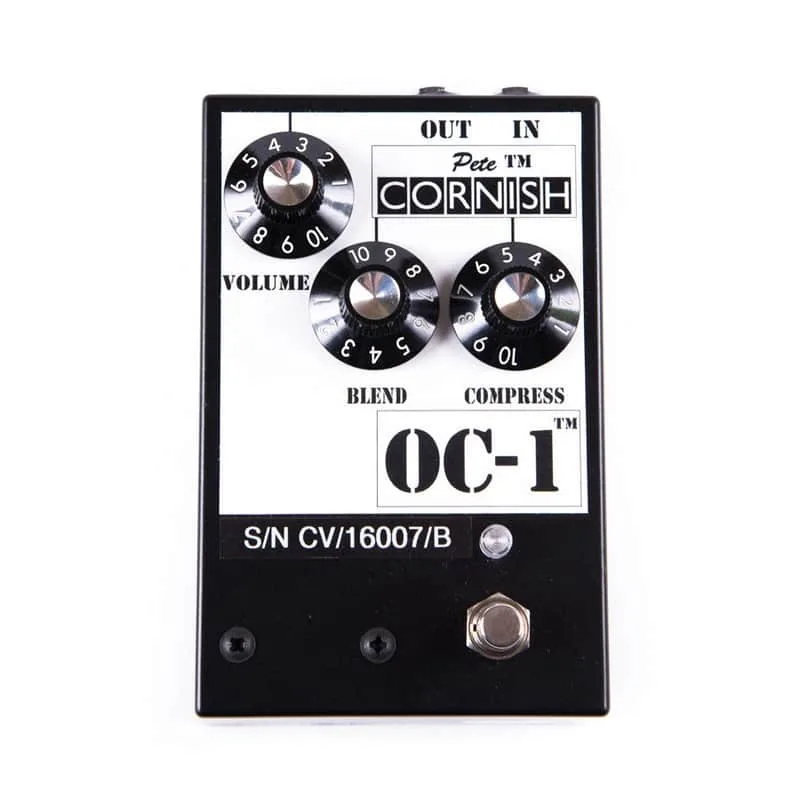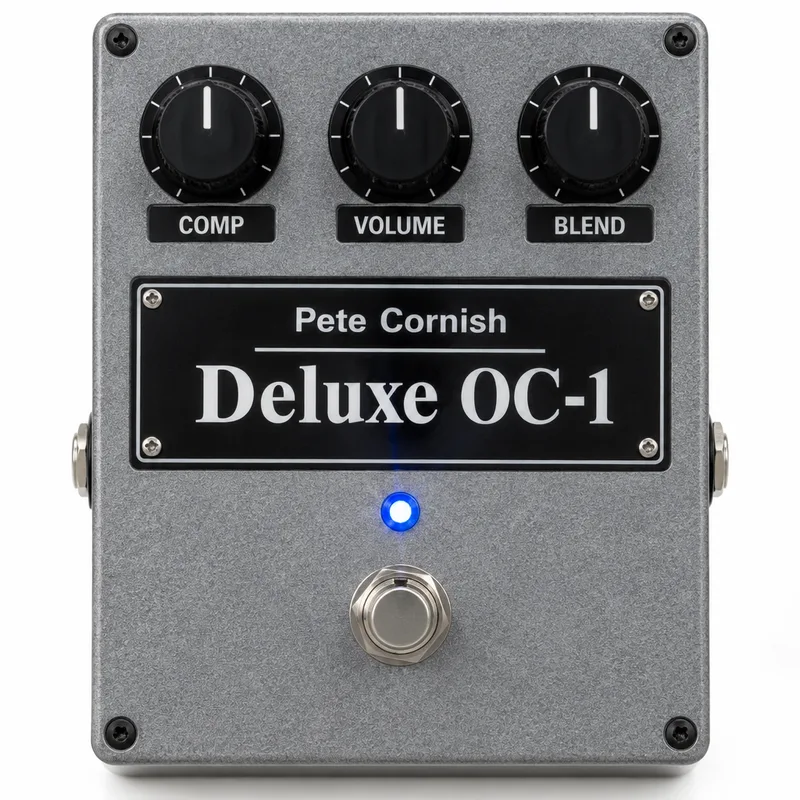


The Pete Cornish Deluxe OC-1 is an optical compressor pedal, and the maker's first optical compressor, described by Pete Cornish as "designed specifically for, but not limited to, Guitar"1. It is a Deluxe Series version of the original Pete Cornish OC-1, which is also housed in a rugged die-cast box21. The Deluxe OC-1 includes an RFI rejecting input and bypass buffer, and a heavy duty custom made all-metal footswitch with a large cap, protection ring and Hi-Brite LED1.
Like all compressor pedals, it evens out the volume differences between your loudest and quietest notes and adds sustain. What sets it apart is how it does that: a feed-forward optical circuit in which a light-controlled attenuator, driven by a six stage side chain, turns down the signal in proportion to what is coming in1.
An original feed-forward optical compressor
The OC-1 is a feed-forward design with a minimized two stage audio signal path: an input buffer and an output make-up gain stage, with a light controlled variable attenuator in between, driven by a six stage side chain1. In a feed-forward compressor, the control circuit reads the incoming signal rather than the compressed output, so the gain reduction reacts to what you play before it happens.
Independent circuit analysis by Aion FX, who traced the original OC-1 in 2019, fills in how the compression actually works. The signal passes through what they call "the classic Cornish buffer, and then a 3-way split into the compressed path, clean path for blending, and sidechain (peak detector)"3. The compression itself comes from a simple voltage-dividing attenuator formed by a resistor and the light-dependent resistor inside a vactrol: as the side chain current lights the vactrol's LED, the LDR's resistance drops and the signal is turned down. Aion FX notes that "this method of volume reduction is the same type used all the way back in the first optical compressors from the 1950s", the same family as the LA2A studio compressor3.
The side chain itself drew the analysts' attention: "The sidechain is designed to turn the audio signal into a control current to illuminate the LED in the vactrol. We've never seen this topology before"3.
"the X-rays were enough to tell us that the OC-1 was in fact an original design, not quite like anything else we'd seen before"
Pete Cornish states the same from the maker's side: the OC-1 is "a completely original design, not copied from any previous or current device", in common with the CC-1 introduced around the same time2. The maker also says the design ensures "no change to frequency response, no distortion and the absolute minimum of added noise"4.
The controls
The Deluxe OC-1 has three knobs: COMP, VOLUME and BLEND1.
| Control | What it does |
|---|---|
| COMP | Sets the amount of compression and sustain. Around 50% (12 o'clock) is the maker's starting point; higher settings give more sustain1 |
| VOLUME | Master volume of the whole output signal in compress mode, at the very end of the audio path. Used to match the bypass level1 |
| BLEND | Adds a controlled amount of the original, uncompressed signal to the output, so the original attack can be heard alongside long sustain at very high compression settings1 |
Aion FX's trace of the original OC-1 adds two practical notes on how the controls behave. The volume control is set up so that its minimum position is unity gain rather than zero, because it is an op-amp gain stage rather than a traditional volume pot at the end of the circuit3. And the volume and blend controls are somewhat interactive: "the volume may need to be backed off when blended signal is added to maintain constant level"3.
The pedal has two modes, bypass and compress, selected by a heavy duty custom made all-metal footswitch with a large cap, protection ring and Hi-Brite LED. At minimum settings it creates no compression and no output boost, so it can sit in a chain without changing your level1. The maker also fits an RFI rejecting input and bypass buffer, which guards against radio frequency interference picked up by long cable runs1.
Power and connections
Setup is straightforward: guitar into the INPUT jack, and the OUTPUT jack to your amp input, both with screened cable1. Inserting a plug into the IN/PWR ON jack switches the internal battery on1.
For external power the pedal needs a 9V DC supply, noise free and fully stabilised, with a 5.5/2.1mm coax connector and a negative center pin. The pedal draws 20mA1.
The Deluxe OC-1 takes an internal 9V battery (preferred type MN1604) in addition to the DC input, with replacement through a removable drawer. The original OC-1 page makes no mention of a battery and lists only the 9V DC input, so battery power is a feature of the Deluxe version12.
Design and release
The Deluxe OC-1 is the current Deluxe Series version of the Pete Cornish OC-1, an optical compressor from the same maker. Both pedals are housed in rugged die-cast boxes, with the Deluxe version adding lined control knobs1. The original OC-1 was also built in a rugged die-cast box2. Each Deluxe OC-1 unit is hand built, wired and tested by Pete, Lynda and Mingus Cornish1.
The warranty on the Deluxe OC-1 runs twelve months from the date of purchase, covering original manufacturing faults, with repairs carried out post paid to the maker. Normal wear, misuse, unauthorised modifications and accidental damage are excluded, the warranty is voided if the guarantee labels are damaged or removed, and it does not cover the customer's own connected equipment1. The original OC-1 carried a two year warranty on the same terms, so the coverage period differs between the two versions2.
Videos
Simon Gotthelf Music
shnobel
CR Guitars
Questions
Does the Pete Cornish OC-1 take a battery?
Yes. The Deluxe OC-1 takes a 9V battery, with MN1604 the preferred type. The battery is switched on when a plug is inserted into the IN/PWR ON jack, and it is replaced through a removable drawer in the enclosure. The pedal can also be powered from an external 9V DC supply.
What power supply does the OC-1 need?
A 9V DC supply, noise free and fully stabilised, with a 5.5/2.1mm coax connector and a negative centre pin. The pedal draws 20mA. Any adapter used should meet those ratings, since the maker specifies a stabilised supply rather than an unregulated one.
Is the OC-1 a copy of an existing compressor?
No. Pete Cornish describes the OC-1 as a completely original design, not copied from any previous or current device. Independent circuit analysis by Aion FX reached the same conclusion, finding the OC-1 to be an original design not quite like anything they had traced before.
What does the Blend control do on the OC-1?
BLEND adds a controlled amount of the original, uncompressed signal back into the output. At very high compression settings this lets the original attack of each note be heard alongside the long sustain, rather than being smoothed away by heavy compression.
How big is the Pete Cornish OC-1?
The Deluxe OC-1 measures 171 x 121 x 55 mm, or 6.75 x 4.75 x 2.2 inches. It is housed in a rugged die-cast box with lined control knobs, so it is a fairly large pedal by compact-pedal standards and takes up a corresponding amount of board space.
What warranty does the OC-1 come with?
The Deluxe OC-1 carries a twelve month warranty from the date of purchase covering original manufacturing faults, with repairs carried out post paid to the maker. Normal wear, misuse, unauthorised modifications and accidental damage are excluded, and the warranty is voided if the guarantee labels are damaged or removed.
Sources (4)
- Pete Cornish Deluxe OC-1, Pete Cornish, 2025
- Pete Cornish OC-1, Pete Cornish, 2025
- Tracing Journal: Cornish OC-1 Optical Compressor, with X-rays!, Aion FX (aionfx.com), 2019-11-15
- Pete Cornish OC-1, Pete Cornish, 2014