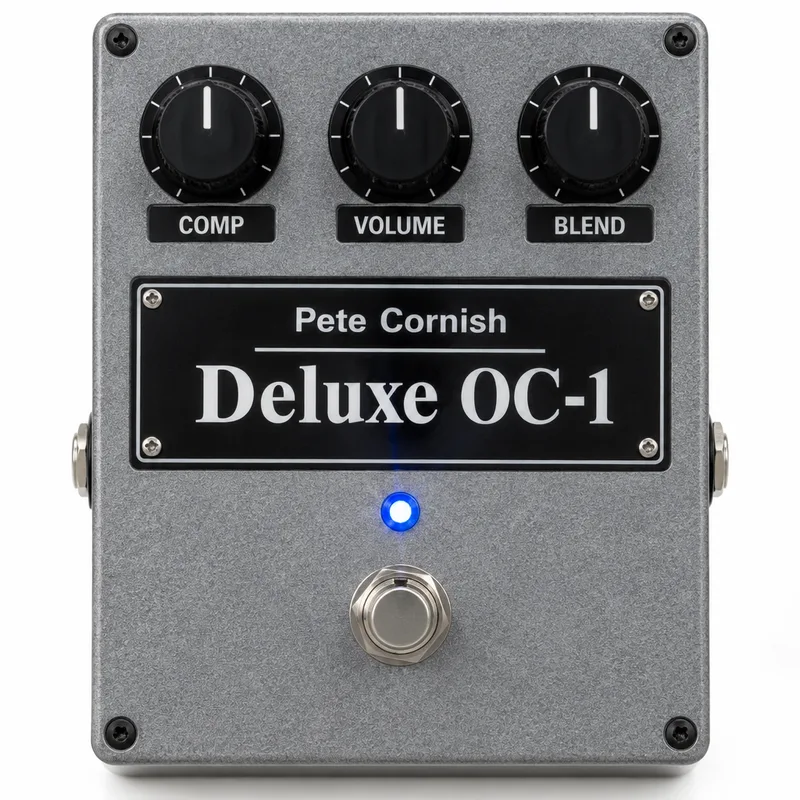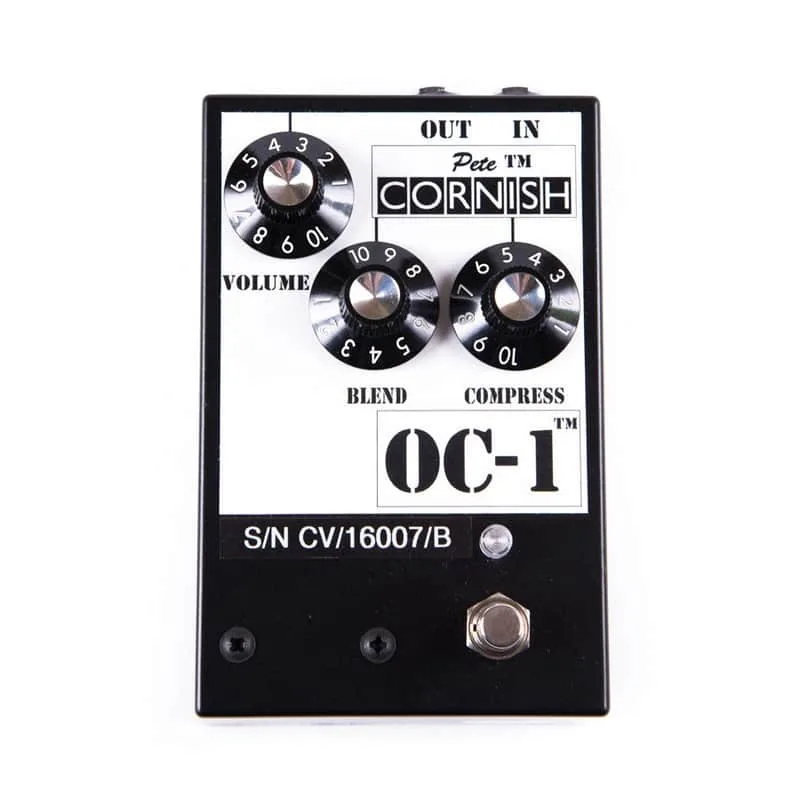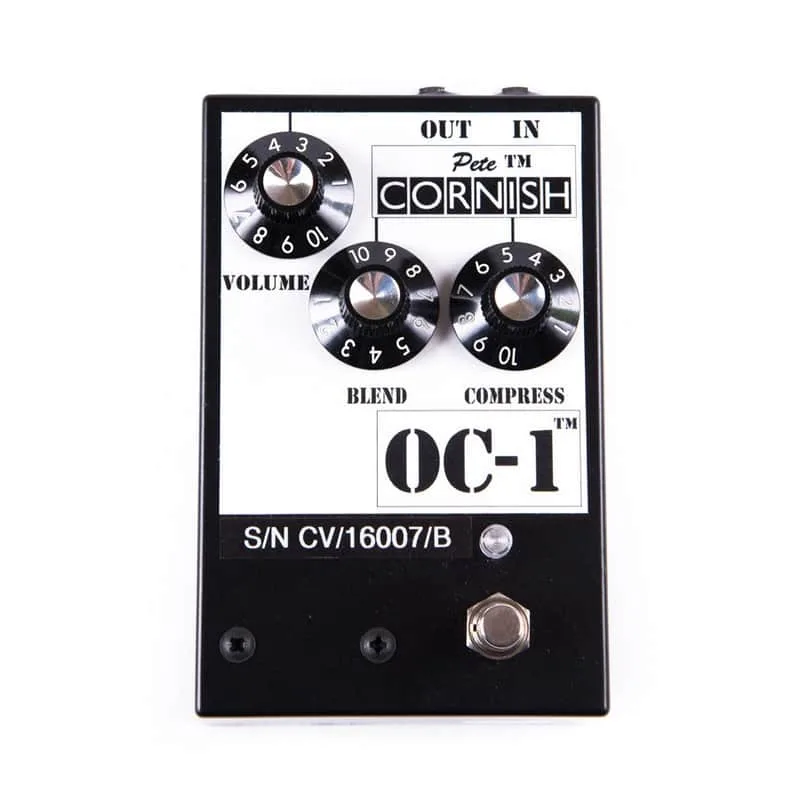


The maker's core claim for the pedal is transparency: no change to frequency response, no distortion, and the absolute minimum of added noise1. It carries three controls, Comp, Volume and Blend, and runs on a 9V DC supply.
How the OC-1 compresses
The OC-1 is a feed-forward design with what the maker calls a minimized two-stage audio signal path: an input buffer and an output make-up gain stage, with a light-controlled variable attenuator driven by the side chain2. In an independent circuit trace published in 2019, Aion FX found the classic Cornish buffer followed by a three-way split into the compressed path, a clean path for blending, and a sidechain peak detector4.
Aion FX's trace describes the compression itself as a simple voltage-dividing attenuator, formed by a resistor and the LDR (light-dependent resistor) portion of a vactrol, essentially a dynamically operated volume reduction4. They note that this method of volume reduction is the same type used in the first optical compressors of the 1950s, such as the LA2A4. The sidechain turns the audio signal into a control current that illuminates the LED in the vactrol, a topology Aion FX reported they had not seen before4.
"The sidechain is designed to turn the audio signal into a control current to illuminate the LED in the vactrol. We’ve never seen this topology before, but if someone recognizes it from an application note or textbook someplace, please let us know so we can add the reference and better explain what is going on."
The controls: Comp, Volume and Blend
| Control | What it does |
|---|---|
| Comp | Sets the amount of compression. Increasing it decreases output volume and increases sustain; about 50% (12 o'clock) is the maker's suggested starting point. At minimum there is no compression or output boost.2 |
| Volume | Master volume of the whole output signal in compress mode, at the very end of the audio signal path. Used to match the bypass level.1 |
| Blend | Adds a small percentage of the original, uncompressed signal to the output. Useful at very high compression settings so the original attack can still be heard alongside the long sustain.1 |
Aion FX's trace adds two practical notes on how the controls interact. The volume and blend controls are somewhat interactive, so the volume may need to be backed off when blended signal is added to keep a constant level. And the volume control's minimum position is unity rather than zero volume, because it is an op-amp gain stage rather than a traditional volume knob at the end of the circuit4.
Power and connections
The OC-1 has no battery input; it is powered through an input for a 9V DC supply2. The adapter should be noise free and fully stabilized at 9V DC, capable of supplying 20mA. The coax connector is 5.5/2.1mm with the center pin negative2.
Connections are straightforward: guitar to the OC-1 INPUT using screened cable, and the OC-1 OUTPUT to your amp input using screened cable2.
The later Deluxe OC-1 differs on power: it takes a 9V battery (preferred type MN1604), switched on when a plug is inserted into the IN/PWR ON jack and replaced through a removable drawer5.
An original design from Pete Cornish
Pete Cornish describes the OC-1 as a completely original design, not copied from any previous or current device, and notes it was introduced in common with the recently introduced CC-1, a compressor with active three-band EQ2. Aion FX's independent trace backed the claim: their X-ray examination of the circuit, which was covered in thick epoxy, was enough to tell them the OC-1 was in fact an original design, not quite like anything else they had seen4.
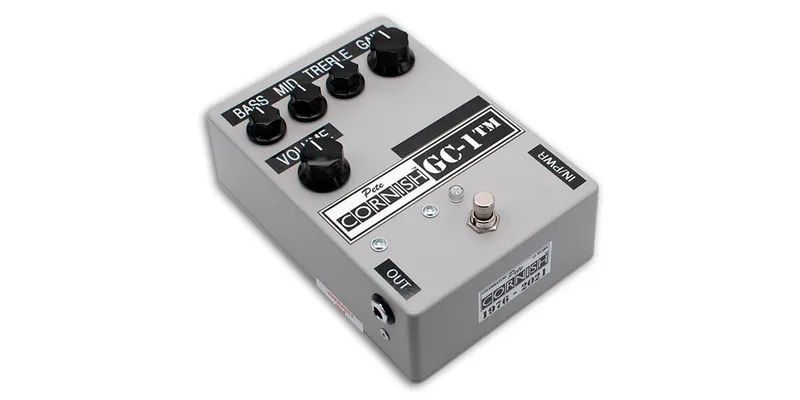
The OC-1's own approach differs from the CC-1's: where the CC-1 offers active Bass, Middle and Treble bands that are completely independent, the OC-1 has no tone controls at all, consistent with the maker's claim of no change to frequency response61.
Each unit is hand built, wired and tested by Pete, Lynda and Mingus Cornish2. The pedal carries a two-year warranty from date of purchase covering original manufacturing faults, with normal wear, misuse, unauthorized modifications and accidental damage excepted; the warranty is voided if the guarantee labels are damaged or removed, and it is not transferable2.
Videos
gigisca
Simon Gotthelf Music
shnobel
Sources (6)
- Pete Cornish OC-1, Pete Cornish, 2014
- Pete Cornish OC-1, Pete Cornish, 2025
- Grey Series Effects Pedals, petecornish.co.uk, 2026-03-31
- Tracing Journal: Cornish OC-1 Optical Compressor, with X-rays!, Aion FX (aionfx.com), 2019-11-15
- Pete Cornish Deluxe OC-1, Pete Cornish, 2025
- Pete Cornish CC-1, Pete Cornish, 2025