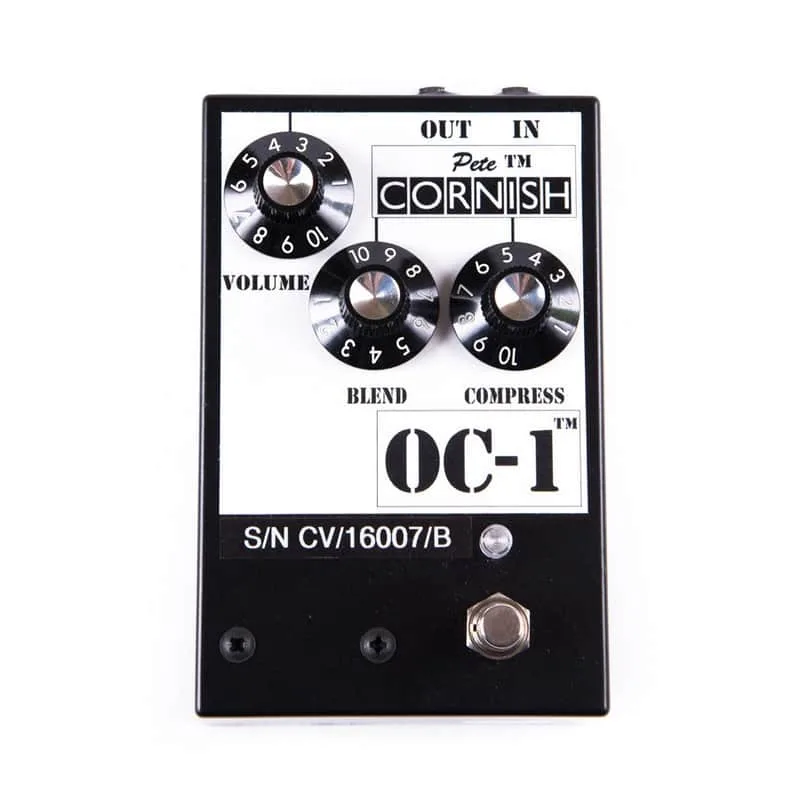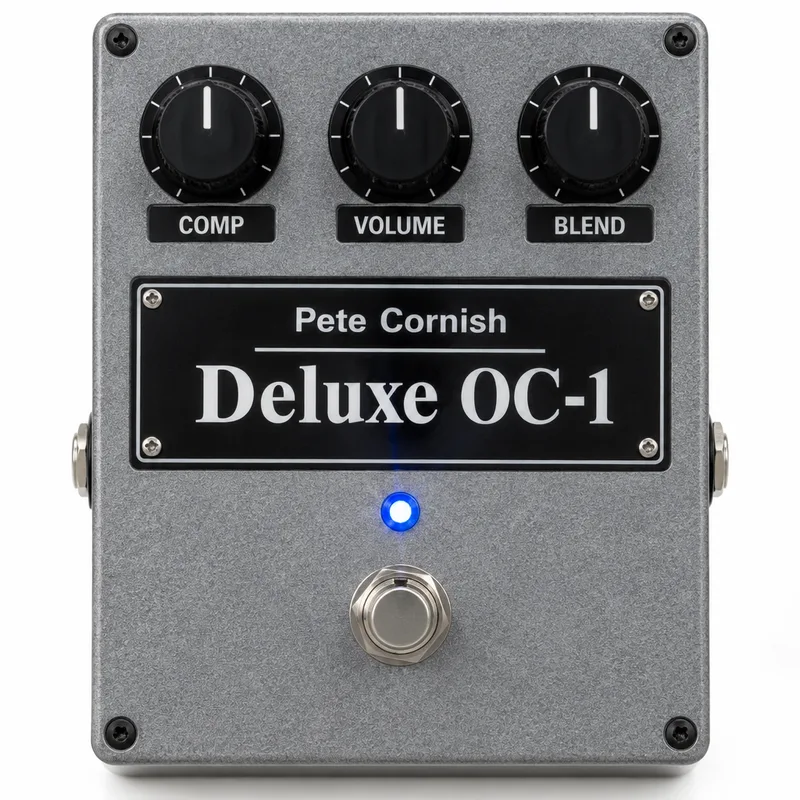


The Pete Cornish OC-1 is an optical compressor pedal introduced by the Pete Cornish Partnership in 2014, the maker's first optical compressor after what the company described as many years of development12. It is a feed-forward design with a deliberately short two-stage audio path: an input buffer and an output make-up gain stage, with a light-controlled variable attenuator driven by a sidechain1. Pete Cornish says the design goal was a compressor that produces no change to frequency response, no distortion and the absolute minimum of added noise2.
The pedal is aimed at guitar players specifically, though the maker notes it is not limited to guitar1. Aion FX, which traced the circuit in 2019, describes Cornish pedals as best known for being extremely expensive3.
An optical compressor with a clean blend
The OC-1's compression comes from an optical element called a vactrol, a package containing an LED and a light-dependent resistor. Aion FX's trace found the circuit begins with the classic Cornish buffer, followed by a three-way split into a compressed path, a clean blend path and a sidechain peak detector4.
The sidechain's job is to turn the audio signal into a control current that illuminates the LED in the vactrol. Aion FX noted that this sidechain topology was one they had not seen before in any other circuit4. The compression itself happens through a simple voltage-dividing attenuator, formed by a fixed resistor (R13) and the light-dependent resistor inside the vactrol. In effect, it is a dynamically operated volume reduction: the louder the input signal, the more the LED lights, the lower the LDR's resistance, and the more the signal is attenuated4.
"This method of volume reduction is the same type used all the way back in the first optical compressors from the 1950s such as the LA2A."
So while the OC-1 is an original design, its core compression method has a long lineage, going back to the first optical compressors of the 1950s, such as the LA2A4.
The clean blend
What sets the OC-1 apart from a basic optical compressor is its clean blend path. Pete Cornish describes the BLEND control as allowing a small percentage of the original, uncompressed signal to be added to the output, which is useful at very high compression settings, where the original attack of each note can still be heard alongside the long sustain2. The Deluxe OC-1's page makes the same point: a controlled amount of the original attack can still be heard together with the long sustain at very high compression settings5.
Aion FX's trace adds a detail players will want to know: the blend is not a balance control. It does not go from full clean at one end to full effect at the other. Instead, the clean blend path gradually combines the clean signal with the compressed signal as you turn it up4.
The controls and how they interact
The OC-1 has three controls: COMP, VOLUME and BLEND. The table below summarizes what each does, based on the maker's own descriptions.
| Control | What it does |
|---|---|
| COMP | Sets the amount of compression. Increasing it decreases output volume and increases sustain. Pete Cornish suggests approximately 50% (12 o'clock) as a starting point12. |
| VOLUME | Master volume of the whole output signal in compress mode, placed at the very end of the audio path. Used to match the bypass level2. |
| BLEND | Adds a small percentage of the original, uncompressed signal to the output, useful at high compression settings so the original attack remains audible2. |
The maker's suggested starting procedure is simple:
- Set COMP, VOLUME and BLEND to minimum, at which point the pedal creates no compression or output boost1.
- Increase COMP to approximately 50% (12 o'clock) while playing, and note the decrease in output volume alongside the increase in sustain12.
- Use VOLUME at the end of the signal path to match the bypass level2.
- Add BLEND if you want more of the original attack back in the mix2.
One interaction is worth knowing before you dial it in. Aion FX found that the volume and blend controls are somewhat interactive with each other, and the volume may need to be backed off when blended signal is added, to maintain a constant level4.
Bypass and buffering
The OC-1 is not true bypass. Aion FX's trace found the classic Cornish buffer in the audio path, meaning the pedal operates as a buffered bypass4. Pete Cornish states that with all controls at minimum, the pedal creates no compression or output boost, so the bypass mode sits at unity level1. The pedal also includes an RFI rejecting input and bypass buffer, a feature shared with other Cornish pedals such as the CC-1, which the maker describes as having a high impedance RFI rejecting input and bypass buffer5.
Original design, hidden circuit
Pete Cornish describes the OC-1 as a completely original design, not copied from any previous or current device, and notes that it shares this original design approach with the CC-1, a compressor the company had recently introduced at the time12. Aion FX's independent trace reached the same conclusion, stating that the OC-1 was in fact an original design, not quite like anything else they had seen before4.
The reason the circuit could not simply be inspected is that it is covered in thick epoxy. Aion FX described the goop as hard as a rock, so they traced the circuit using X-rays instead4. Those X-rays were enough to confirm the originality of the design4.
The OC-1 and the Deluxe OC-1
The Pete Cornish Deluxe OC-1 is a later version of the same optical compressor concept. It is housed in a rugged die-cast box with lined control knobs, and its power uses a coax connector of size 5.5/2.1mm5. Both pedals carry the same core control set (COMP, VOLUME and BLEND) and the same description as completely original designs, not copied from any previous or current device21. The Deluxe OC-1's page also describes it as the maker's first optical compressor, designed specifically for, but not limited to, guitar5.
Videos
gigisca
Simon Gotthelf Music
shnobel
Questions
Is the Pete Cornish OC-1 based on another compressor?
No. Pete Cornish describes the OC-1 as a completely original design, not copied from any previous or current device, and notes it shares its original design approach with the CC-1. Aion FX's circuit trace independently concluded it was an original design, not quite like anything else they had seen before.
How does the vactrol work in the OC-1?
A sidechain circuit turns the audio signal into a control current that lights an LED inside a vactrol. The LED shines on a light-dependent resistor, and that resistor forms a voltage-dividing attenuator with a fixed resistor, reducing volume dynamically. This is the same volume-reduction method used by the first optical compressors of the 1950s, such as the LA2A.
Is the OC-1 true bypass?
No. The OC-1 uses a buffered bypass built around the classic Cornish buffer, which sits in the audio path. Pete Cornish states that minimum settings create no compression or output boost, so the bypass mode operates at unity level, and the pedal includes an RFI rejecting input and bypass buffer.
Is the blend control on the OC-1 a balance control?
No. According to Aion FX's trace, the clean blend path gradually combines the clean signal with the compressed signal as you turn it up. It is not a balance control with full clean at one end and full effect at the other. Pete Cornish describes it as adding a small percentage of the original uncompressed signal to the output.
Why can't the OC-1 circuit be seen inside?
The circuit is covered in thick epoxy that Aion FX described as hard as a rock, so the components cannot be inspected directly. Aion FX traced the circuit using X-rays, which showed the design was original rather than a copy of an existing circuit.
What is the difference between the OC-1 and the Deluxe OC-1?
The Deluxe OC-1 is a later version of the same optical compressor concept, housed in a rugged die-cast box with lined control knobs and fitted with a 5.5/2.1mm coax power connector. Both share the same core controls, including COMP, VOLUME and BLEND, and both are described by Pete Cornish as completely original designs.
Sources (5)
- Pete Cornish OC-1, Pete Cornish, 2025
- Pete Cornish OC-1, Pete Cornish, 2014
- Oceanid Optical Compressor / Cornish OC-1, Aion FX, 2019-11-15
- Tracing Journal: Cornish OC-1 Optical Compressor, with X-rays!, Aion FX (aionfx.com), 2019-11-15
- Pete Cornish Deluxe OC-1, Pete Cornish, 2025