

The Pigtronix Infinity 2 is a stereo double looper pedal from Pigtronix, announced in January 2020 as the second version of the company's Infinity looper. It carries two independent stereo loops, each holding up to five minutes, built around what Pigtronix describes as the high-fidelity audio and ultra-low-latency looping engine of the original Infinity Looper, in a smaller and simpler box123.
The idea behind the pedal is what Pigtronix calls a verse/chorus workflow: you record one part on one loop, another on the second, and shuttle between them at the click of a footswitch, even mid-recording or while overdubbing14. It shipped to dealers worldwide at a MAP price of $199 USD5.
Two loops for verse and chorus
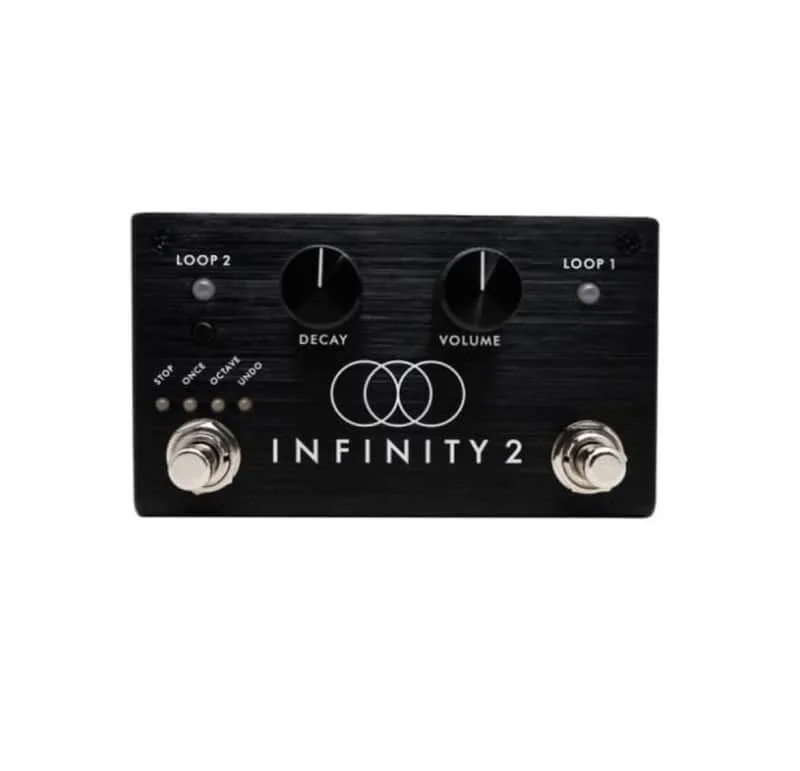
The core of the Infinity 2 is its pair of independent stereo loops, with one footswitch per loop: the switch nearest the volume knob handles loop one, the other handles loop two26. Pigtronix says the pedal lets you switch between loops seamlessly, even during initial recording or while overdubbing, which is what makes the verse/chorus setup practical for live use1. Sweetwater's Don Carr describes it as "two independent stereo loops for a verse/chorus workflow"6.
Beyond the basic double-looper setup, the pedal can run as a standard looper on the right footswitch while the left footswitch takes one of five selectable modes1. It can also be configured for wet/dry routing, where output 1 is a dry pass-through and all loop material goes to output 26. Guitar.com's news coverage also noted 24-bit/44kHz USB recording among its features3.
The controls
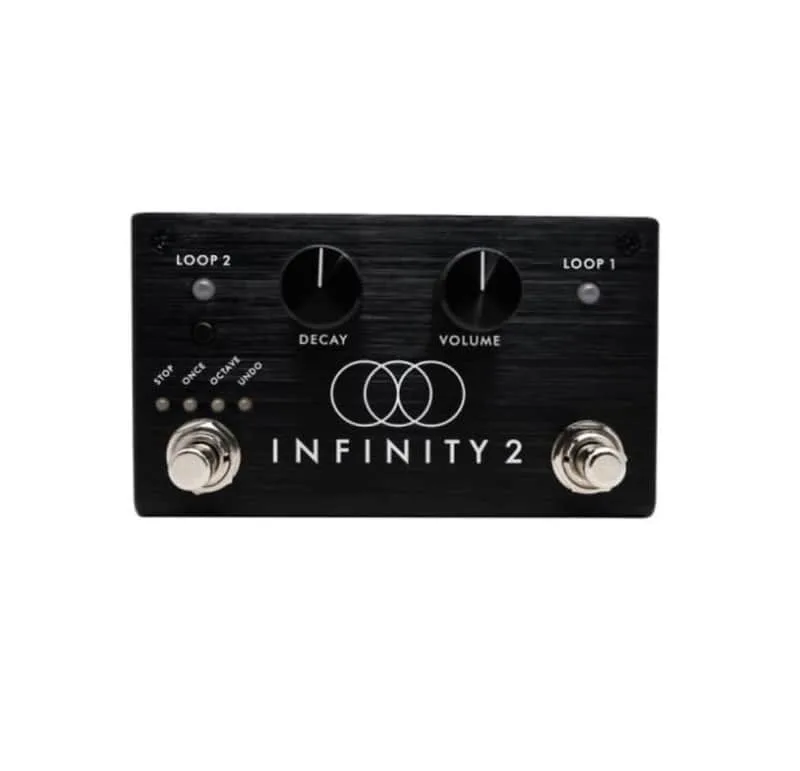
The panel is deliberately sparse: two footswitches, two knobs (Volume and Decay), and a soft-touch mode button26. The mode button opens up the other functions of the Loop 2 footswitch when you are only using Loop 1, giving access to Undo, Stop, Once and Octave modes7.
| Control | What it does |
|---|---|
| Volume knob | Sets the volume of looped audio1 |
| Decay knob | Sets the time it takes for loops to fade away during overdub1 |
| Mode button | Selects the mode assigned to the left footswitch: Undo, Stop, Once or Octave17 |
| Loop 1 footswitch | Records, plays and overdubs loop one6 |
| Loop 2 footswitch | Records, plays and overdubs loop two, or operates the selected mode67 |
The Decay knob is where the pedal gets deeper than its face suggests. Fully clockwise, loops play back continuously; fully counterclockwise, each overdub lasts only one cycle; in between, overdubbing creates constantly evolving loop textures that can be snapped back to a previous state with the Undo function68. The assignable modes work like this17:
- Undo: removes the most recent overdub layer; tap again to bring it back.
- Stop: press once to stop at the loop boundary, twice to stop immediately, press and hold to fade.
- Once: press once for one more playback, repeatedly for a stutter effect, press and hold to play through.
- Octave: toggles the sample rate between 48kHz and 24kHz, slowing the loop by an octave.
The footswitch status lights tell you the pedal's state at a glance6:
- Off: no audio recorded
- Red: recording; green: playback; orange: overdubbing
- Blinking red, green or orange: that action will start at the loop boundary
- Slow blinking green: loop is stopped and audio is present
Power and connections
The Infinity 2 runs on 9VDC at 100mA draw1. It has two separate inputs and two separate outputs that accept mono or stereo signals at instrument or line level, with stereo outputs and a high input impedance12. There is also a TRS remote expression input1.
The bypass is buffered, not true bypass1, so the pedal's buffer stays in your signal chain. At 100mA it also draws more than a basic analog pedal, which is worth knowing when planning a power supply.
An optional two-button footswitch from Pigtronix gives access to octave, once and stop modes6, and third-party makers such as American Loopers sell single-button aux switches for the stop function9.
From the original Infinity Looper
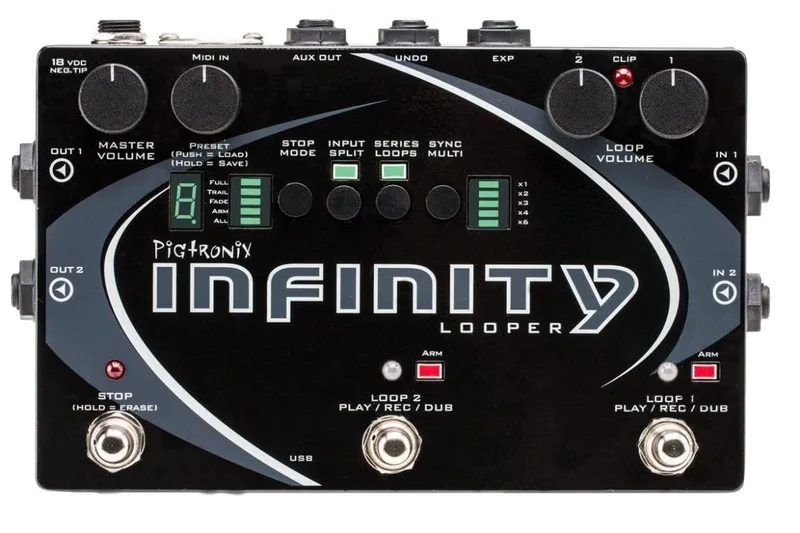
The Infinity 2 descends from the original Pigtronix Infinity Looper, which offered two stereo loops that could be configured to work together in several ways, with zero latency, and which received a 2.0 firmware update bringing significant upgrades101112. The Infinity 2 simplified the existing user interface, smartened up the graphics and squeezed the ultra-low-latency looping engine into a compact stompbox36.
The original Infinity Looper also offered a Loop 2 multiplier with settings of x1, x2, x3, x4 and x6, setting Loop 2's length as a multiple of Loop 113. The Infinity 2 carries the same looping engine forward in a smaller box, and Pigtronix later moved the Infinity line on again with further versions in the series61.
What reviewers said
Reviewers found the Infinity 2 deceptively deep but still easy to use, praising its overall ease of use and depth6. Guitar Player listed it at $199 street14, and the reviewer found that as a standard looper plus assignable effects it becomes an ambient dream machine141.
"With its dual outputs, instant switching and intuitive layout, the Pigtronix Infinity 2 is an incredible tool for songwriters"14
In Sweetwater's demo video, Don Carr walked through the pedal's layout, the status lights, the decay behavior and the octave mode, concluding:
"this pedal is deceptively deep but still easy to use"6
Videos
Pete Thorn
Pigtronix
News
Questions
Does the Pigtronix Infinity 2 have MIDI sync?
No. MIDI sync is not part of the Infinity 2's feature set, a point readers raised when it was announced because the original Infinity Looper could sync over MIDI. Players who need MIDI syncing are served by the later Pigtronix Infinity 3, which is MIDI-compatible.
How long can each loop on the Infinity 2 be?
Each of the two independent loops holds up to five minutes of stereo audio. The pedal records at 24-bit resolution, sampling at 48kHz in normal mode and 24kHz in octave mode.
What does the octave mode do on the Infinity 2?
Octave mode drops the sample rate from 48kHz to 24kHz, which slows a recorded loop down by an octave and gives half-speed playback. Guitar.com's reviewer describes using it to record a loop, slow it down by an octave, and play a lead line over the top.
Is the Pigtronix Infinity 2 true bypass?
No. Pigtronix lists the bypass as buffered, so the pedal's buffering is always in the signal path when it is on your board rather than switching to a true-bypass hardwire.
What is the difference between the Infinity 2 and Infinity 3?
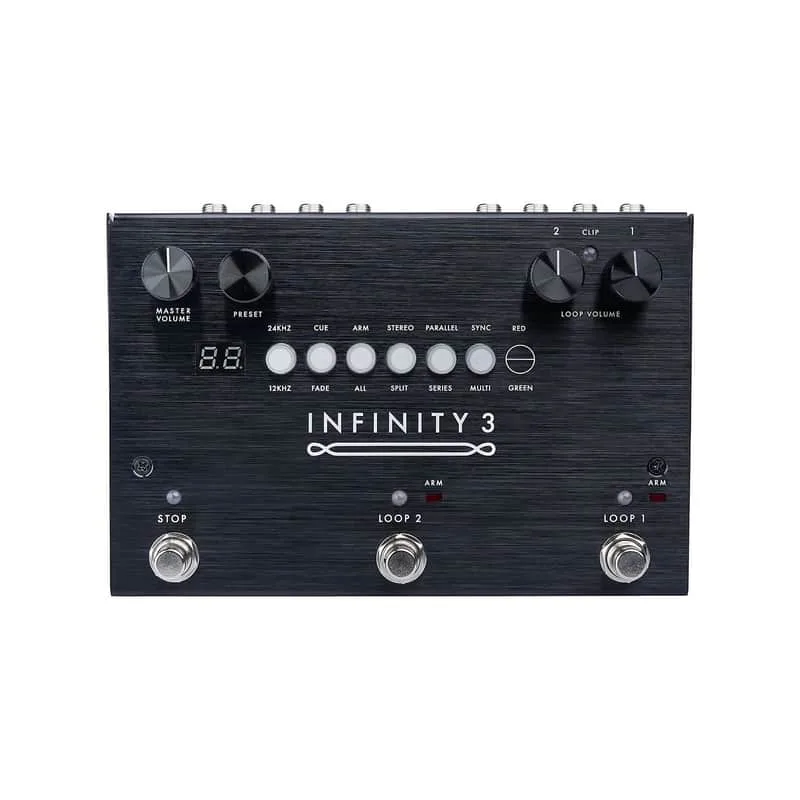
The Infinity 3, released in June 2021 at $419, superseded the Infinity 2. It is MIDI-compatible, offers up to three hours of looping time against the Infinity 2's two five-minute loops, and shipped alongside a three-footswitch Universal Remote. The Infinity 2 remains the simpler, cheaper option.
Can the Infinity 2 use an external footswitch?
Yes. Pigtronix offers an optional two-button footswitch that gives access to octave, once and stop modes, and the pedal has a TRS remote expression input. Third-party makers such as American Loopers also sell single-button aux switches for the stop function.
Sources (14)
- Infinity 2, Pigtronix, 2026-09-02
- NAMM 2020: Switch between parts with the Pigtronix Infinity 2 Double Looper, MusicRadar, 2020-01-18
- NAMM 2020 Video: Pigtronix talks us through the Infinity 2, a streamlined yet powerful stereo looper, Guitar.com, 2020-01-16
- Pigtronix Infinity 2: A new elegant double loop station pedal, gearnews.com, 2020-01-20
- Pigtronix unveils the Infinity 2 Double Looper, MusicPlayers.com, 2020-01-14
- Pigtronix Infinity 2 Looper Pedal Demo, Sweetwater, 2020-02-04
- Review: Pigtronix Infinity 2, Guitar.com, 2020-05-19
- Pigtronix Infinity 2 Double Looper, Delicious Audio, 2021-03-08
- 1 Button Aux External Switch for the Pigtronix Infinity Loop 2, American Loopers
- Pigtronix Infinity Looper review, MusicRadar, 2013-05-07
- Pigtronix Infinity Looper Pedal Review, Premier Guitar, 2013-01-09
- Pigtronix Releases Infinity Looper 2.0 Firmware and Web Site, Guitar Interactive Magazine, 2015-07-02
- Guitar Pedal Reviews: Pigtronix Infinity Looper, Delicious Audio, 2013-07-19
- Pigtronix Infinity 2 Double Looper Review, GuitarPlayer, 2020-08-19