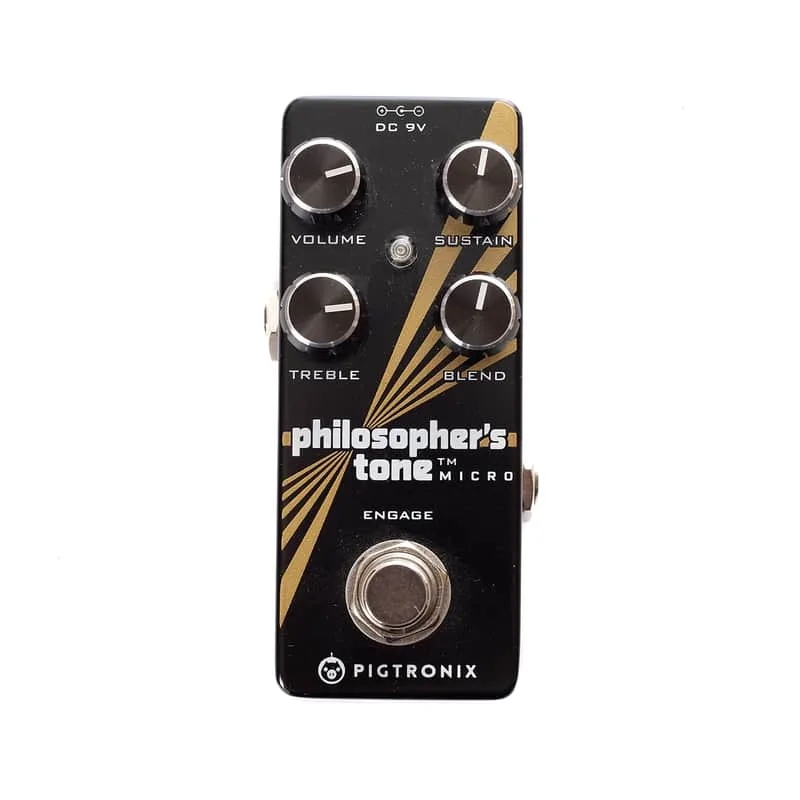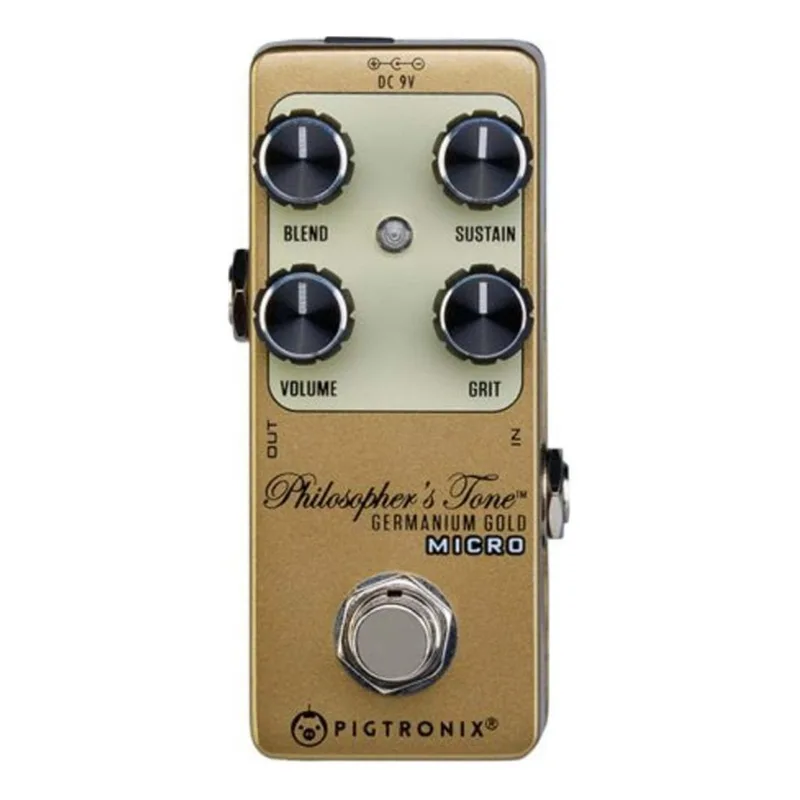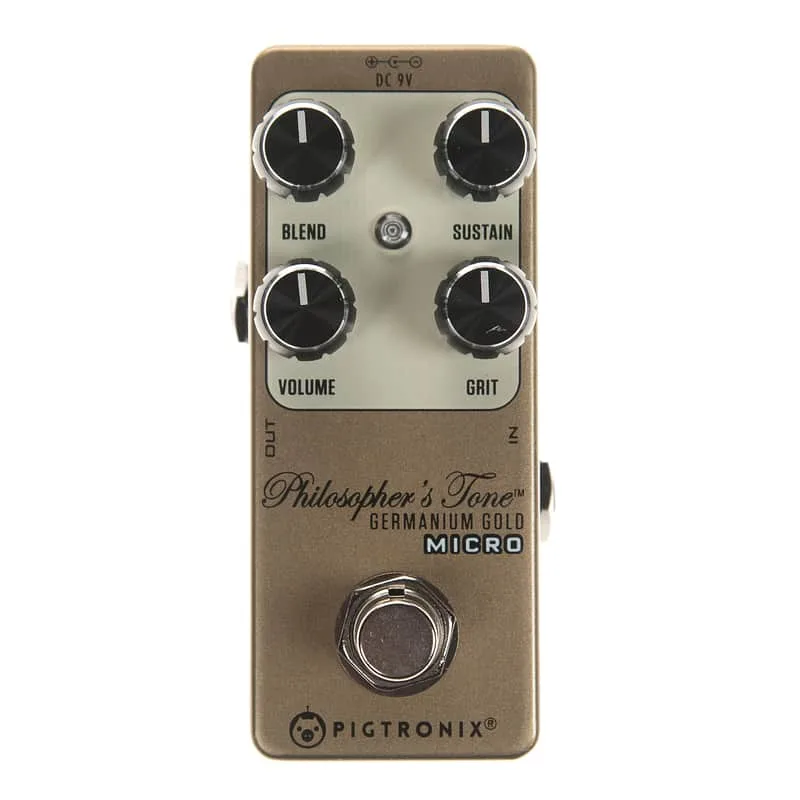


The Pigtronix Philosopher's Tone Germanium Gold Micro is a micro-sized compressor pedal that puts the optical sustain engine of the original Philosopher's Tone into a small enclosure, then adds a germanium-diode distortion stage on top. Pigtronix announced it in June 2018 as a micro version of the limited-edition Germanium Gold, available at a $134 list price1, and Premier Guitar reported it shipping at all Pigtronix retailers worldwide that April2.
The idea is two effects in one box. The clean side is the same photo-optical compression circuit as the original Philosopher's Tone, while the Grit knob is coupled to germanium diode circuitry that adds drive to the compressed signal. Pigtronix describes the distortion side as having "a smooth top-end and rich midrange response"3. At 92 x 44 x 46mm it is small enough to fit on most pedalboards4.
What it does: optical compression with germanium grit
The pedal's compression comes from Pigtronix's original photo-optical circuit, the same "optical sustain engine at its heart" as the standard Philosopher's Tone6. Optical compressors read the signal with a light element and control gain with a light-dependent resistor, which is the same basic approach as classic studio opto compressors. Guitar.com's news coverage confirmed that the clean side of the Germanium Gold Micro "remains identical to Pigtronix's original Philosopher's Tone"6.
The twist is the grit. Where a plain compressor leaves the compressed signal clean, the Grit knob here feeds it through germanium clipping diodes. Gearnews described the result as "a dash of nice usable distortion" layered on top of the optical compression circuit1. Pigtronix says the germanium distortion has "a smooth top end and rich midrange response"1.
MusicRadar's reviewer, Trevor Curwen, found the combination works as a boost as well as a compressor, noting "there's plenty of extra whoomph in this pedal from above 2 o'clock on the volume knob to give the front end of your amp" a push7.
The controls
Four knobs sit on the small enclosure: Volume, Blend, Sustain and Grit1.
| Control | What it does |
|---|---|
| Volume | Sets output level; above 2 o'clock it gives extra boost into the front end of your amp7 |
| Blend | Mixes dry and compressed sound, so you can keep some untouched signal in the output7 |
| Sustain | Sets the amount of compression7 |
| Grit | Adds gritty drive to the compressed portion of the sound, from a raw edge to full amp-like raunch7 |
Volume and Sustain behave like the controls on any compressor, while Blend and Grit are what set the pedal apart from a basic squeeze box. Because Grit only affects the compressed portion of the signal, blending in dry sound changes both the compression character and how much of the germanium drive you hear17.
Power: 9V only, internal 18V circuit
There is no battery. The pedal runs only off an external 9V power supply, and the supply is not included in the price14.
Inside, the circuit runs at 18V. Gearnews noted the Germanium Gold Micro "has an internal 18V circuit, which in theory should give you a touch more headroom"1. The same design appeared on the original Philosopher's Tone Micro, which Premier Guitar's launch coverage described as having "internal 18V power rails for maximum clean headroom, even when used with hot pickups and line-level signals"5. A charge pump converts the 9V input to the higher internal voltage, which is how the Micro works with a standard 9V adapter8.
The switching is true bypass, so the pedal does not load down your signal when disengaged1.
How it differs from other Philosopher's Tone pedals
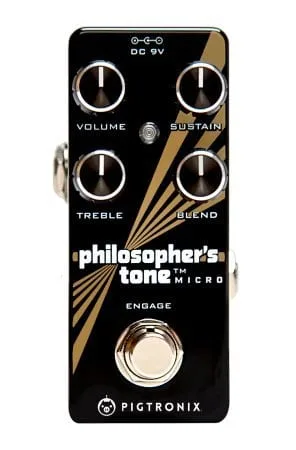
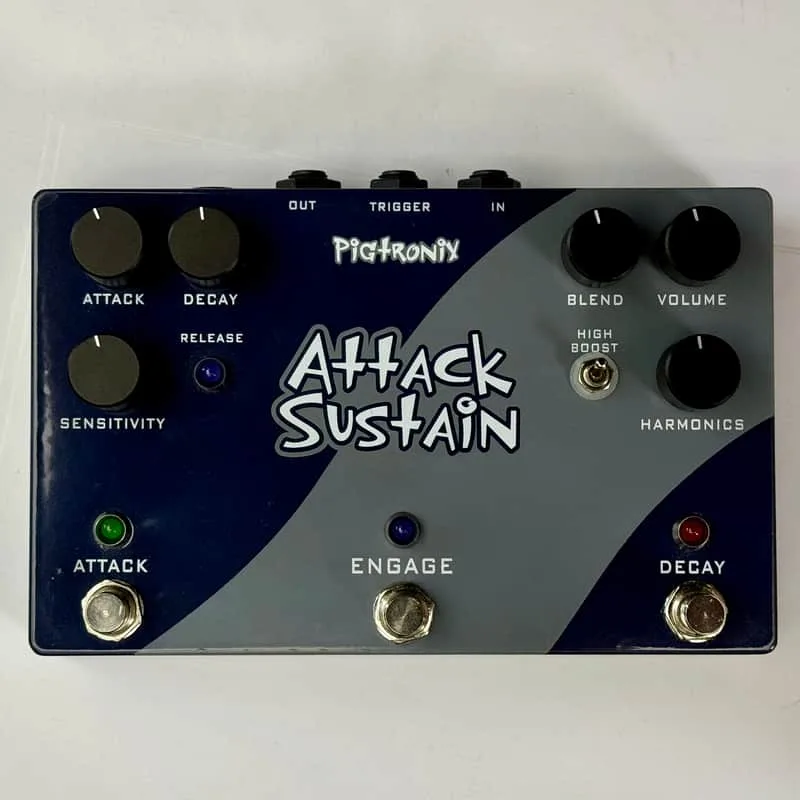
The Philosopher's Tone line has gone through several editions and revisions over the years9:
The Germanium Gold Micro is therefore the micro-sized take on the limited-edition Germanium Gold: same optical compression as the standard pedal, with the germanium clipping stage built in. Guitar.com's Richard Purvis called the original Germanium Gold "a limited-edition take on Pigtronix's acclaimed Philosopher's Tone compressor with added" germanium clipping diodes4.
What reviewers said
Gearnews liked its flexibility: "I like that the pedal is pretty versatile while giving off a bit of a vintage vibe"1. MusicRadar's Trevor Curwen highlighted the Volume knob's boost range and the way Blend and Grit interact, describing the Grit control as running "from a raw edge to full amp-like raunch"7.
Videos
Pigtronix
Pigtronix
Mike Hermans
Questions
Does the Philosopher's Tone Germanium Gold Micro take a battery?
No. It runs only off an external 9V power supply, and no battery option is fitted. The supply itself is not included in the price, so you need a 9V adapter to use the pedal. Internally the circuit runs at 18V for extra headroom.
Is the Philosopher's Tone Germanium Gold Micro true bypass?
Yes. The pedal uses true-bypass switching, so when it is disengaged it does not color your tone. Reviewers noted this alongside the rest of the design, and the same true-bypass approach appears across the Philosopher's Tone family.
What is the difference between the Philosopher's Tone and the Germanium Gold version?
The clean, compressed side of the Germanium Gold Micro is identical to the original Philosopher's Tone, with the same optical sustain engine. The difference is the distortion side: germanium diodes feed the Grit knob, which Pigtronix says gives a smooth top end and rich midrange response.
Does the Philosopher's Tone Micro come with a power supply?
No. The Germanium Gold Micro is powered by an external 9V supply that is not included in the price. You will need your own 9V adapter, and since there is no battery option, the pedal cannot run without one.
Where is the Pigtronix Philosopher's Tone Micro made?
The Philosopher's Tone Germanium Gold Micro is made in China. Guitar.com noted in 2019 that Pigtronix had returned to Chinese production six years after moving to US production. In Europe, the UK and the Republic of Ireland the pedal was distributed exclusively by JHS.
Sources (9)
- Pigtronix Philosopher’s Tone Germanium Gold Micro compressor pedal, gearnews.com, 2018-06-08
- Philosopher’s Tone Germanium Gold Micro by Pigtronix, Premier Guitar, 2018-04-23
- Pigtronix goes for germanium gold with new Philosopher's Tone Micro compressor pedal, MusicRadar, 2018-06-08
- Review: Pigtronix Philosopher's Tone Germanium Gold Micro, Bob Weir's Real Deal & Ringmaster, Guitar.com, 2019-01-10
- Pigtronix Unveils the Philosopher's Tone Micro, Premier Guitar, 2016-06-25
- Pigtronix updates Philosopher’s Tone compressor, Guitar.com, 2018-06-12
- Pigtronix Philosopher's Tone Germanium Gold Micro review, MusicRadar, 2018-08-03
- Tracing Journal: Pigtronix Philosopher’s Tone Micro, Aion FX, 2025-03-28
- Polyphemus Optical Compressor / Pigtronix Philosopher’s Tone, Aion FX, 2023-07-03