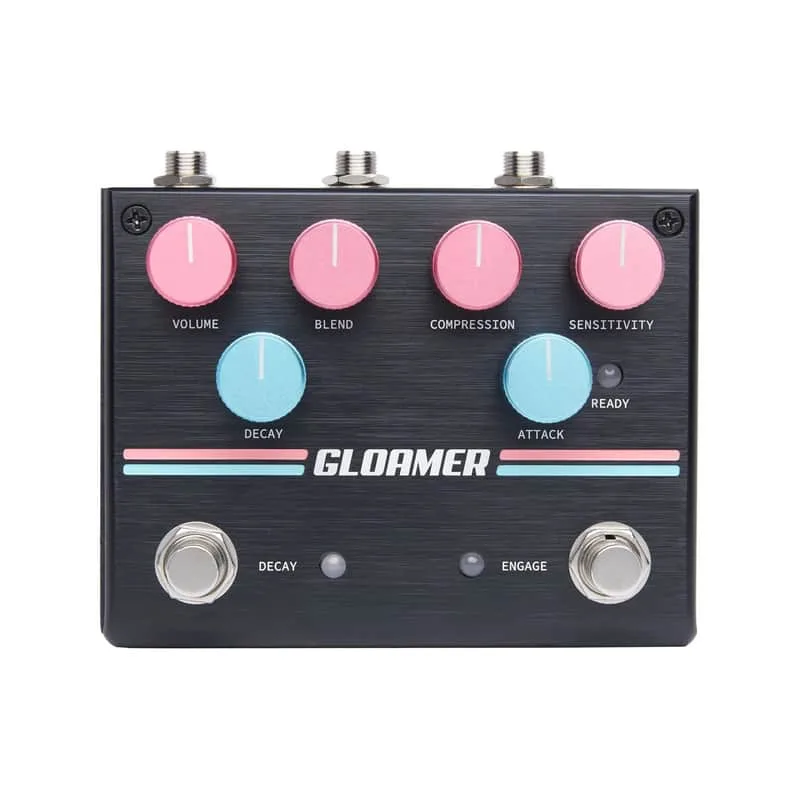



The Pigtronix Gloamer is a compact pedal, housed in an enclosure suitable for pedalboards1. Its two main controls shape how notes begin and end: the Attack knob sets the signal fade-in time from silent to peak, while the Decay knob adjusts the signal fade-out time from peak to silent2. In practice, that means the pedal can fade your notes in from silence and fade them out again at speeds you set. Pedal of the Day's reviewer could see it "working really well when combined with, for example, reverb or a delay pedal," noting the ambience and experimental tones that pairing brings out2, and found that "to get to the goods, Gloamer pretty much has to be paired with other pedals"3.
Where it came from
The Gloamer's automatic fade-in behavior is set by its Attack control, which takes the signal from silent to peak over a time you choose, with the Decay knob handling the fade back down to silence2. That way of shaping a note's start and end is what gives the pedal its character, and it is a sound that tends to open up in a chain: Pedal of the Day's reviewer found that "to get to the goods, Gloamer pretty much has to be paired with other pedals," suggesting reverb or delay as natural companions for the ambience and experimental tones it produces3.
The controls and footswitches
The pedal's knobs cover both the swell behavior and the compression side12:
| Control | What it does |
|---|---|
| Attack | Sets the signal fade-in time from silent to peak2 |
| Decay | Adjusts the signal fade-out time from peak to silent2 |
| Bloom | One of the pedal's main controls, listed by RockBoard's PedalPedia1 |
| Sensitivity | One of the pedal's main controls, listed by RockBoard's PedalPedia1 |
| Compression | Dial in as much compression as you require2 |
| Blend | Listed among the pedal's self-explanatory controls2 |
| Volume | Master output level12 |
Two footswitches handle the on/off duties. Engage switches the compressor and attack on or off, while the Decay footswitch toggles the decay on and off2. The Decay switch is a dedicated momentary footswitch, so it only fades the signal while you hold it down: Paolo De Gregorio explains that it "allows the player to fade out the signal at the chosen speed"4.
The Decay footswitch is momentary, so the fade-out only runs while the switch is held. Release it and the decay stops.
Triggering and the sidechain input
Beyond playing your guitar to drive the swells, the Gloamer has a Sidechain input that lets an external source trigger the Attack and Decay cycles rather than your guitar's signal2. That opens up uses beyond standard playing: another instrument or audio source can set the timing of the swells while your signal responds to it.
What reviewers said
Reviewers generally saw the Gloamer as a pedal that rewards pairing. gearnews.com's Jef wrote, "I can see this pedal working really well when combined with, for example, reverb or a delay pedal. As it has ambience and experimental tones"2. Premier Guitar's reviewer was more pointed about how to get the most from it: "To get to the goods, Gloamer pretty much has to be paired with other pedals"3. Both reviews point the same way: the swell and compression engine is the foundation, and time-based effects such as reverb or delay are where the ambience and experimental textures come out.
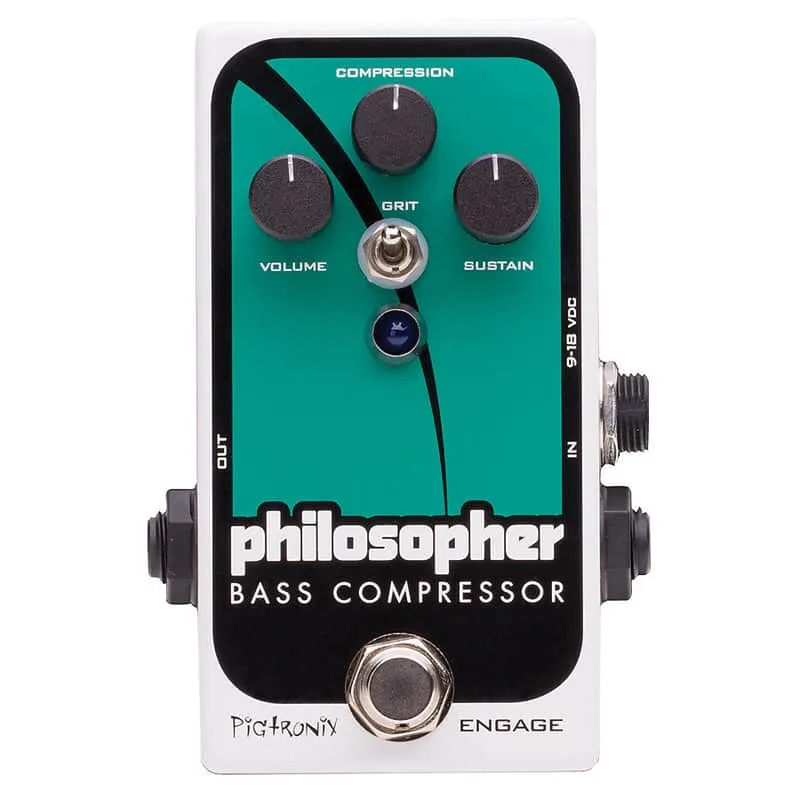
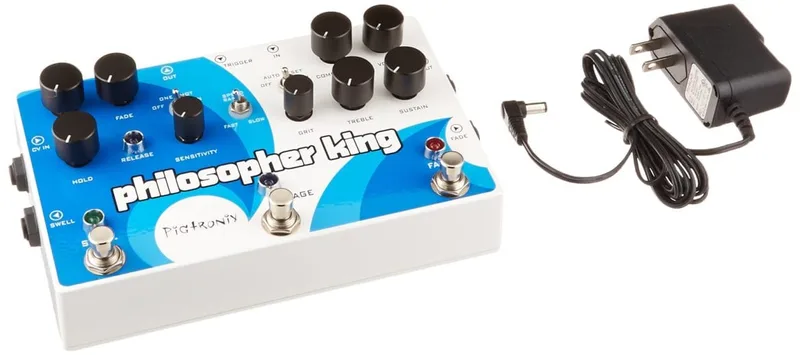
The pedal is housed in a compact enclosure suitable for pedalboards1, and it sits within Pigtronix's wider compressor line alongside pedals like the Philosopher's Tone and Philosopher's Tone 2, though the Gloamer's automatic volume fader function sets it apart from those straight compressors. For more on the category, see Compressor Pedals.
Videos
Pigtronix
Pigtronix
Pigtronix
Questions
Is the Pigtronix Gloamer analog or digital?
The Gloamer is an all-analog pedal. Delicious Audio's Paolo De Gregorio describes it as an all-analog, polyphonic amplitude synthesizer that alters the attack and decay time of any sound source without sacrificing the fidelity of the original tone. RockBoard's PedalPedia lists it as an optical compressor and volume swell pedal with an analog circuit type.
What power supply does the Pigtronix Gloamer need?
The Gloamer runs on 9V DC, center negative, the standard supply used by most pedalboard power supplies. RockBoard's PedalPedia lists this voltage in its specifications for the pedal.
Is the Pigtronix Gloamer based on the Boss Slow Gear?
The Gloamer is not a copy, but it works in the same territory as the Boss Slow Gear, a long-discontinued effect that has become collectable. MusicRadar describes the Gloamer as employing a Slow Gear-style Attack function, and gearnews.com places it in a similar bracket to the Slow Gear.
Can the Gloamer be triggered by something other than my guitar?
Yes. The Gloamer has a Sidechain input that lets an external source trigger the Attack and Decay cycles rather than your guitar's signal, as gearnews.com notes in its review. That means another instrument or signal can drive the swell behavior while your guitar passes through.
Does the Gloamer work with bass?
Yes. Pigtronix designed the Gloamer for electric guitar and bass, according to the maker's product page on RockBoard's PedalPedia. Its polyphonic amplitude synthesizer design is intended to alter the attack and decay of any sound source.
How much does the Pigtronix Gloamer cost?
The Gloamer carries a list price of $279. gearnews.com reported an MSRP of USD 279 when the pedal was announced in August 2022, and Premier Guitar listed a US MAP of $279 around the same release.
Sources (6)
- Gloamer by Pigtronix, RockBoard PedalPedia, 2026
- Pigtronix Gloamer adds swells and plays with your attack, gearnews.com, 2022-08-10
- Pigtronix Gloamer Pedal Review, Premier Guitar, 2022-10-10
- Pigtronix Gloamer Volume Swell + Compressor, Delicious Audio, 2023-06-27
- Pigtronix Launches the Gloamer Decay Guitar Effects Pedal, Premier Guitar, 2022-08-11
- Pigtronix Gloamer Polyphonic Amplitude Synthesizer Compressor, Pedal of the Day, 2022-09-28