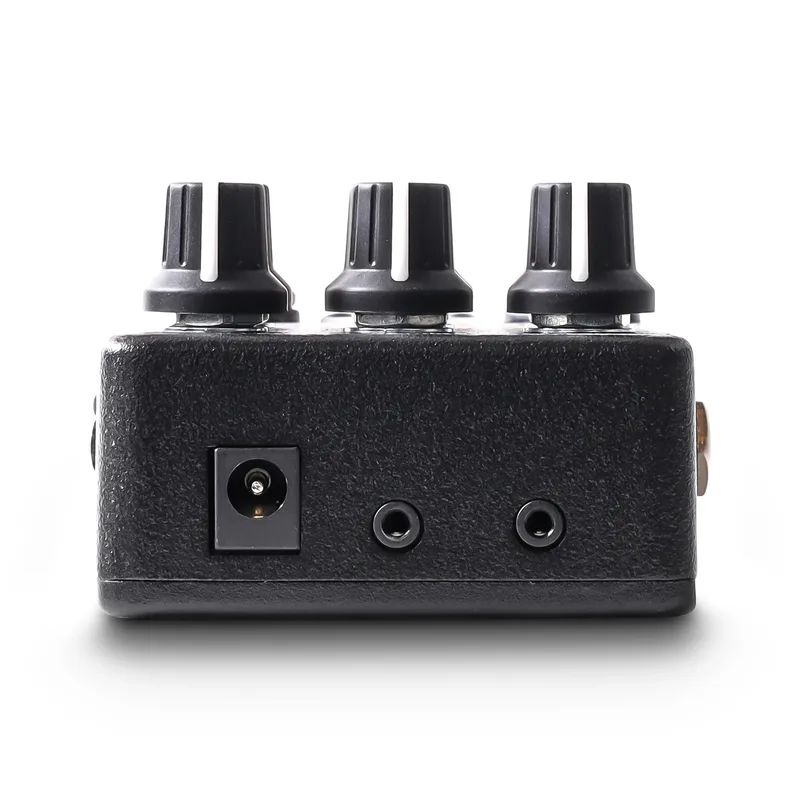
The Quilter Labs Neuron Gain Intelligence is a dynamic multistage guitar preamp in a compact pedal format, with a built-in compressor, noise gate, speaker simulator, presets and MIDI control1. It is not an amp modeler: Quilter Labs describes it as a unique design, based on years of research into amps and pedal circuits, that is not a model, emulation or simulation of any particular amp1. The pedal was introduced under the Neunaber Audio name, and Pedal of the Day called it "the culmination of years of researching both solid state and tube amplifiers," with new algorithms semi-based on those amps but with an original flavor of their own2.
The core idea is gain shaping with dynamics. Quilter Labs says the amp feel players chase is actually a result of voltage supply sag and speaker thermal compression, both of which the Neuron reproduces without tubes1. Its multistage gain architecture offers over 60 dB of gain, from clean to heavy distortion1.
The controls
The Neuron has six knobs on top, and the manual notes that the order of the preset functions in the signal flow is printed above their controls3. Pedal of the Day observed that the six-knob control section "is secretly hiding a multitude of other functions, adding to the presence and customization" of the pedal2.
| Control | What it does |
|---|---|
| Gain | Over 60 dB of gain, from clean to heavy distortion1 |
| Level | Output level of the signal1 |
| Tightness | Adjusts a pre-gain high-pass filter, thinning the low end before the gain stages1 |
| Presence | Adjusts a post-gain low-pass filter, shaping the top end after the gain stages1 |
| Comp | Single-knob compressor1 |
| Gate | Adjusts the noise reduction threshold1 |
The Tightness and Presence knobs are the shaping pair: Tightness cuts lows feeding the gain stages (tighter, less flubby at high gain), while Presence rolls off highs after them. The compressor and noise gate are built in rather than separate pedals, and the gate threshold is stored as part of each preset3. Pedal of the Day highlighted the "studio-quality noise reduction for higher gain level adjustment" as part of the package2.
There is also a global Tilt EQ, a one-knob compensation for a variety of output connections. It is a global setting independent of preset selection, accessed by holding down the Engage switch while turning the knob, and the manual describes it as a way to adapt the Neuron to your particular setup without changing presets4.
Presets and MIDI
Presets come in three tiers depending on how you control the pedal:
- On the pedal: up to 6 presets via the Preset footswitch, or 7 including Manual Mode, and these correspond to the first MIDI presets13
- Over MIDI: up to 24 presets recalled via MIDI Program Change commands15
- In software: unlimited presets via the optional Neuron Commander software1
MIDI connects through the newer micro-jack standard, a 2.5mm TRS jack, and two adapter cables to 5-pin DIN are included1. Program Changes change presets and Control Changes adjust parameters; the pedal has a MIDI Input and a Thru/Out1. The manual also covers MIDI channel selection for use with a MIDI controller, noting that setting a channel is not necessary if you only use Neuron Commander4. The pedal is compliant with MIDI Specification CA-033 for MIDI IN/OUT5.
For connecting to a computer, the Neuron attaches via a USB-to-MIDI adapter using the included 5-pin MIDI-to-2.5mm adapter cables3. The manual lists adapters that have been thoroughly tested and are known to work with the Neuron and Neuron Commander: the HiFing USB-MIDI interface and the Roland UM-ONE mk2, with the Roland requiring a driver installation on macOS4.
The preset LED color can also be changed via a MIDI Control Change command5, a small convenience for reading your presets on a dark stage.
Running it direct: the speaker simulator
The Neuron includes a speaker simulator mode for running the pedal direct, which Pedal of the Day pointed to as a way to skip an amp or speaker simulation pedal entirely and go straight to a desk or interface2. Combined with the relay true bypass, which Pedal of the Day said "ensures consistent sound from your original source when the pedal is in bypass mode"2, the pedal covers both the in-front-of-an-amp and direct-to-mixer roles.
Power: 9 to 12 V DC, 70 mA
The Neuron runs on a standard 9V pedal power supply (not included) with a 9 to 12 V DC input, drawing 70 mA, comfortably under 100 mA1. The connector is center-negative, 5.5 mm OD x 2.1 mm ID, and Quilter Labs recommends a 9 V DC, 100 mA or greater pedal power supply1.
The manual recommends an isolated 9V or 12V pedal power adapter and discourages powering the Neuron in a daisy-chained connection with a total current over 500 mA5. If you share one supply across several pedals, keep the chain's total draw under that figure or use isolated outputs.
Questions
Is the Quilter Labs Neuron Gain Intelligence an amp modeler?
No. Quilter Labs states it is not a model, emulation or simulation of any particular amp. It is an original design based on years of research into amps and pedal circuits, and the maker says the amp feel comes from voltage supply sag and speaker thermal compression, which it reproduces without tubes.
Is the Neuron true bypass?
Yes. The pedal uses a relay-based true bypass, so when it is disengaged your original signal passes through untouched. Pedal of the Day noted that the true bypass keeps the sound consistent when the pedal is in bypass mode.
Can the Neuron be controlled over MIDI?
Yes. It is MIDI controllable via the 2.5mm TRS micro-jack standard, and two adapter cables to 5-pin DIN are included. Program Changes recall presets and Control Changes adjust parameters, with up to 24 presets available over MIDI.
Does the Neuron have a built-in noise gate?
Yes. A Gate knob sets the noise reduction threshold, and the gate threshold is stored as part of each preset. Pedal of the Day described it as studio-quality noise reduction for higher gain settings.
Where is the Quilter Neuron made?
Quilter Labs manufactures the Neuron locally in Orange County, California, USA. The pedal was originally released under the Neunaber Audio name before Neunaber became part of Quilter Labs.
Sources (5)
- Neuron - Gain Intelligence - Quilter Labs, Quilter Labs
- Neunaber Audio Neuron Gain Intelligence Preamp, Pedal of the Day, 2019-03-29
- Neuron Commander User Guide, Neunaber Audio (Quilter Labs)
- Neuron Commander User Guide, Quilter Labs
- Neuron Gain Intelligence User Guide, Quilter Labs, 2019