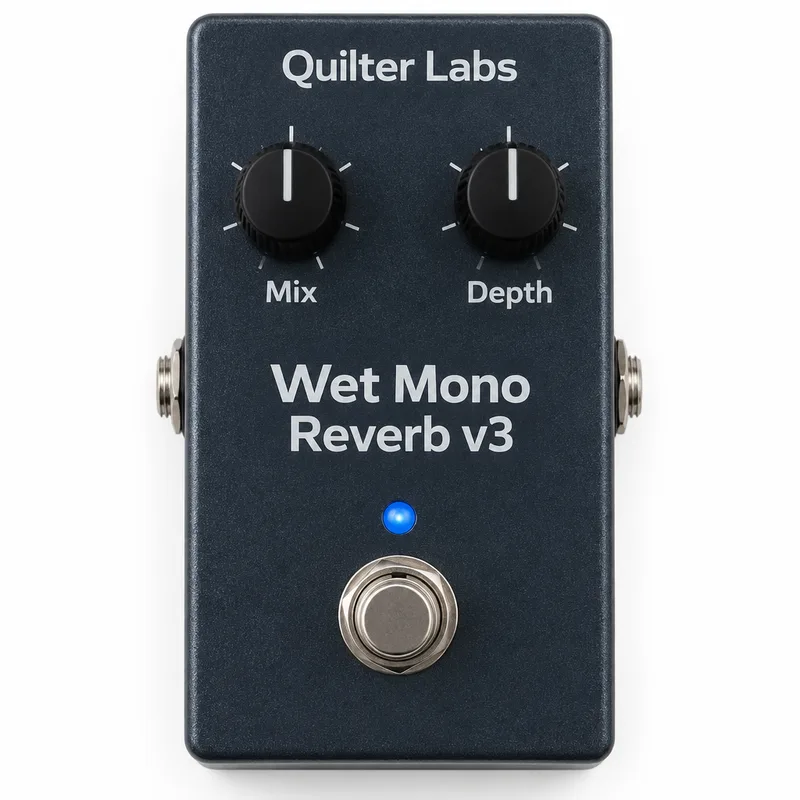
The Quilter Labs Wet Mono Reverb v3 is a mono reverb pedal with a deliberately small control set: two knobs, Mix and Depth, and a bypass footswitch. The mono input jack accepts input directly from your instrument or an amplifier's effects loop output, and the mono output jack feeds another effects pedal, an amplifier input, or an effects loop input1.
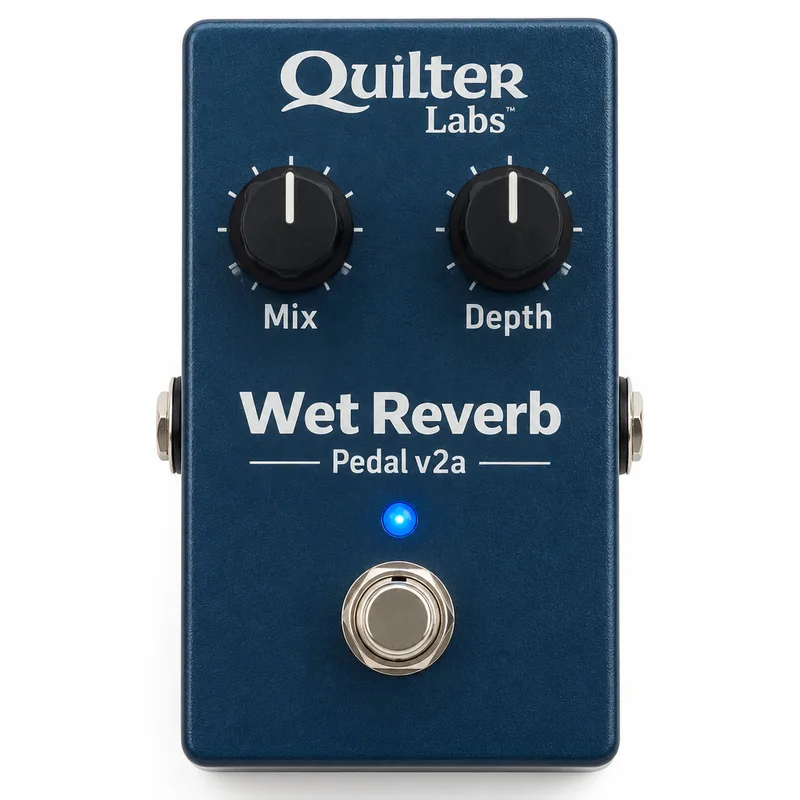
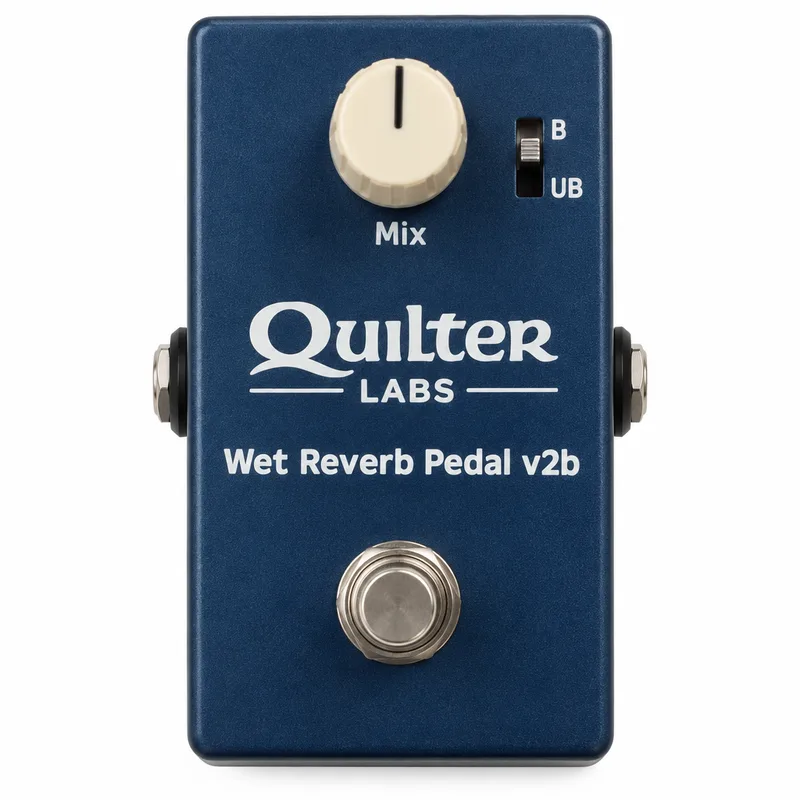
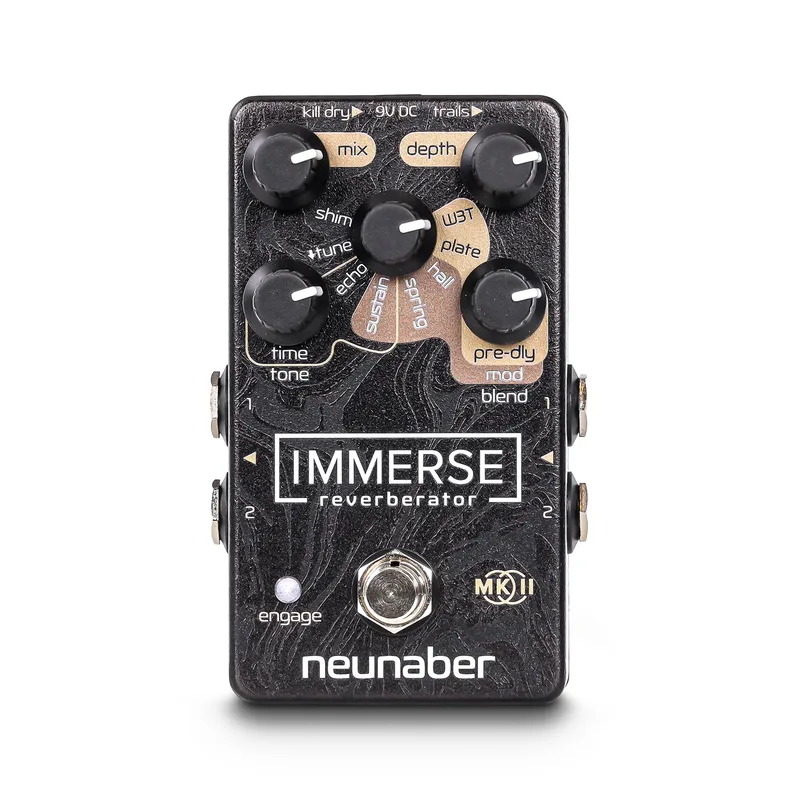
Quilter Labs describes the taper of the Mix knob as tailored so that "you may easily dial in just-a-touch through completely awash in reverb"1. It sits in the same Wet family as the Wet Reverb Pedal v2a, the Wet Reverb Pedal v2b and the stereo Quilter Immerse Reverberator Mk II.
A mono reverb with Mix and Depth
The two knobs divide the work between them. The Mix knob controls the blend between the dry signal and the reverb: full counter-clockwise is 100% dry, full clockwise is 100% reverb, and approximately 3 o'clock gives an even mix1. The Depth knob controls the length of the reverb tail, or in the maker's words, "the size of the room"1.
| Control | What it does |
|---|---|
| Mix | Blends dry signal and reverb; full counter-clockwise is 100% dry, full clockwise is 100% reverb, about 3 o'clock is an even mix1 |
| Depth | Sets the length of the reverb tail, or the size of the room1 |
| Bypass footswitch | Switches the effect on and off; the LED lights when the effect is active1 |
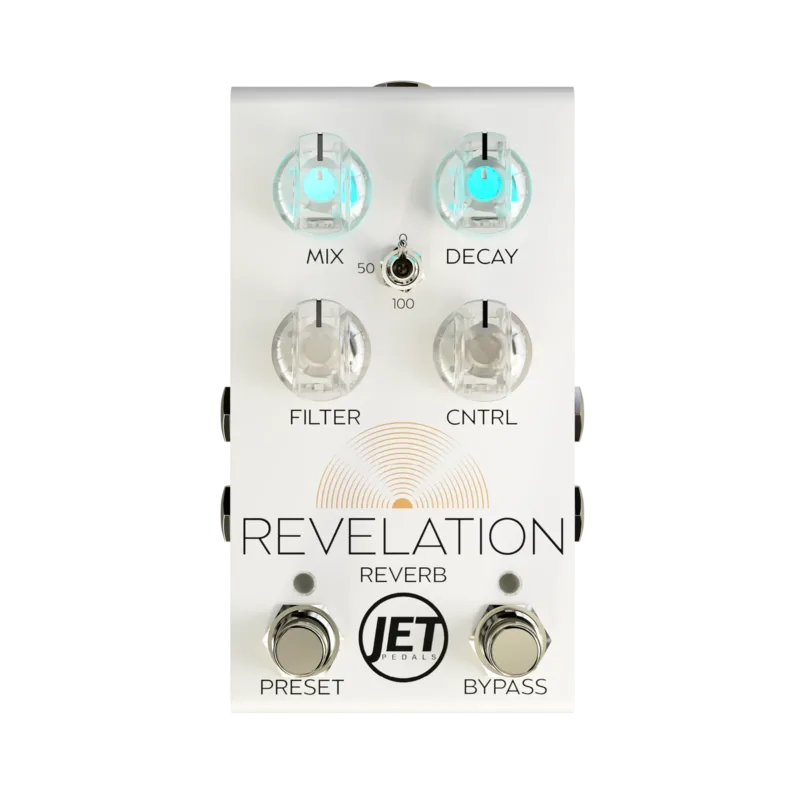
That two-knob layout is the point of the pedal: it is aimed at players who want one reverb sound they can dial in quickly, rather than a multi-mode unit. For comparison, other v3 reverb pedals take different approaches. The JET Pedals Revelation Reverb V3 enhanced its maker's existing algorithms, added pre delay, and a filter knob for creating darker reverbs, with full stereo analog dry thru2. The Wet Mono Reverb v3 offers none of that: no pre delay control, no filter knob, and no stereo path.
Bypass behavior
The pedal implements a buffered "trails" bypass, so when you switch the effect off the reverb trails off naturally rather than stopping dead1. Two related details from the manual matter to a player:
- The dry signal gain is within +/-1 dB between the enabled and bypassed states, measured on the dry signal only1.
- Bypassing does not significantly change power consumption, because it does not turn off power to the pedal1.
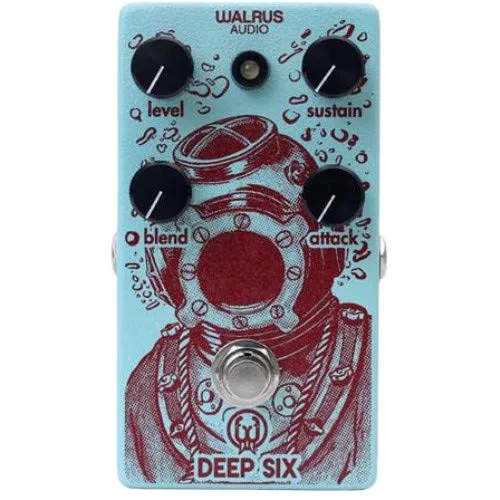
This is not a true bypass design, unlike pedals such as the Walrus Audio Deep Six Compressor V3, which lists true bypass among its features. Whether buffered trails bypass suits you depends on where the pedal sits in your chain and whether you want reverb tails to fade after switching off13.
Power: 9-12V DC, 65mA minimum
The power jack accepts a standard center-negative pedal power adapter, which is not included with the pedal1. The adapter must be 9 to 12V and capable of supplying at least 65 mA, with a 5.5 mm OD x 2.1 mm ID plug1.
No battery option is described in the user guide, and the adapter is not included, so plan on a dedicated 9 to 12V DC center-negative supply before the pedal arrives on your board.
Because bypassing does not change power consumption, the pedal draws power continuously once connected, so budget the full 65 mA in your power supply planning regardless of how often you have the effect engaged1.
Audio specifications and size
The manual gives a clean set of audio figures for the dry and bypassed path1:
| Specification | Value |
|---|---|
| Frequency response | 20 Hz to 20 kHz, +0.1 dB / -0.5 dB (dry signal or bypassed)1 |
| Signal-to-noise ratio | 105 dB typical (knobs at 50%, 22 Hz to 22 kHz, A-weighted, 2 V RMS reference)1 |
| Total harmonic distortion | < 0.002% typical (dry signal or bypassed, 22 Hz to 22 kHz, 1.0 V RMS, 1 kHz)1 |
| Input impedance | 1 MΩ1 |
| Output impedance | 470 Ω1 |
| Nominal input level | +4 dBu, line level, Mix < 60%1 |
| Gain, enabled vs. bypass | +/-1 dB (dry signal only)1 |
The 1 MΩ input impedance means the pedal presents a typical guitar-amp load to passive pickups, and the 470 Ω output impedance is low enough to drive long cable runs and most amplifier inputs without loading issues1.
Physically, the pedal measures 2.8" wide, 4.5" long and 1.85" high (71 x 115 x 47 mm) and weighs 6.7 oz (190 g)1, a compact footprint that leaves room on a small board.
Questions
Does the Quilter Labs Wet Mono Reverb v3 take a battery?
No. The manual describes only a power jack for a standard center-negative pedal power adapter, and no battery compartment is mentioned. You will need an external 9 to 12V DC supply to run the pedal.
Does the Wet Mono Reverb v3 come with a power adapter?
No. Quilter Labs states in the user guide that the power adapter is not included. The pedal needs a 9 to 12V DC center-negative supply with a 5.5 mm OD x 2.1 mm ID plug, delivering at least 65 mA.
Is the Wet Mono Reverb v3 true bypass?
No. It uses a buffered trails bypass, so when you switch the effect off the reverb tail fades out naturally instead of cutting off abruptly. The dry signal gain is within +/-1 dB between enabled and bypassed states.
Is the Wet Mono Reverb v3 stereo?
No. It is mono only, with one input jack and one output jack. If you need stereo reverb, Quilter Labs also makes the Immerse Reverberator Mk II, and other makers offer stereo reverb pedals.
What polarity does the Wet Mono Reverb v3 power supply need?
Center-negative. The power jack accepts a standard center-negative pedal power adapter with a 5.5 mm OD x 2.1 mm ID plug, running at 9 to 12V DC and supplying at least 65 mA.
How big is the Wet Mono Reverb v3?
It measures 2.8 inches wide, 4.5 inches long and 1.85 inches high, or 71 mm by 115 mm by 47 mm, and weighs 6.7 oz (190 g). That is a compact single-pedal footprint for most boards.
Sources (3)
- Wet Mono Reverb v3 User Guide, Quilter Labs
- Revelation Reverb V3 by JET Pedals, RockBoard (www.rockboard.de), 2026
- Deep Six Compressor Stomp Box, Walrus Audio