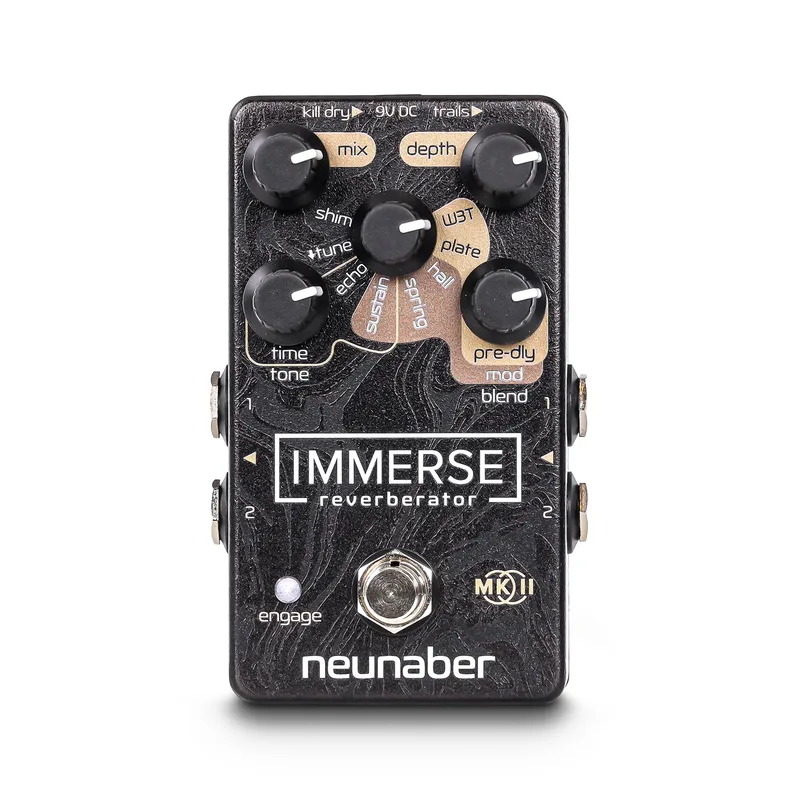


The Quilter Immerse Reverberator Mk II is a stereo reverb pedal offering eight reverb algorithms in one box, from familiar hall, plate and spring spaces to shimmer, detune and an infinite sustain mode. Its algorithms were designed by Brian Neunaber, and the pedal is built by Quilter Labs1. The dry signal stays fully analog for zero latency, while the reverb itself is digital1.
The Mk II is a redesign rather than a tweak: Quilter Labs describes it as having completely redesigned circuitry and upgraded algorithms over the original Neunaber Immerse Reverberator1. It lists at $2691.
Eight reverb algorithms
The center knob selects one of eight algorithms: W3T (Wet v3), Plate, Hall, Spring, Sustain, Echo, Detune and Shimmer2. Guitar.com called the eight stereo reverbs "the MKII's crowning glory"3.
| Algorithm | What it does |
|---|---|
| W3T (Wet v3) | The flagship: smooth, three-dimensional reverb with adjustable pre-delay1 |
| Plate | Classic plate reverb4 |
| Hall | Classic hall reverb4 |
| Spring | Classic spring reverb4 |
| Sustain | New algorithm built on W3T, configurable as a sustainer or an infinite reverb1 |
| Echo | W3T reverb combined with stereo echo for ambient, rhythmic space1 |
| Detune | Pitch-shifted shimmer movement under the reverb tail for a wide, modulated wash1 |
| Shimmer | Octave-shifted reverb that rises into ethereal, cathedral-like texture1 |
The Sustain mode is the most unusual: MusicRadar noted it "can be set up as a sustainer or infinite reverb"5. Every mode can now go 100% wet via the mix knob, a feature MusicRadar highlighted as new to the Mk II5.
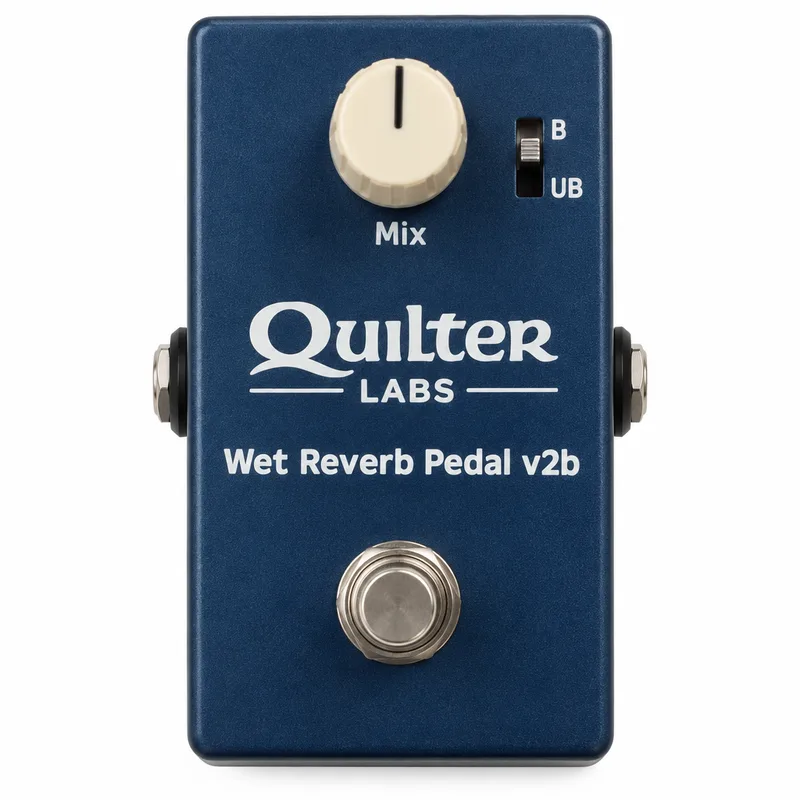
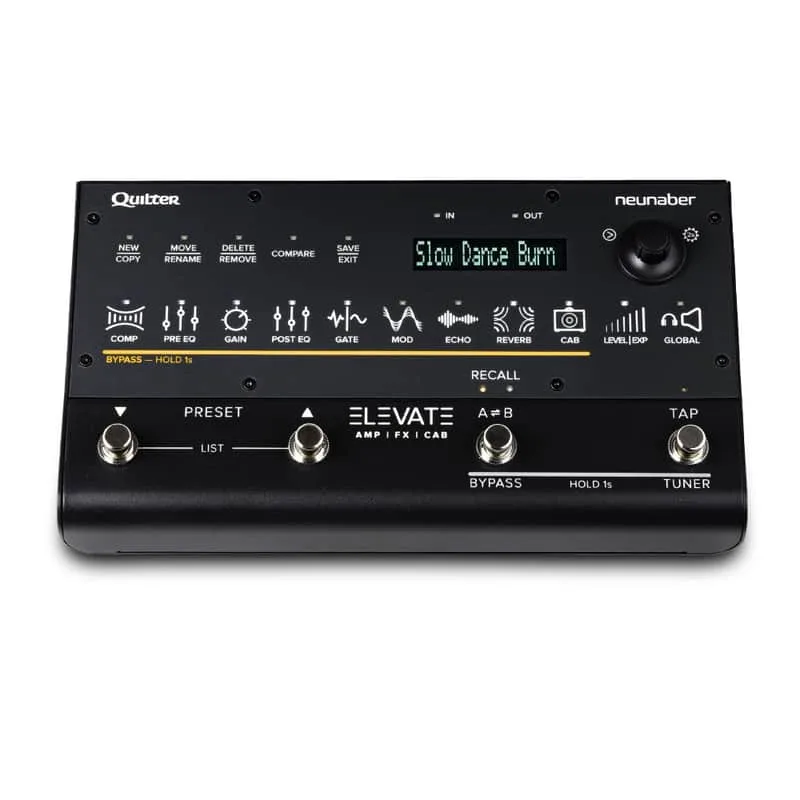
The W3T algorithm has a lineage. Quilter Labs says this is the same engineering behind the Wet Reverb and the Illumine, and that W3T also powers the reverb block inside the Quilter Elevate1.
The controls: one knob per function
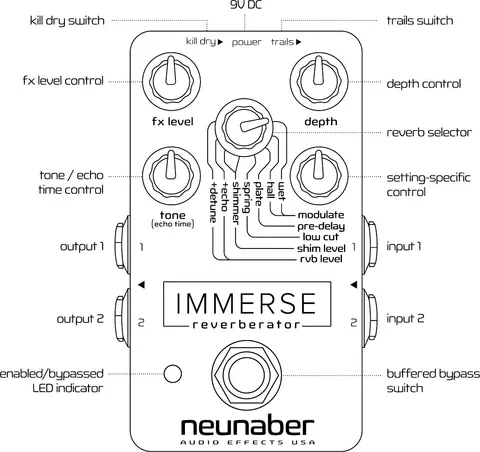
The Mk II follows a one-knob-per-function design with no menus or presets to dig through1. Guitar World's reviewer described the panel as a mix knob, a reverb depth knob, and two other knobs that change parameter depending on the selected effect6.
| Control | What it does |
|---|---|
| Effect (center knob) | Selects the reverb effect; the knobs below may change function depending on the selected effect2 |
| Time / Tone | Adjusts effect tone; on Sustain it controls Hold time, on Echo it controls delay time2 |
| Depth | Controls reverb depth (decay time); with Echo it also controls the number of repeats (regeneration)2 |
| Mix | Sets the wet/dry balance, up to 100% wet25 |
In Echo mode the Time knob adjusts echo time from 50 to 700 ms, Depth sets both reverb decay and echo repeats, and Blend controls the mix between reverb and echo2.
How the Mk II differs from the original
The original Immerse Reverberator, released under the Neunaber name, also offered eight stereo reverbs, but a different set: Wet, hall, plate and spring reverbs, two shimmers, Wet+echo and Wet+detune7. The Mk II replaces that lineup with the eight algorithms above, adding Sustain and a standalone Shimmer and Detune, and returns plate, hall, spring and echo in redesigned form5.
Key differences:
- Completely redesigned circuitry and upgraded algorithms1
- All modes can go 100% wet via the mix knob5
- A new Sustain algorithm built on W3T1
- Selectable true / buffered bypass1
The original ran on 9-12 V DC at 70 mA8; the Mk II manual specifies an adapter between 9 V and 12 V capable of supplying 80 mA or more2.
Bypass, mono and stereo operation
The Mk II offers selectable true or buffered bypass1. The manual describes a high-quality buffered bypass in which the signal is always buffered whether the pedal is engaged or bypassed2, and Guitar World's reviewer found the buffered bypass "especially useful as most guitarists place reverb pedals at the end of the signal chain directly before the amp"6.
"plug into a single amp and Immerse sums to mono automatically with only output 1 connected"
For mono players, that automatic summing means no special setup. For stereo, the pedal provides true stereo operation in addition to mono6, and using both outputs creates a stereo signal from a mono input8. Inputs 1 and 2 should not be used with two discrete signals, such as two different instruments2. The outputs are buffered and capable of driving long cables2.
Power and connections
The pedal powers from any standard 9V or 12V pedal supply, or a 100mA brick output1. The manual specifies a center-negative adapter, 5.5 mm OD x 2.1 mm ID, between 9 V and 12 V, capable of supplying 80 mA or more; no adapter is included and there is no battery option2.
No battery option exists and the power adapter is not included, so you will need a center-negative 9-12 V supply before the pedal is usable2.
Videos
Neunaber Audio
Matt Kelly
Questions
Does the Quilter Immerse Reverberator Mk II work in mono?
Yes. Plug into a single amp and the pedal sums to mono automatically with only output 1 connected. It also runs in true stereo with both outputs, and using both outputs creates a stereo signal from a mono input.
Is the Immerse Mk II true bypass or buffered?
The Mk II offers selectable true or buffered bypass. The manual describes a high-quality buffered bypass in which the signal is always buffered whether the pedal is engaged or bypassed, and Guitar World's reviewer found that especially useful since reverb usually sits at the end of a signal chain.
Who designed the Immerse Reverberator?
The Mk II's reverb algorithms were designed by Brian Neunaber, whose Neunaber Technology originally built the Immerse line. The pedal is now built by Quilter Labs, and the same engineering sits behind the Wet Reverb and the Illumine.
Does the Immerse Mk II have presets?
No stored presets. The design is one knob per function with no menus, and the eight reverb algorithms are selected directly with the center Effect knob. Guitar.com described the eight stereo reverbs as the pedal's crowning glory, accessible via that knob.
What voltage does the Immerse Mk II use?
It powers from any standard 9V or 12V pedal supply, or a 100mA brick output. The manual specifies a center-negative adapter between 9 V and 12 V capable of supplying 80 mA or more; no adapter is included and there is no battery option.
Sources (8)
- Immerse Reverberator Mk II, Quilter Labs
- Immerse Reverberator MkII User Guide, Quilter Labs, 2018
- Neunaber Audio announces the Immerse Reverberator MKII, Guitar.com, 2018-10-09
- Neunaber IMMERSE Reverberator, Delicious Audio, 2016-01-29
- Neunaber crams eight “magical stereo reverbs” into Immerse Reverberator Mk II, MusicRadar, 2018-10-08
- Review: Neunaber Immerse Reverberator MKII, Guitar World, 2019-02-14
- Neunaber, Delicious Audio, 2017-10-19
- Immerse User Guide (Original), Quilter Labs / Neunaber Technology LLC, 2016