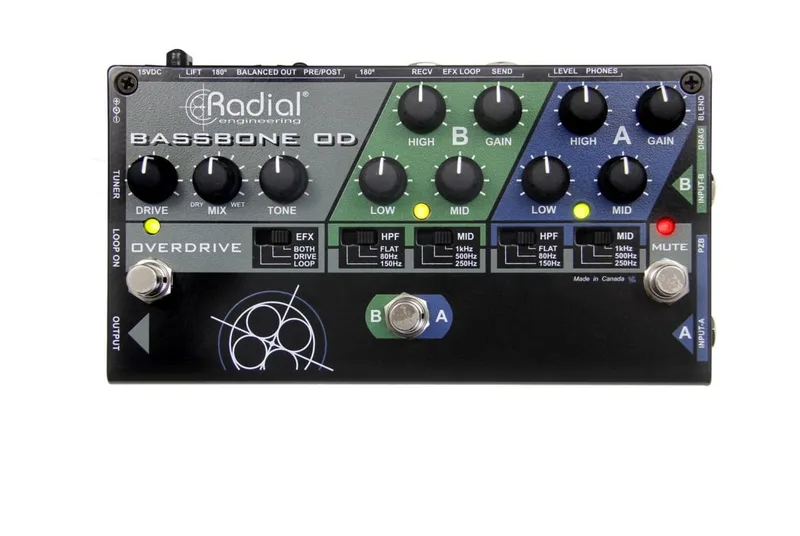


The Radial Bassbone OD is a bass preamp and overdrive unit from Radial Engineering, announced at NAMM in January 2014 and shipping from May that year at an estimated retail price of $500 USD12. It is a two-channel preamp: each channel has level control, a semi-parametric equalizer and a low frequency resonance filter, and you toggle between them with a footswitch, like playing through a two-channel amp1. On top of the preamp it adds a built-in overdrive circuit, an effects loop for external pedals, and a full set of outputs for stage and front-of-house use.
Radial describes the design goal behind the overdrive in terms bass players will recognize:
"in order to deliver a solid bass foundation and the natural tone of the instrument, you have to maximize the frequency response, retain the dynamics and introduce the ability to 'mix in' the dry original signal with the distortion"2
In other words, the dry bass signal stays in the mix alongside the distortion, so the low end does not disappear when the drive is engaged. In Radial's NAMM demo, bassist Ric Fierabracci noted that slap playing keeps its crispness and that the drive can be dialed down to what he called an "SVT-like grunt"3.
The overdrive and effects loop
The overdrive section has its own Tone control and a Mix knob that sets the dry-wet balance between the original bass tone and the distortion63. Radial's approach of mixing the dry signal back in is what keeps the instrument's fundamental intact at higher drive settings2.
The effects loop is a set of send and receive 1/4" connections for external effects6. A Footswitch Assign switch sets what the OD footswitch activates: the overdrive, the effects loop, or both62. In the NAMM demo, Fierabracci described a further option: a separate switch can hold the loop on all the time, leaving the footswitch for drive only3. Radial notes that professional studio effects can be used in the loop, recommending unbalanced connections and levels kept below the distortion point7.
The XLR output can be routed pre or post, before or after the effects loop and overdrive, to suit the engineer's preference, using the Pre-Post switch61.
Channels, controls and switching
| Control | What it does |
|---|---|
| Channel-A knobs | EQ and Gain for Channel-A6 |
| Drag control | Adjusts the load on a magnetic pickup for a more natural sound6 |
| HPF knob | High pass filter to roll off excessive resonance and clean up the signal6 |
| Mix knob | Sets the dry-wet mix between original tone and distortion6 |
| Tone control | Tone control for the overdrive3 |
| Pre-Post switch | Routes the balanced output before or after the effects loop and overdrive6 |
| Footswitch Assign switch | Sets the footswitch to activate overdrive, effects loop or both6 |
| AB footswitch | Toggles between Channel-A and Channel-B6 |
| Mute footswitch | Mutes all outputs except the tuner out for quiet on-stage tuning6 |
| Blend switch | Mixes both channels together, for a dual pickup system1 |
Channel-A carries Drag Control load correction, which Radial positions as a way to optimize tone and feel with a vintage passive instrument such as a Fender bass1. Channel-B takes a different slant, with a PZB booster that increases the sensitivity and load to 10 meg ohms for piezo transducers as commonly used on upright bass1. Because each channel has its own EQ, you can set them differently, for example bringing out 500 Hz on channel B for harmonics3.
Input-B uses a 1/4" switching jack: the bass connected to input-A can feed channel-B when input-B is not in use, so one bass gets both channels6. The two inputs can also be used simultaneously, for example an upright bass with a magnetic pickup and a piezo pickup, or two separate basses3.
A note on Drag Control: it has no audible effect with an active bass, because the bass's internal preamp already buffers the signal. Radial states it only works when coupled directly to the magnetic pickup7.
Power: 15V, 400 mA
The Bassbone OD runs on a 15V DC power supply6. Radial explains the choice: "By using a 15V, 400 mA power supply, we can increase the headroom and reduce distortion for a more natural bass tone"7. The unit requires 400 milliamps of current7.
No battery and no phantom power. Radial says batteries would die within minutes due to the current needed, and 48V phantom power supplies only 5 to 10 milliamps, far short of what the unit requires. Make sure the proper polarity is applied, or the input could be damaged7.
The Bassbone OD is a unity gain device: it only boosts the signal when the power booster is activated, and Radial describes its EQ as passive-interactive, like an old Fender amp, hiding output power in the EQ7. Measured specifications from Radial include a frequency response of 20Hz to 18kHz, total harmonic distortion of 0.05% at -15dBu, dynamic range of 85dB, and a maximum input of +7 dBu5.
Outputs: amp, DI, tuner and headphones
The rear of the unit carries four outputs:
- Amp out: a 1/4" bass amp output used to feed the artist's personal stage amplifier6
- Balanced out: a built-in active Radial DI to feed the PA or recording system, with a 180° polarity reverse and ground lift65
- Tuner out: a separately buffered, dedicated tuner output that is always on6
- Phones output: a 3.5mm TRS mono headphone output with level control6
The active DI output is unique to the Bassbone OD, but very similar to the buffering circuit used in the Radial J487. The tuner out works with the mute footswitch for quiet on-stage tuning1. It can also feed a second amp, but Radial cautions that it is always on and not isolated, so hum and buzz from ground loops may occur7.
The unit does not generate 48V phantom power for a condenser microphone; an external supply such as the Radial SB48 is needed. It is equipped with blocking capacitors that protect it from DC current if phantom power is present on a connected line7.
A BLEND switch on the unit lets you mix an external music source, such as an iPod, with the bass for practice. The Bassbone OD is mono, so a stereo mix is lost7.
Where it came from
Radial announced the Bassbone OD with shipping planned for Spring 2014 and an estimated retail price of $500 USD1. By the time of Radial's shipping announcement, the Bassbone OD was available to buy2. The OD footswitch may be assigned to the loop, overdrive or both, and Radial's approach to the overdrive was to maximize the frequency response, retain the dynamics and let the player mix in the dry original signal with the distortion21.
Radial's demo video, presented at the Radial booth, walks through the channels, Drag Control, the overdrive's tone and mix controls, and the pre/post balanced output63:
Videos
Premier Guitar
Sweetwater
Questions
Can the Radial Bassbone OD run on phantom power or a battery?
No to both. Radial says 48V phantom power only supplies 5 to 10 milliamps of available current, while the Bassbone OD requires 400 milliamps, so phantom power cannot run it. Batteries would die within minutes due to the amount of current the unit needs. It runs on the supplied 15V DC power supply, and correct polarity is required or the input could be damaged7.
Does Drag Control work with an active bass?
No. Drag Control adjusts the load on a magnetic pickup, and Radial states it only works when the circuit is coupled directly to the pickup. An active bass has an internal preamp that already buffers the signal, so the load adjustment has no audible effect. It is aimed at passive instruments, such as a vintage Fender bass71.
Can the Bassbone OD tuner out feed a second amp?
Yes, but with caveats. Radial says the tuner output can feed a second amp, but it is always on and not isolated, so hum and buzz from ground loops may occur. The output cannot be switched off, and it stays live even when the mute footswitch is engaged for silent tuning7.
Can I use a piezo upright bass with the Bassbone OD?
Yes. Channel-B has a PZB booster that raises the input load to 10 meg ohms to suit piezo transducers as commonly used on upright bass. The two inputs can also be used at the same time, for example an upright with a magnetic pickup on one channel and a piezo on the other, mixed with the blend switch13.
Does the Bassbone OD supply phantom power for a microphone?
No. The Bassbone OD does not generate 48V phantom power, so a condenser microphone needs an external supply such as the Radial SB48. The unit is equipped with blocking capacitors that protect its circuitry from DC current if 48V phantom is present on a connected line7.
Sources (7)
- NAMM 2014 VIDEO: Radial Engineering Bassbone OD, MusicRadar, 2014-01-26
- Radial Engineering's Bassbone OD (Overdrive) Now Shipping, Guitar Interactive Magazine, 2014-05-06
- NAMM 2014: Radial Engineering Bassbone OD, MusicRadar, 2014-01-24
- Bassbone OD, Radial Engineering, 2026-10-02
- Bassbone OD Specifications, Radial Engineering, 2018-04-17
- Bassbone OD Features, Radial Engineering, 2025-01-23
- Bassbone OD FAQ, Radial Engineering, 2021-09-27