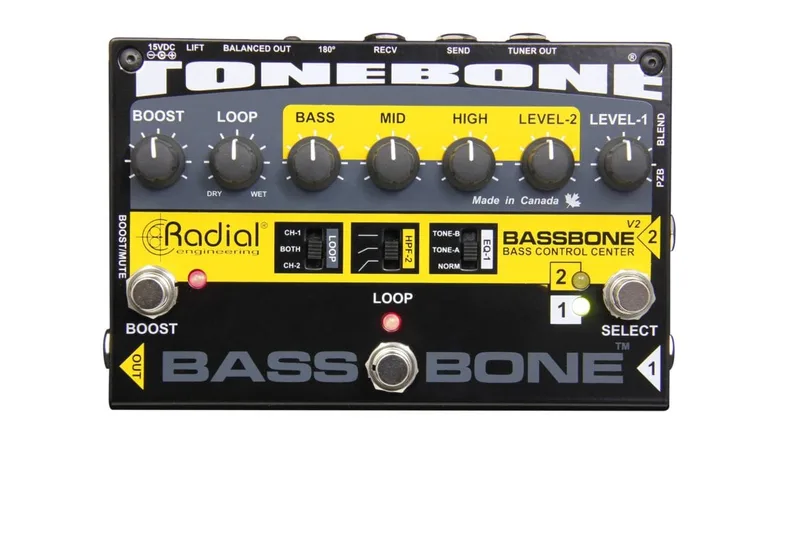


The Radial Tonebone Bassbone V2 is a two-channel bass preamp and boost pedal from Radial Engineering, built for players who gig with more than one instrument or want two different tone profiles from the same bass. It takes two inputs, gives each channel its own level control, adds EQ and a high-pass filter on channel 2, blends a parallel effects loop, and sends your post-EQ sound to the PA or a recording console through a balanced XLR direct out12. Radial describes it as "a power-packed bass preamp that combines on-stage efficiency, amazing tonal control and superb audio performance in a compact box"3.
It is an analog, solid-state design with a discrete class-A FET input and low-noise ICs, in a 14-gauge steel enclosure sized 5.5" x 4.2" x 2" (203 x 107 x 48mm) and weighing 2.55 lb (1157 grams)45. Radial introduced it in 2015 as the replacement for the original Tonebone Bassbone, and it remains in the lineup; in 2022 the artwork was refreshed with no internal changes67.
The controls and footswitches
The front panel carries three footswitches. Select toggles between channels when you use one bass, or between instruments when you use two. Loop turns the effects loop on and off. Boost activates a power booster, or a mute if you prefer, with a large LED indicator2. Bass Gear Magazine's reviewer described these as "three solid footswitches: one for selecting between Channel 1 and 2; one for engaging the effects loop, and one for engaging the boost (or muting the signal)"6.
| Control | What it does |
|---|---|
| Level-1 and Level-2 knobs | Adjusts instrument level for each channel2 |
| 3-band EQ (channel 2) | Active EQ for carving tone to suit any playing style or instrument2 |
| HPF-2 switch | High-pass filter on channel 2 at 60Hz, 80Hz, or off, to roll off excessive low end2 |
| Boost knob | Sets boost amount from unity gain to +8dB2 |
| Loop Wet/Dry knob | Mixes the dry bass sound with the wet effects loop2 |
| Loop Assign switch | Three-position switch assigning the loop to one or both channels2 |
| Boost/Mute button | Recessed button making the Boost footswitch act as a mute instead6 |
| Ground Lift switch | Disconnects pin-1 on the XLR out to break ground-loop hum2 |
| 180° (XLR) switch | Reverses pins 2 and 3 at the XLR out to phase-align with the PA or reduce feedback2 |
| PZB switch | Raises input impedance and gain, most dramatically on channel 2, for piezo instruments6 |
| Blend switch | Allows two instruments, or one instrument switched between channels6 |
Channel 1 keeps things simple: a contour switch set to Flat bypasses the EQ so the instrument's original tone passes through unaltered9. The Boost level and Loop knobs apply to both channels6. On the bench, Bass Gear Magazine's Amp Lab measured the boost reaching about 12dB with the control fully on5, and found the channel 2 Bass control useful in both boost and cut, with the low end never fully disappearing even cut all the way6.
Inputs, outputs and the XLR direct out
Input-1 is the primary 1/4" instrument input; when nothing is plugged into input-2, the signal is automatically sent to channel 2 as well2. Input-2 is a second 1/4" jack for a second bass2. The 1/4" Out jack feeds your bass amplifier2, and the balanced XLR direct out sends the post-EQ Bassbone sound to the PA or recording console2. Radial compares this active DI output to its J48 direct box9.
The top edge adds a tuner out, effects send and receive jacks, and the power input6. The tuner out is always on for tuning on the fly, or pair it with the mute function for silent tuning2. The effects loop is parallel and blendable: the Loop Wet/Dry knob dials in as much or as little of your wet effects as you want, and the loop can be assigned to channel 1, channel 2, or both6. This replaced the original Bassbone's serial TRS loop6.
The ground lift and phase-shift buttons affect only the balanced XLR output6. The unit is buffered rather than true bypass; Radial says its specially designed buffers drive the two preamp channels, EQ, power booster, tuner and effects loop with no signal level loss9.
Power: 15V, 400mA
The Bassbone V2 runs on 15V DC at 400mA from the included Radial power supply82. A cable clamp locks down the adapter cable to prevent accidental disconnection2.
Radial chose a 15V, 400mA supply to increase headroom and reduce distortion for a more natural bass tone10. The unit cannot be powered by 48V phantom power, though blocking capacitors on the XLR protect it from phantom and other DC currents arriving from a console9. Spec-sheet figures include a frequency response of 20Hz to 18kHz, dynamic range of 85dB, total harmonic distortion of 0.05% at -15dBu, and a maximum input of +7dBu4.
History: from the original Tonebone Bassbone
The original Tonebone Bassbone was introduced in 2003, and it immediately became a hit among gigging bassists, particularly players who routinely gigged with two disparate instruments, or those who needed to switch between two different tone profiles from the same instrument6. The Bassbone V2 followed in 2015, made in Canada, and Radial says it faithfully reproduces the same award winning tone as the original while adding features through new generation parts6. Its audio circuit is the same as the original Bassbone's, built around a discrete class-A FET input with low noise ICs94.
Radial says the V2 faithfully reproduces the same award-winning tone as the original while adding features through new-generation parts9. In March 2022 the pedal received a purely cosmetic refresh: the artwork was updated to complement modern pedalboards, with nothing touched internally7.
How it compares to the Bassbone OD
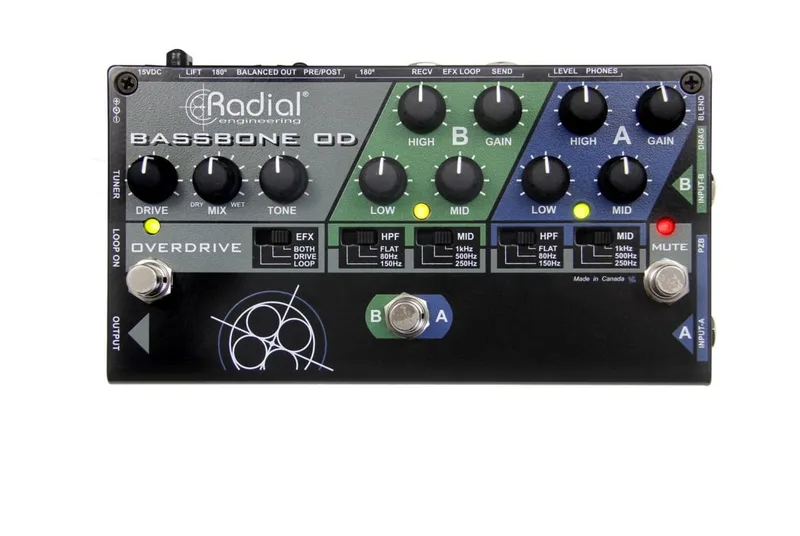
The Bassbone OD is a bass preamp and overdrive: two fully equipped input channels, each with separate level and EQ controls, sharing a built-in overdrive section11. The V2 has no overdrive of its own; its second channel carries the active 3-band EQ and high-pass filter, and its effects loop is parallel and blendable rather than serving an onboard drive. Both run on the same 15VDC/400mA supply1242. Players who want drive in the box go to the OD; players who want a clean two-channel switching preamp with a blendable loop stay with the V2.
What reviewers and players said
Bass Gear Magazine's Tom Bowlus tested the V2 against the original with instruments ranging from a Fender Precision to a Kay upright and a Rob Allen Mouse, giving it an average in-hand score of 4.58 on the magazine's 1-to-5 scale, with top marks for features and ease of use6. His verdict:
"The Bassbone V2 does not take anything away from your tone and gives you numerous ways to sculpt and tweak in musical ways."
The magazine's in-hand review scored the Bassbone V2 highly, giving it 5 out of 5 for in-hand features and ease of use, 4.5 for tonal flexibility, tone and value, and 4 for aesthetics, for an in-hand average of 4.586. The reviewer noted that the PZB switch increases both the input impedance and the gain on both channels, most dramatically on Channel 2, to optimize for piezo-equipped instruments6. The Blend switch allows for using two different instruments plugged into each input, or using one instrument and switching between the two channels, and a recessed Boost/Mute button lets the Boost footswitch function as a mute instead6.
Radial's artist pages list Chuck Rainey and Rhonda Smith among its users1, and Martin Isenberg uses it to switch between his P Bass and his upright:
"I use the V2 as my preamp and to switch between channels for my P Bass and my upright."
For more on the category, see preamp pedals and bass pedals.
Videos
Sweetwater
Radial Engineering
Deadbeat Studios
Questions
Can the Bassbone V2 run on 9V?
No. The Bassbone V2 is powered by a 15V DC, 400mA center-negative supply, which Radial includes in the box. A standard 9V pedal supply does not meet its voltage requirement, and Radial warns that incorrect polarity on a third-party supply can damage the unit. Use the included adapter or a supply that matches 15V DC at 400mA with the correct polarity.
Can I use the Bassbone V2 with an upright bass?
Yes. Radial designed it to switch between any two instruments, including active basses, passive magnetic-pickup basses, and uprights with piezo pickups. The PZB switch raises input impedance and gain, most dramatically on channel 2, to suit piezo-equipped instruments. Radial also notes it works with guitar, mandolin, banjo, fiddle, dobro, and cello, though it is optimized for bass.
Why is my bass quieter through the Bassbone V2?
A slight volume drop compared with plugging straight into your amp is normal. Radial deliberately backed down the output level to compensate for how powerful the EQ is at full settings. The unit produces an instrument-level output between -30dB and -15dB depending on your instrument's output, so a small level difference is by design.
Can the Bassbone V2 be powered by phantom power?
No. The Bassbone V2 cannot be powered by 48V phantom power. It does have blocking capacitors on the XLR output that protect the unit from 48V phantom and other DC currents coming from a mixing console, so phantom on the DI line will not harm it, but it cannot run the pedal.
What is the difference between the Bassbone V2 and the Bassbone OD?
The Bassbone V2 is a bass preamp and boost with two channels, a blendable parallel effects loop, and a balanced XLR out. The Bassbone OD, introduced in 2014, is a bass preamp and overdrive: its two channels each have separate level and EQ controls and share a built-in overdrive section. The V2 carries no overdrive of its own and more closely resembles the original 2003 Bassbone.
Sources (12)
- Bassbone V2, Radial Engineering, 2026-04-27
- Bassbone V2 Features, Radial Engineering, 2026-04-09
- Martin Isenberg, Radial Engineering
- Bassbone V2 Specifications, Radial Engineering, 2022-03-16
- AMP Lab - Radial Tonebone Bassbone V2 | Bass Gear Magazine, Bass Gear Magazine, 2021-04-02
- Radial Tonebone Bassbone V2 Pedal, Bass Gear Magazine, 2021-03-24
- New Look For the Radial Engineering Bassbone V2 and Hotshot DM1, Bass Musician Magazine, 2022-03-30
- Bassbone v2 by Radial Engineering, rockboard.de, 2026
- Bassbone V2 FAQ, Radial Engineering, 2019-05-13
- Bassbone OD FAQ, Radial Engineering, 2021-09-27
- Bassbone OD, Radial Engineering, 2026-10-02
- Bassbone OD Features, Radial Engineering, 2025-01-23