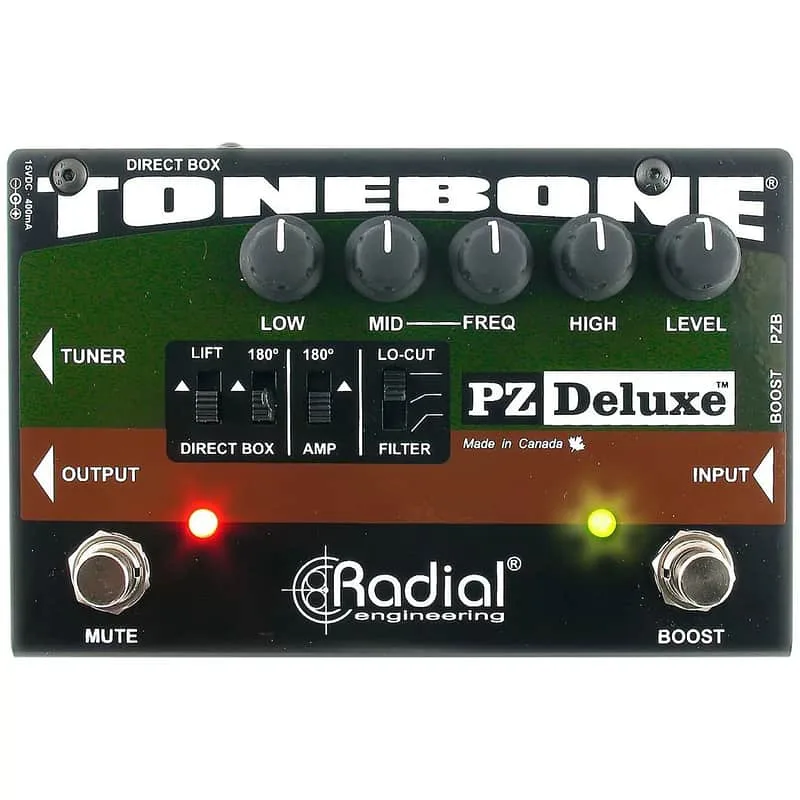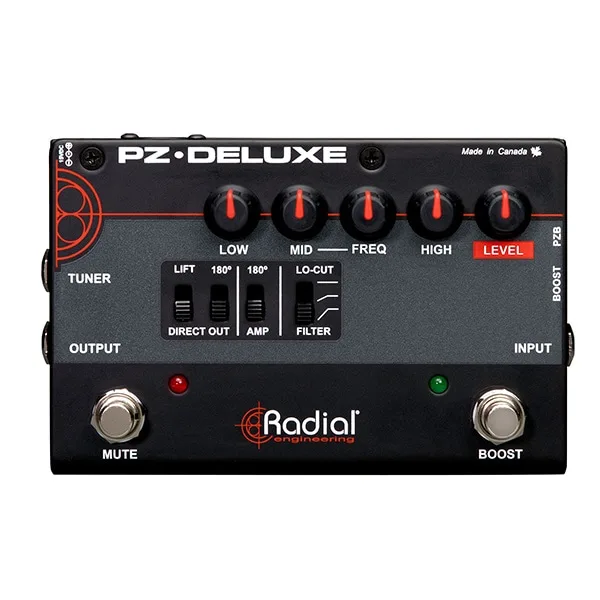


The Radial PZ-Deluxe is a studio-quality acoustic instrument preamp and DI built into a compact pedal enclosure for live stage use, with tone-shaping EQ controls1. Radial describes it as "a high performance preamp disguised as an effects pedal"2. It is marketed under the Tonebone name, and it is a single-input design: MusicRadar's reviewer, Dave Burrluck, notes that where the Radial Tonebone PZ-Pre offers more, "the PZ-Deluxe strips it down to a more focused, single-input design"3.
The core idea is direct piezo hook-up. Radial says the PZ-Deluxe eliminates the need for a separate preamp when connecting a piezo guitar: you activate the PZB gain stage and connect the guitar directly to the preamp1. For players with an upright bass, Radial says you can bypass your external preamp by turning on the PZB for optimum performance1.
The controls and the PZB gain stage
The PZB gain stage is the feature the pedal is built around. Radial says it can be activated for instruments with piezo transducers, increasing the input impedance to 10 meg ohms to eliminate the squawk and harshness associated with those pickup systems1. With the PZB off, the input impedance is 6.8k ohms, which Radial notes assumes the instrument is buffered, as most acoustic guitars are5. The spec sheet confirms both values: 6.8k ohms with the PZB off, 10 meg ohms with it on2.
For tone shaping, the PZ-Deluxe has a semi-parametric three-band EQ. MusicRadar's review describes the mid-frequency range as very wide3. Radial's own support article explains how the EQ differs from the PZ-Pre's: "The Q on the PZ-Deluxe is wider and more musically pleasing and is better suited for tone shaping," and not narrow enough to work as a swept notch filter for feedback control5.
| Control | What it does |
|---|---|
| PZB gain stage | Raises input impedance to 10 meg ohms for piezo transducers1 |
| Three-band EQ with semi-parametric mid | Tone shaping; wide mid-frequency range, wide Q53 |
| Lo-Cut filter | Three-position slide switch: flat, low-mid cut, low-cut3 |
| Output level rotary | Sets level for both the XLR and jack amp outputs3 |
| Boost level | Recessed control set with a cross-head screwdriver, so it will not get moved in transit3 |
| Mute footswitch | Silent plugging in and unplugging, silent tune-ups13 |
| Boost footswitch | Instant level boost for solos1 |
| Phase inversion | Separate 180-degree phase reverse for both the DI and amp outputs3 |
| Ground lift | Slide switch3 |
The built-in mute and boost footswitches give instant control for solos, instrument changeovers, or silent tune-ups on stage1. The spec sheet summarizes the feature set as 180-degree polarity reverse, ground lift, HPF, level control, EQ control and boost23.
Power and connections
The PZ-Deluxe runs on a 15V DC center-negative supply with a 400mA current rating, and the external supply is included534. Radial says the 15V supply delivers more headroom than typical 9V devices, for greater dynamics, less distortion and more natural tone1. Radial's support article adds that "a special 15VDC supply with 400 milliamps is used to give the PZ-Deluxe headroom"5.
The 15V, 400mA requirement means the PZ-Deluxe cannot run on a standard 9V pedal supply. Plan for its included adapter or a power brick with a 15V output.
On the output side, the spec sheet lists 1/4-inch and XLR output connectors2. Separate 1/4-inch outputs feed a stage amp and tuner, while the balanced XLR DI drives long cable runs to the PA4. The XLR output impedance is 600 ohms2.
Radial's support article also describes a cable for feeding the pedal from a +48V phantom supply's XLR output: an XLR female to 1/4-inch TS male cable with pin 3 (ground) wired to pin 1 (cold)5.
How it relates to the PZ-Pre
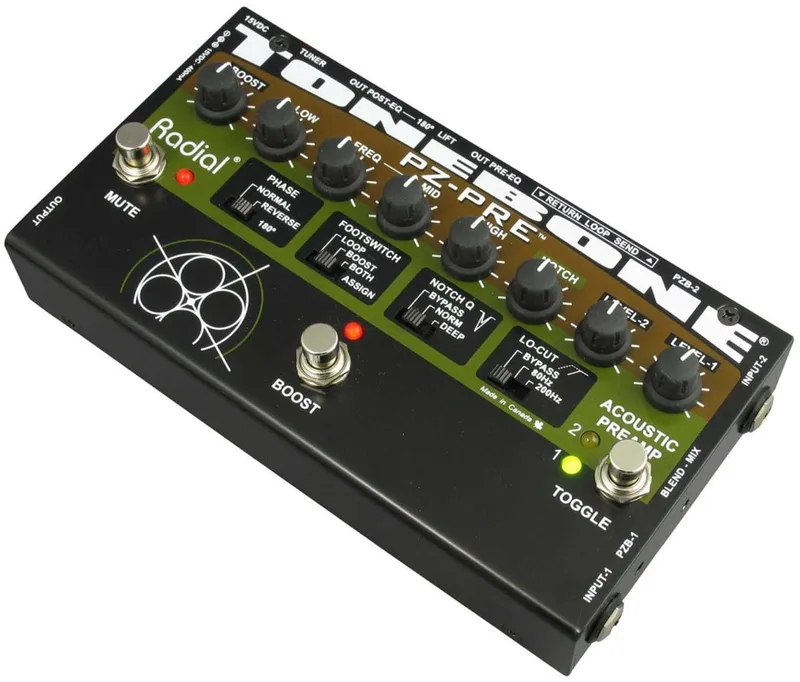
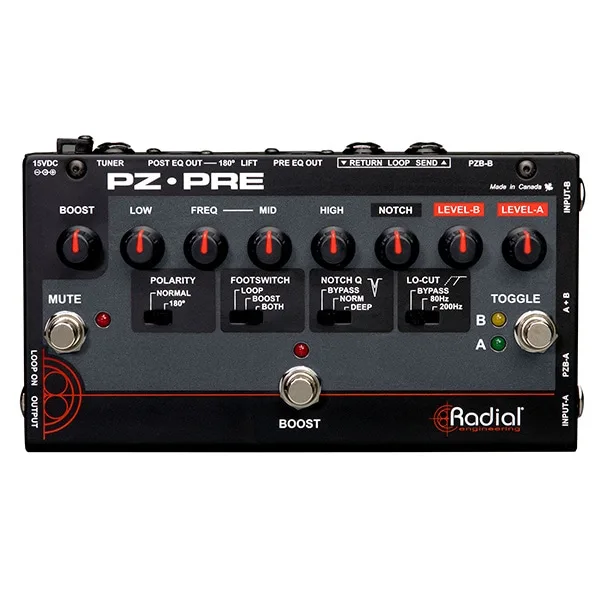
Radial's support article is direct about the relationship: "The PZ-Deluxe has less features and a smaller foot print. But the primary audio circuit is the same" as the PZ-Pre5. In other words, the PZ-Deluxe is a trimmed-down, single-input version of the same audio signal path, aimed at players who do not need the PZ-Pre's extra inputs and features. Players who need feedback-fighting notch filtering should note the EQ difference above: the PZ-Deluxe's wider Q is for tone shaping, not notching out feedback frequencies5.
Measured performance
The spec sheet lists these figures for the audio path2:
| Specification | Value |
|---|---|
| Gain | +21dB (PZB off) |
| Frequency response | 20Hz to 18kHz (0/-3dB) |
| Total harmonic distortion | 0.03% @ -20dB output |
| Intermodulation distortion | 0.07% |
| Dynamic range | 105dB |
| Equivalent input noise | -108dBu |
| Low noise design | about -120dB at all frequencies |
Radial specifies use in dry locations only, between 5°C and 40°C2.
Videos
Sweetwater
Fabian Holland
FOX17 Rock & Review
Questions
Does the Radial PZ-Deluxe work with upright bass?
Yes. Radial says players using an upright bass with an external preamp can bypass that preamp by turning on the PZB for optimum performance. The PZB gain stage raises the input impedance to 10 meg ohms, which suits piezo transducers on instruments like upright bass.
What is the input impedance of the PZ-Deluxe?
It depends on the PZB gain stage. With the PZB off, the input impedance is 6.8k ohms, which assumes the instrument is buffered like most acoustic guitars. With the PZB on, it rises to 10 meg ohms to better suit piezo transducers.
Does the Radial PZ-Deluxe have an XLR output?
Yes. The spec sheet lists 1/4-inch and XLR output connectors. Separate 1/4-inch outputs feed a stage amp and tuner, while the balanced XLR DI output, at 600 ohms, drives long cable runs to the PA.
Can the PZ-Deluxe run on phantom power?
The PZ-Deluxe is powered by its own 15V DC supply, not phantom power. Radial does describe a related setup: connecting a +48V phantom power supply's XLR output to the PZ-Deluxe input using a special XLR female to 1/4-inch TS male cable with pin 3 wired to pin 1.
Does the Radial PZ-Deluxe have a mute switch?
Yes. Built-in mute and boost footswitches give instant control for solos, instrument changeovers, or silent tune-ups on stage. MusicRadar's review notes the mute switch allows silent plugging in and unplugging of your guitars.
Sources (5)
- PZ-Deluxe, Radial Engineering, 2026-01-28
- PZ-Deluxe Specifications, Radial Engineering, 2018-05-15
- Radial Tonebone PZ-Deluxe review, MusicRadar, 2016-03-11
- Tonebone PZ-Deluxe by Radial Engineering, RockBoard (PedalPedia), 2026
- PZ-Deluxe FAQ, Radial Engineering, 2019-05-13