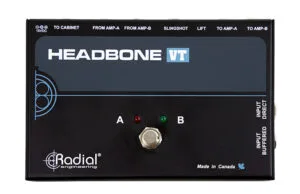


The Radial Engineering Headbone VT is an amp head switcher: a rack-style switching device that lets you toggle between two tube amplifier heads using a single speaker cabinet1. Instead of moving cables between amps, you wire both heads into the Headbone, run one line to the cab, and stomp to change amps. Radial describes the unit's job plainly: it safely switches the amps and makes sure the tube output stage always sees a load, which matters because a tube head running without a load can be damaged2.
The Headbone VT sits in the wider family of switching pedals from Radial, aimed at players who want the sounds of two heads without two cabinets or a tangle of speaker cables123.
How the switching works
The Headbone VT is a Class-A audio circuit that Radial says retains the tone of the amplifier, with the actual amp selection handled by a programmed PIC controlled relay23. Switching between heads takes 11.2 milliseconds3. An on-board footswitch toggles between amp heads, and large LED indicators monitor the current signal path so you can see at a glance which head is live3.
Only one head is active at any time. Radial's support documentation is direct about this: switching to the second channel with only one amp connected is not safe, because the Headbone only lets you select and use one head at a time4.
Connections and controls
| Jack or control | What it does |
|---|---|
| Buffered Input | 1/4" jack connects guitar to the Headbone and amplifiers5 |
| Direct Input | 1/4" jack bypasses the input buffer for true bypass connectivity5 |
| To Amp 1 & 2 | 1/4" jacks connect the Headbone to the amplifier guitar inputs5 |
| To Speaker Cabinet | 1/4" jack connects from Headbone to speaker5 |
| Remote In | 1/4" jack for Slingshot remote switching5 |
| Ground Lift | Switch lifts ground to help eliminate hum and buzz caused by ground loops5 |
The input buffer can be bypassed entirely: the direct input overrides the buffered input as soon as a guitar cable is plugged into it4. For remote switching, the Slingshot input accepts any standard footswitch or a MIDI controlled contact closure, so the Headbone can be integrated into a larger switching system2.
The Headbone has only one speaker output. To drive two cabinets, Radial says to connect the first cabinet and feed the second through its parallel jacks, or to use the Tonebone Cab-Link4.
Power
The Headbone VT runs on a 15V DC center-negative supply drawing 400mA1. Radial fits the unit with a jack for a high-power 400mA supply, which is provided, for greater headroom5.
Radial says 16V or 18V supplies from a power brick may be used, but this may shorten the lifespan of the internal voltage regulators. If you go that route, the supply must have the correct polarity and sufficient current for the job4.
Things to watch for
A few operating limits come from Radial's own support documentation:
- Digital delay in the amp's effects loop: using one can overheat and fail the internal load resistor and possibly damage the amp. Radial does not recommend it without understanding the risk4.
- Cable length: keep cables under 6 meters (20') when not using the Slingshot remote, to reduce noise picked up from electromagnetic fields4.
- Operating conditions: for use in dry locations only, between 5°C and 40°C3.
Videos
Zach Wish
Guitar IQ - Play Smarter
Brandon Breeze
Questions
Can the Radial Headbone VT switch two tube amp heads into one cabinet?
Yes. The Headbone VT is a switching device built for exactly that: it connects two tube amplifier heads to a single speaker cabinet and lets you toggle between them. Only one head is active at a time, and the unit keeps the tube output stage of the unused amp seeing a load so the amps are switched safely.
What power supply does the Radial Headbone VT need?
It runs on a 15V DC center-negative supply drawing 400mA, and Radial supplies a 400mA power adapter with the unit for greater headroom. Radial says 16V or 18V supplies from a power brick may be used, but this may shorten the lifespan of the internal voltage regulators, and correct polarity and sufficient current are required.
Is the Headbone VT analog or digital?
It is analog. Radial lists the circuit type as analog, with a proprietary electro-mechanical audio circuit and a programmed PIC controlled relay doing the switching. A Class-A audio circuit is used to retain the tone of the amplifier.
How fast does the Headbone VT switch between amp heads?
Radial specifies a switching time of 11.2 milliseconds. Switching is done with an on-board footswitch, or remotely through the Slingshot input using a standard footswitch or a MIDI controlled contact closure.
Sources (5)
- Headbone VT by Radial Engineering, RockBoard (PedalPedia), 2026
- Headbone VT, Radial Engineering, 2026-08-21
- Headbone VT Specifications, Radial Engineering, 2018-05-03
- Headbone VT FAQ, Radial Engineering, 2021-10-28
- Headbone VT Features, Radial Engineering, 2021-03-24