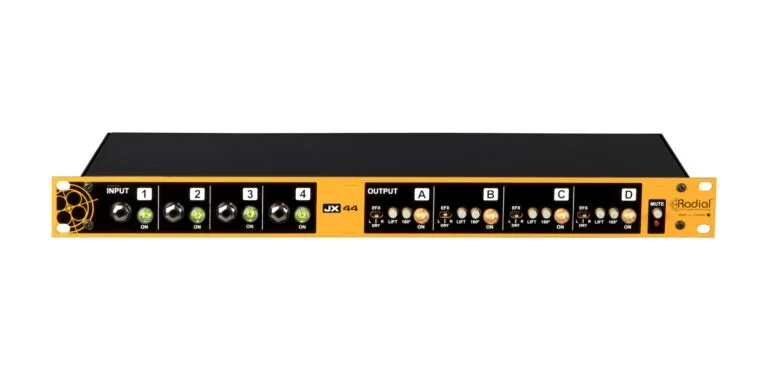


The Radial JX44 is a rackmount guitar signal manager from Radial: a combination guitar input selector, signal distribution amplifier, effects router, direct box and Reamper in one unit1. Built for players who change guitars and run multiple amplifiers on stage, it lets you select between instruments, split the signal to several amps with transformer isolation to avoid ground loop noise, feed a tuner, send a balanced DI to the desk, and reamp recorded tracks later21.
The original JX44 is discontinued and no longer shipping3. Its successor, the JX44 V2, is a guitar signal manager designed to handle four guitars and four amplifiers with effects routing and MIDI control4.
Four guitars to six amps, with a DI and reamp
The JX44's job is to sit between you and a complex rig. On the input side, it takes up to four instruments and lets you select between them. On the output side, the original JX44 provides two single amp outputs and two dual amp outputs, for up to six amplifiers at once2. The amp outputs are transformer isolated, which Radial describes as eliminating noise caused by ground loops between amps on separate power circuits2. A balanced XLR direct out feeds a mixing console, and a buffered tuner output with a simple footswitch mute keeps tuning silent5.
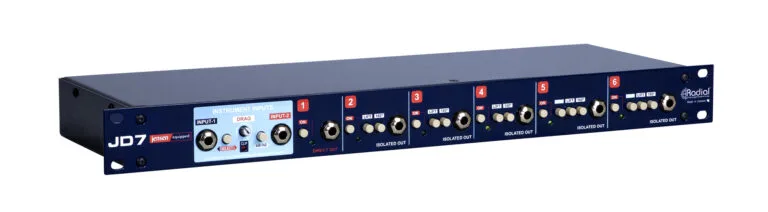
The DI and Reamp functions work together for recording: the DI captures a clean, balanced feed of the guitar while the Reamp path lets you send a recorded track back through your amps and pedals later. Radial positions the JX44 alongside the Radial JD7 Injector, a rackmount class-A guitar distribution center and splitter with a built-in Radial DI and Reamp that can drive up to seven amps or pedal chains simultaneously75. The two share the same active circuit, but the studio-focused JD7 uses Jensen transformers while the live-focused JX44 uses a special order isolation transformer8.
The JX44 V2 scales the same idea to four guitars and four amplifiers, with effects routing and MIDI control, and uses six Jensen JT-11-YMPC transformers on its amp outputs and SGI send/receive plus a Jensen JT-DB-EPC645.
Inputs, outputs and controls
The original JX44's input and output layout is built around how players actually plug in on stage:
| Connection | What it does |
|---|---|
| Input A & B | Front and rear jacks; front jacks have priority over rear. Drag Control load correction on each5 |
| Input C & D | Rear input jacks with TRIM controls to balance instrument levels2 |
| Rear inputs | Instrument inputs for rackmount preamps and wireless systems2 |
| Amp outputs | Two single and two dual amp outputs, up to six amps, transformer isolated2 |
| Tuner & Mute | Buffered output for an electronic tuner with footswitch mute2 |
| SGI Loop | Balanced effects loop that works with the SGI-44 to drive long cables to and from a pedalboard52 |
| Remote Control | Ports that connect to the JR-5 footswitch with standard mic cables2 |
| DI output | Balanced XLR direct out15 |
A few details matter in use. Channels 1 and 2 have inputs on both the front and rear panels, and the front panel jacks have priority: the moment you connect a cable plug into the front panel jack, the input diverts there8. The Drag Control load correction lets you dial in the pickup loading as if the guitar were plugged straight into an amp, but it has little or no effect with wireless systems or acoustic guitars, because those signals are already buffered8. The 1/4 inch connectors are glass filled nylon, used to isolate channels and reduce noise with a full ground plane and virtual ground8.
The effects loop is wired in series8. The V2 adds a 180 degree polarity reverse, ground lift, effects loop and remote footswitch control5, and its effects loop can be switched remotely from a 1/4 inch TS jack that accepts standard momentary footswitches6.
Footswitch and standalone control
The JX44 connects to Radial JR-5 remote footswitches over standard mic cables through its remote control ports52. On the JX44 V2, the XLR remote connections accept optional JR-5 footswitches that can be assigned to control either the instrument inputs or the amplifier outputs, and two JR-5 units can be used simultaneously6. You can also run the unit without any footswitch at all.
"Yes. The front panel has all of the controls to let you do most tasks."
Power and specifications
Both versions share a 14-gauge steel chassis and outer shell5. The original JX44 has a maximum input of +12dBu unbalanced input to unbalanced output, a frequency response of 20Hz to 20kHz (±2.5dB), and a dynamic range of 118dB on the same unbalanced path71. Its total harmonic distortion measures 0.008% at 1kHz, with intermodulation distortion of 0.02% at -20dBu71. The JX44 V2 raises the maximum input to +18dBu at 1% THD at 1kHz, with gain accuracy of ±0.3dB and THD of 0.0006% at 1kHz at 0dBu35.
Key measurements for the original JX443:
| Specification | Value |
|---|---|
| Frequency response | 20Hz to 20kHz (± 2.5dB) |
| Dynamic range | 118dB (unbalanced in to unbalanced out) |
| Noise floor | -106dBu (unbalanced in to unbalanced out) |
| Total harmonic distortion | 0.008% @ 1k (unbalanced in to unbalanced out) |
| Intermodulation distortion | 0.02% @ -20dBu (unbalanced in to unbalanced out) |
| Maximum input | +12dBu (unbalanced in to unbalanced out) |
| Input impedance | Variable from 10k Ohms to 1 megaOhm |
| Output impedance | 3k Ohms (1/4" unbalanced), 150 Ohms (XLR balanced) |
| Dimensions | 17.5" x 6" x 1.75" |
| Weight | 10.7lb (4.8kg) |
| Warranty | Radial 3-year, transferable |
Radial's own spec sheet sums up the noise behavior: "The JX44 does an exemplary job at keeping noise levels down."31
For the V2, Radial lists a maximum input of +18dBu at 1% THD @ 1kHz, gain accuracy of ±0.3dB, THD of 0.0006% @ 1kHz at 0dBu, and the same 14 gauge steel chassis and outer shell construction5. The original JX44 is specified for use in dry locations only, between 5°C and 40°C31.
The original JX44 is discontinued and no longer shipping3. Specifications above are split between the two versions: original-unit figures come from the JX44 spec sheet, V2 figures from the JX44 V2 spec sheet, and the two are not interchangeable.
Videos
Audiofanzine in English
Sammy Bones
gearwire
Questions
Is the Radial JX44 discontinued?
Yes. Radial states that the original JX44 has been discontinued and is no longer shipping. It has been followed by the JX44 V2, a guitar signal manager that handles four guitars and four amplifiers with effects routing and MIDI control, and uses Jensen transformers on its amplifier outputs.
What footswitch does the Radial JX44 use?
The JX44 connects to Radial JR-5 remote footswitches over standard mic cables through XLR remote control ports. On the JX44 V2, a JR-5 can be assigned to control either the instrument inputs or the amplifier outputs, and two JR-5 footswitches can be used at the same time.
Can the Radial JX44 be used without a footswitch?
Yes. Radial's support documentation states that the front panel has all of the controls needed to do most tasks, so the JX44 can be operated without a footswitch for setup and testing at the rack.
Does the Radial JX44 have an effects loop?
Yes. The JX44 has an effects loop wired in series, plus a balanced SGI loop that works with the SGI-44 driver to send and return long cables to and from a pedalboard. The JX44 V2 adds a 1/4 inch TS jack for a standard momentary footswitch to turn the effects loop on and off remotely.
What power supply does the Radial JX44 need?
The original JX44 runs on a 15V 1A adapter, which is included. The JX44 V2 is powered internally at 100-240VAC, 0.45A, 50/60Hz, and Radial also describes it as operating on 120/240V for international use via a standard IEC power cable, which is included.
Sources (8)
- JX44 Specifications, Radial Engineering, 2018-04-17
- JX44 Features, Radial Engineering, 2018-04-17
- JX44 - Radial Engineering, Radial Engineering, 2023-08-08
- SGI Stereo, Radial Engineering, 2026-06-26
- JX44 V2 Specifications, Radial Engineering, 2026-05-20
- JX44 V2 Features, Radial Engineering, 2026-05-15
- Comparing Reampers, Radial Engineering, 2023-09-20
- JX44 FAQ, Radial Engineering, 2018-05-14