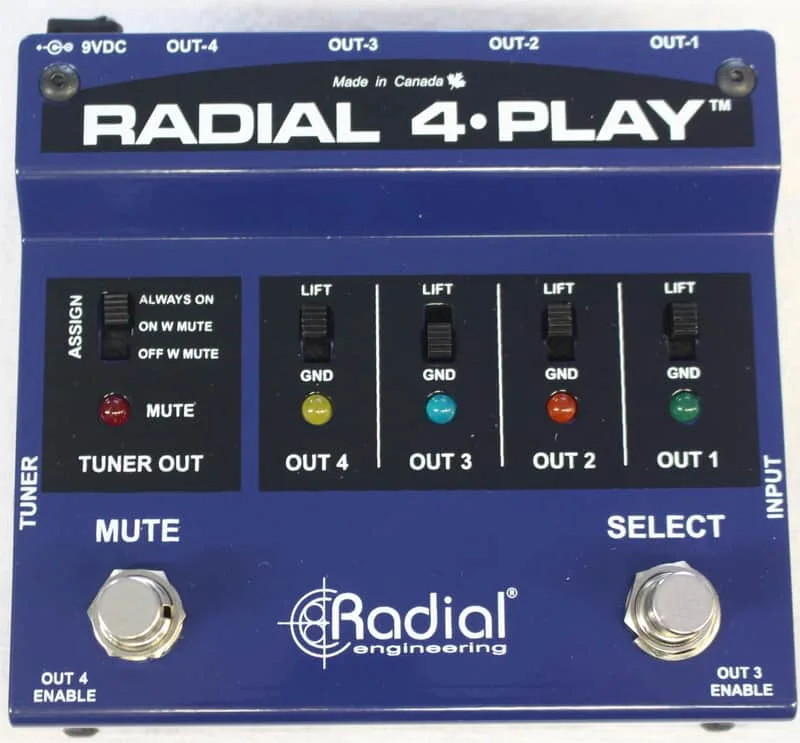
The Radial Engineering 4-Play is an active multi-output DI box with a switching function. It takes a single instrument input and lets the player switch between four balanced DI outputs running to the PA or monitor system, all in one rugged steel chassis built for live performance1. A DI box (direct input box) converts an instrument's unbalanced signal into a balanced line level that mixing consoles can work with, which is why a unit like this lives between the stage and the front of house.
What it does on stage
The 4-Play is aimed at live performance and at routing multiple instruments through a single point. One instrument input feeds the unit, and the player selects which of the four balanced DI outputs the signal goes to1. For a player whose signal reaches the PA rather than an amp, that means one box handles the switching that would otherwise take several separate units.
Two features support quiet stage work:
- A shared tuner output, so a tuner stays connected whatever the selected output1
- A mute footswitch, for quiet instrument changes or tuning on stage1
The tuner output pairs naturally with a dedicated tuner pedal, and the switching role places the 4-Play among switching pedals more broadly.
Controls and noise control
Each of the four outputs carries its own ground-lift switch. Ground loops between powered equipment on stage are a common cause of hum and buzz, and lifting the ground on an output breaks the loop. Having a switch per output means each line can be handled on its own1.
Power
The 4-Play runs on 9V DC, center negative, and draws 80mA1. That draw is well above a typical single stompbox, so a daisy chain shared with low-draw pedals may not be the best home for it; a supply with headroom for the full 80mA is the safer plan.
At 80mA, the 4-Play draws more current than most compact pedals. Plan your power supply around that figure rather than assuming a standard multi-output brick slot will cover it1.
Radial publishes an English manual for the 4-Play on its own site1.
Videos
5best Deals
Questions
Is the Radial 4-Play analog or digital?
The 4-Play is an analog unit. It is an active DI box, meaning its circuit is powered rather than passive, but the signal path itself stays analog from the instrument input through to the four balanced outputs. There is no digital conversion or modeling involved, which matters for players who want their instrument's signal passed to the PA or monitors without added processing.
How many outputs does the Radial 4-Play have?
It has four balanced DI outputs plus a shared tuner output. A single instrument input feeds the unit, and the player switches between the four balanced outputs, which can run to the PA or monitor system. The tuner output is shared, so a tuner can stay connected regardless of which output is selected.
What does the ground-lift switch on the Radial 4-Play do?
Each output has its own ground-lift switch. Ground loops, caused by multiple pieces of equipment sharing ground paths, are a common source of hum and buzz on stage. Lifting the ground on an output breaks that loop, and having a switch per output means each of the four lines can be dealt with individually.
What power does the Radial 4-Play need?
The 4-Play runs on 9V DC, center negative, and draws 80mA. That current draw is higher than many single-effect pedals, so it is worth keeping in mind when planning a power supply or daisy chain with other pedals on a board.
Can I tune silently with the Radial 4-Play?
Yes. The 4-Play combines a shared tuner output with a mute footswitch. Muting the signal allows quiet instrument changes or tuning on stage, and the tuner output keeps a tuner connected at all times, so the player can tune without the audience hearing the instrument.
Sources (1)
- 4-Play by Radial Engineering, RockBoard (rockboard.de PedalPedia), 2026