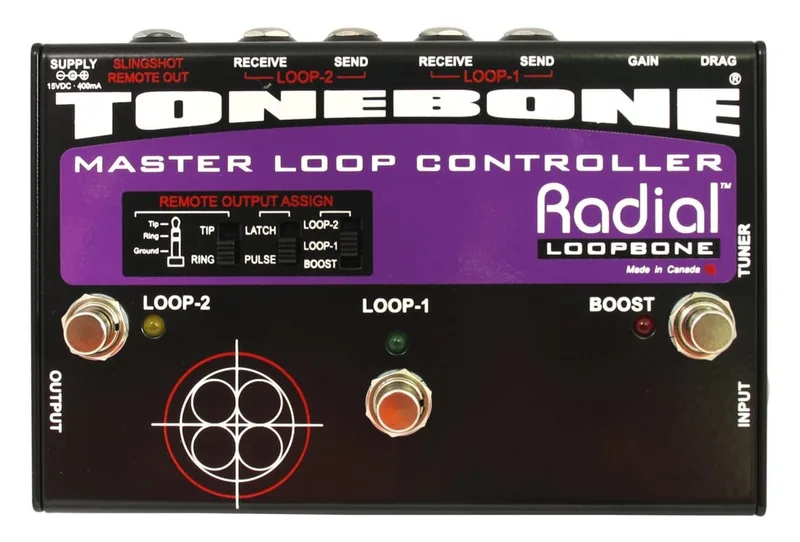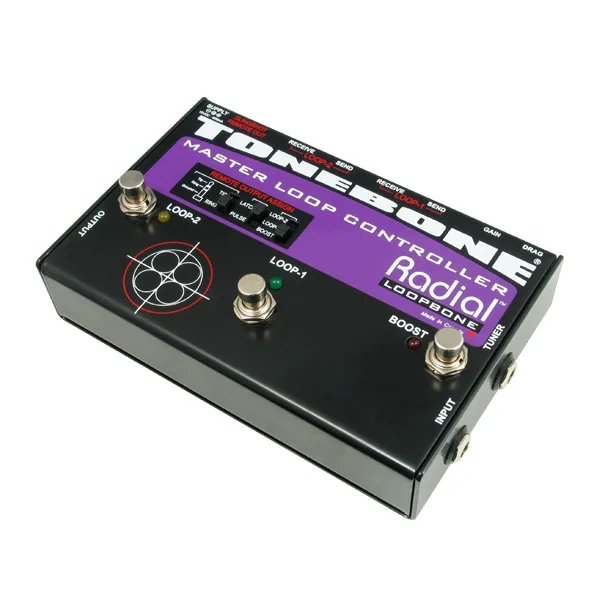

The Radial Loopbone is a high-performance effects-loop switcher that lets a guitarist insert, remove and combine pedals in two effects loops at their feet, in the order they choose1. It is a switching pedal from Radial Engineering's Tonebone line, built around the maker's 100% discrete class-A buffer circuit, with Drag Control load correction, an adjustable gain control, a boost feature and a tuner-out jack12.
Radial states on the product page: "This product has been discontinued and is no longer shipping."1 The page and its User Guide remain available in Resources1.
What it does
The Loopbone sits between the guitar and the amplifier and holds two effects loops. Radial describes it as enabling the guitarist to insert, remove and combine pedals1. The two loops are wired in series, which Radial says is "to enable the first loop to be fed into the second"1, so a pedal in loop one can feed a pedal in loop two in a fixed order rather than running side by side.
Vintage Guitar's Bob Tekippe, reviewing the pedal in the August 2005 issue, listed its connections: "The Loopbone has two sets of effects send/receive jacks, and the Slingshot jack."2 The Slingshot jack is Radial's connection for remote switching of amplifier functions, letting the Loopbone pass switching commands along with its audio routing2.
Buffer, Drag Control and noise
The design begins with what Radial calls its "award winning 100% discrete class-A buffer circuit for the very best audio fidelity"1. On top of that sits Drag Control, which Radial describes as "a load correction circuit that allows the user to reintroduce the natural tone and feel of the guitar as if connected directly to a tube amplifier"1. In practice, that is a control for dialing back the signal loss a player hears when pedals and cable runs load down a guitar's pickups.
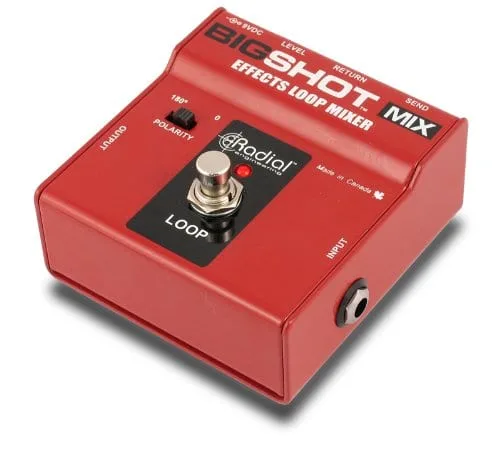
Radial also addresses switching noise directly. In a support article, the maker wrote: "The Radial Tonebone Loopbone eliminates switching noise because it employs active class-A buffers and photocells that ramp up the signal level"3. Photocell switching means the audio path is ramped rather than hard-switched, which is how the design avoids the pops some loopers produce.
Gain, boost and bass
The Loopbone carries an adjustable gain control, which Tekippe listed alongside the Drag control and tuner-out jack2. The review also singled out the boost feature:
"The Loopbone's boost feature is fantastic - and you can manipulate gain boost with its inset control."
Tekippe described it as producing a transparent volume boost with a slight edge on the clean setting and an equally transparent, searing solo boost on the distorted loop2.
For bass players, Radial says the buffering suits low-tuned instruments too: "The Loopbone's 100% discrete class-A buffering will deliver your full tone without affecting the bottom end"1. Players pairing it with other low-end gear can also see the site's bass pedals page.
Where it sits in Radial's switching range
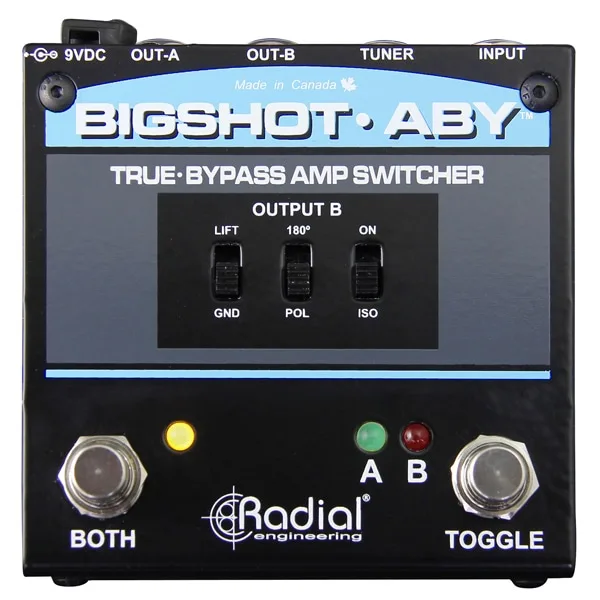
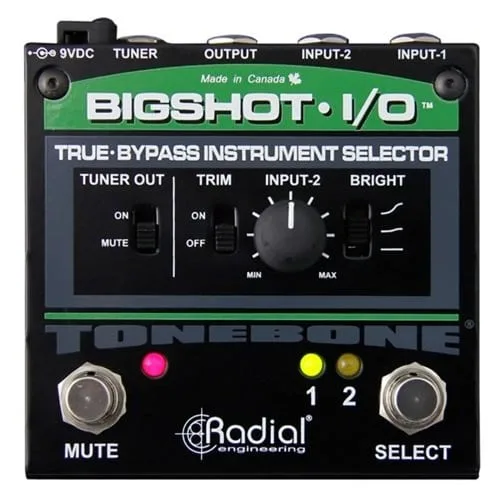
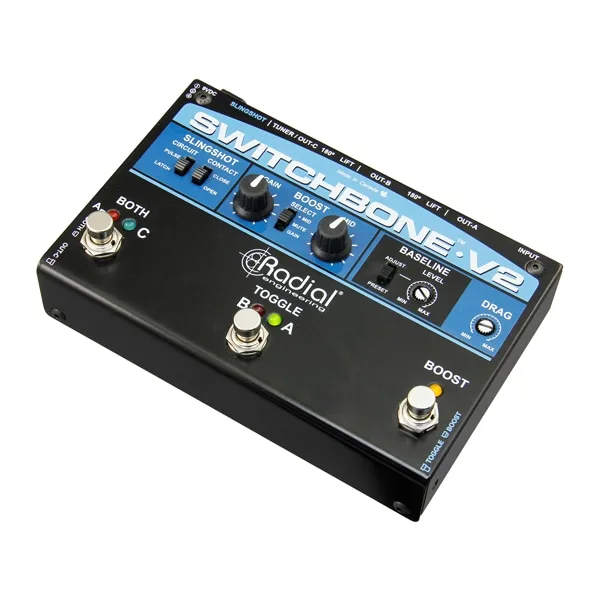
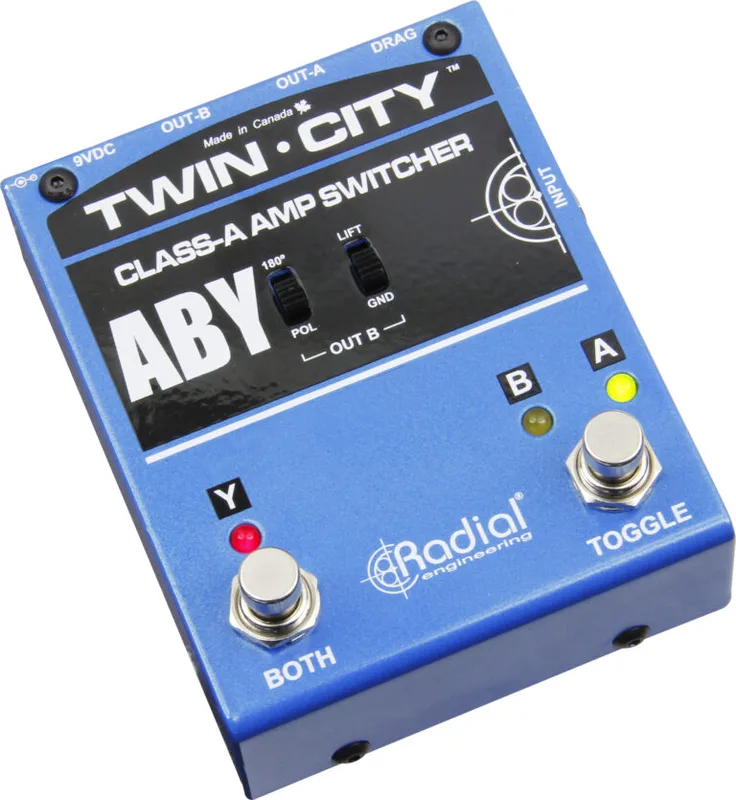
The Loopbone is one of several switching devices Radial has made for managing pedals and amps. Others covered on this site include the BigShot ABY amp switcher, the BigShot I/O instrument selector, the Switchbone amp switcher, the Twin-City and the JX44 guitar signal manager. The Loopbone's specialty among them is series effects-loop switching with a built-in class-A buffer and Drag Control1.
Videos
Bright Tech Vision
Questions
Is the Radial Loopbone discontinued?
Yes. Radial Engineering's product page states plainly that the Loopbone has been discontinued and is no longer shipping. The page remains online as a reference, and the user guide is still available in the Resources section of that page for owners who need documentation.
What is the Radial Loopbone's Slingshot jack?
The Slingshot jack is one of the Loopbone's connections, listed by Vintage Guitar's Bob Tekippe alongside the two sets of effects send/receive jacks. Radial's Slingshot system is the maker's method for switching amplifier functions remotely, letting the Loopbone pass switching commands to a Slingshot-equipped device or amplifier.
Are the Loopbone's two effects loops in series or parallel?
They are wired in series. Radial says the two effects loops are wired in series to enable the first loop to be fed into the second, so a pedal in loop one can feed a pedal in loop two in a set order.
Does the Radial Loopbone work with bass?
Radial says it does. According to the maker, the Loopbone's 100% discrete class-A buffering will deliver your full tone without affecting the bottom end, which is the concern bass players usually have with buffered switching devices.
Does the Radial Loopbone have a tuner output?
Yes. Vintage Guitar's review lists a tuner-out jack among the Loopbone's features, along with an adjustable gain control and a Drag control that eliminates signal loss.
Where can I find the Radial Loopbone manual?
Radial's product page for the Loopbone lists a User Guide under the page's Resources section. Since the pedal is discontinued, that page is the place to find the documentation.
Sources (3)
- Loopbone, Radial Engineering, 2021-03-17
- Radial Cabbone, Switchbone, and Loopbone, Vintage Guitar magazine, 2010-04-05
- BigShot EFX FAQ, Radial Engineering, 2018-05-14