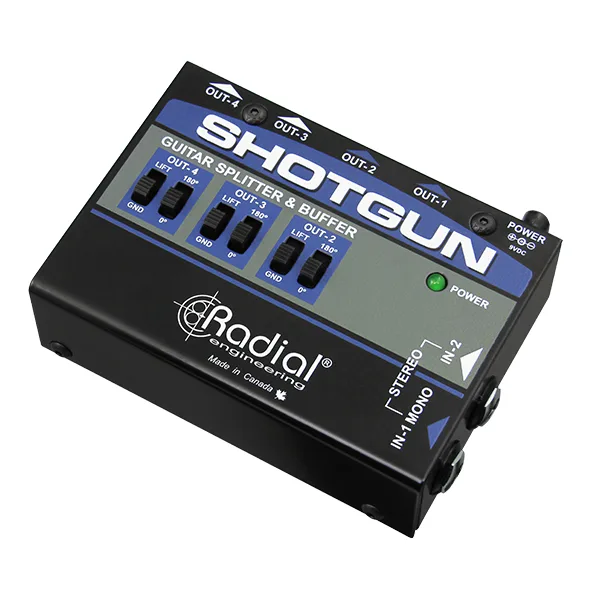
The Radial Shotgun is a compact guitar-level signal buffer from Radial, built to drive up to four amplifiers simultaneously while staying small enough to sit on any pedalboard1. Radial's spec sheet describes it as a multi-output unity-gain buffering amplifier designed to faithfully reproduce high-impedance electric guitar signals2. In plain terms: it takes your guitar or pedalboard output, buffers it so long cable runs and multiple amp connections do not load down your tone, and hands that signal to as many as four amps at once.
The Radial Shotgun is a guitar-signal distribution amplifier built into a heavy 14-gauge steel case that provides shielding from power supplies and keeps the internal electronics safe from abuse3. Radial describes it as a distribution amplifier rather than a mixer, so it splits a signal to drive multiple destinations without combining them4.
Mono 1x4 and stereo 2x2 operation
The Shotgun's main trick is that it reconfigures itself depending on which inputs you use. Plug into input-1 alone and you get 1x4 mono: one signal feeding up to four amps simultaneously1. Plug into input-2 as well and the circuit changes to 2x2 stereo, feeding input-1 to the first two amplifiers and input-2 to the second pair31. There is no mode switch to forget before a gig; the box senses the second connection and reroutes itself.
| Setup | Input used | What happens |
|---|---|---|
| Mono 1x4 | Input-1 only | One signal drives all four outputs |
| Stereo 2x2 | Input-1 and Input-2 | Input-1 feeds outputs 1 and 2, input-2 feeds outputs 3 and 4 |
Guitar.com's launch coverage described the same behavior: "the Shotgun may be set up for mono use with one input driving four outputs or in stereo with two inputs driving two pair"5.
Outputs, isolation and ground loops
The four outputs are not all the same. Output-1 is direct, while the other three are transformer isolated to reduce ground noise contamination between amps2. Radial sets output-1 as the default for a reason: it provides a solid ground connection from the guitar to the amplifier, which the company describes as important for both noise and safety4. Guitar.com's coverage made the same point, noting that "Output-1 is the default that provides a safety ground path to the guitar"5.
The isolation matters in practice. When you plug one guitar into several amps on separate power circuits, ground loops can introduce hum and buzz. The Shotgun gives you tools for that:
- Ground lift switches on outputs 2, 3 and 4, which lift the audio ground to help prevent hum and buzz caused by ground loops3
- 180-degree polarity switches to phase-match amps, so two amps whose speakers move in opposite directions do not cancel each other's low end1
Guitar.com noted the ground lift switches at launch, calling them a supplement to the core distribution circuit5.
What it does to the signal
The Shotgun is a unity-gain buffer, so it does not boost or shape your tone. Gain is 0dB, or -0.2dB on the isolated outputs2. Radial says it is intended for guitars with a working range of between -30dB and 0dB, and the spec sheet reports intermodulation distortion of about 0.02%2. Other measured figures from the spec sheet2:
| Specification | Value |
|---|---|
| Maximum input | +8dBu |
| Clip level | +4dBu |
| Dynamic range | 92dB |
| Noise floor | -86dBu |
| Equivalent input noise | -90dBu |
Radial chose a low-noise integrated circuit for the buffer because, as the company explains, the source will likely be a pedalboard with a number of pre-buffered signals already in the chain4. The measured performance backs up that choice: gain of 0dB/-0.2dB, intermodulation distortion of ~0.02%, and equivalent input noise of -90dBu2.
Power and build
The Shotgun runs on a standard 9V connection that accepts a Boss-type power adaptor or a DC brick, and the power supply is not included3. Guitar.com's launch coverage noted the same arrangement, a standard 9V supply or a pedalboard brick connection5. Plan on a brick outlet.
The enclosure is a heavy 14-gauge steel case, which Radial says provides shielding from power supplies and keeps the internal electronics safe from abuse3. It is a small box: 4.5 by 3.5 by 1.37 inches (114 x 92 x 35mm), weighing 1.1lb (0.5kg)2.
Cables, instruments and studio use
Radial recommends 15 meters, about 50 feet, as the maximum cable length from the Shotgun4. For longer runs the company suggests a Radial SGI to balance the signal4.
The Shotgun is not limited to electric guitar. Radial says it works perfectly fine with bass, works with acoustic guitar to drive a stage amp, direct box and tuner at the same time, and works with keyboards, with the caveat that some high-output digital pianos can overload it, in which case Radial's remedy is to turn down the piano's output level if distortion is heard4. In the studio, Radial suggests using it to split your guitar signal to various effects, amps and a direct box so you can Reamp the guitar later1. For the direct box, Radial recommends a passive DI like its JDI, with the ProDI as a more affordable alternative4.
One thing the Shotgun will not do: mix. Radial states plainly that it is a distribution amplifier, not a mixer, so it cannot combine a stereo source down to mono4. If you need summing rather than splitting, this is the wrong box.
Questions
How many amps can the Radial Shotgun run at once?
Up to four. In mono operation you plug into input-1 and the Shotgun feeds four amplifiers simultaneously. Plug into both inputs and it reconfigures itself for stereo, with input-1 driving the first two amps and input-2 driving the second pair.
Does the Radial Shotgun come with a power supply?
No. It uses a standard 9V connection that accepts a Boss-type power adaptor or a pedalboard power brick, but the power supply itself is not included. Plan on a spare outlet on your existing brick or a separate 9V adaptor.
Can the Radial Shotgun be used with bass?
Yes. Radial says it works perfectly fine with bass. It is designed for Hi-Z instruments, and its 20Hz to 20kHz frequency response covers the bass range. Radial also notes it works with acoustic guitar and keyboards, though high-output digital pianos can overload it.
How long a cable can I run from the Radial Shotgun?
Radial recommends 15 meters, about 50 feet, as the maximum cable length from the Shotgun. For longer runs the company suggests using a Radial SGI to balance the signal instead.
Can the Radial Shotgun mix stereo to mono?
No. Radial is explicit that it is a distribution amplifier, not a mixer, so it cannot combine a stereo source down to a single mono output. It splits one or two inputs across up to four outputs; it never sums signals together.
Sources (5)
- Shotgun - Radial Engineering, Radial Engineering, 2026-02-25
- Shotgun Specifications, Radial Engineering, 2018-05-03
- Shotgun Features, Radial Engineering, 2024-09-16
- Shotgun FAQ, Radial Engineering, 2018-05-15
- News: Radial's Shotgun Stereo amp driver and distro now shipping, Guitar.com, 2016-02-16