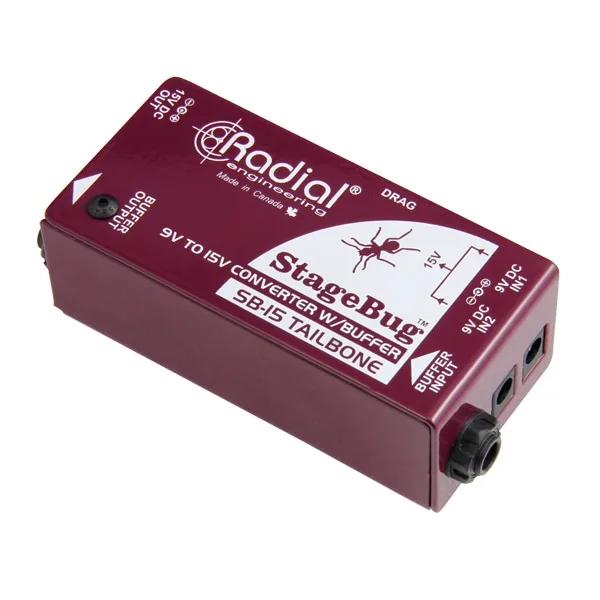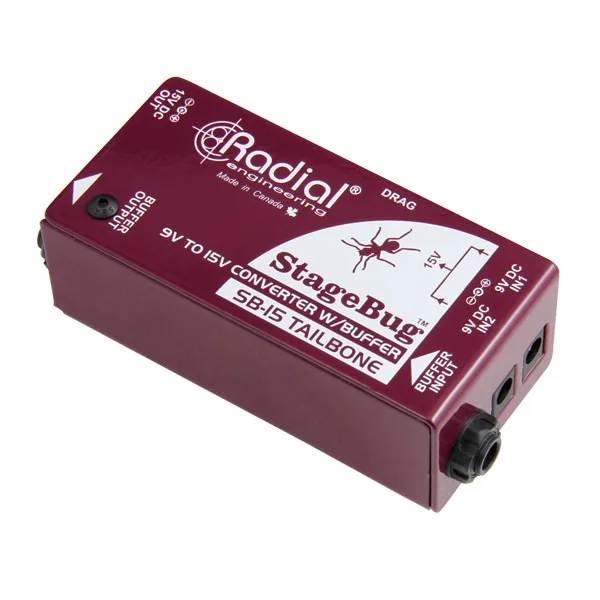
The Radial StageBug SB-15 is a combination hi-Z signal buffer and DC power adaptor for pedalboards, made by Radial Engineering. It is designed to sit at the beginning of the signal chain and drive multiple pedals without added noise or signal loss, and in the same box it converts two 9V outputs from a typical power brick into a 15V supply for a Tonebone pedal12.
The buffer is a 100% discrete class-A FET circuit running at unity gain, so it adds no level, only consistency34. Radial says the higher voltage and double the average current of its power conversion increases headroom and dynamic range5. The product has been discontinued and is no longer shipping1.
Radial lists the StageBug SB-15 as discontinued and no longer shipping1.
A class-A buffer and 15V power converter in one box
The SB-15 does two jobs. First, it is a class-A signal buffer: a high impedance guitar signal goes in, and a low impedance, low noise signal comes out that can drive multiple pedals and long cable runs. When the pedal launched as the SB-15 Tailbone in April 2014 at $90 USD, Premier Guitar described it as:
"a high performance signal buffer designed to sit at the beginning of the signal chain and drive multiple pedals without the added noise that often plagues high impedance circuits"5
That original Tailbone could drive multiple pedals over distances of 15 meters (50 feet) without noise, and used the same award winning class-A buffer as the Radial JD75. The signal is then tamed by Radial's Dragster load correction circuit, which replicates the tone and feel of being connected directly to the amplifier5.
Second, it is a DC to DC converter. Radial says the SB-15 incorporates a converter that takes two 9V supply lines from a typical power brick and produces 15 volts for Tonebone users who need a 15VDC supply13. Radial describes the result as making it easy to power a 15 volt Tonebone using two 9V 400mA outputs, converting both the voltage and the polarity to suit1.
The controls and jacks
The SB-15 has one control, the Drag Control, and two audio jacks: a Hi-Z ¼" buffer input and a ¼" buffer output. It also has three power connections: 9VDC In-1, used to provide power to the buffer circuit, 9VDC In-2, used with 9VDC IN-1 to increase input power, and a 15VDC Out designed to supply Tonebone pedals32.
| Control or jack | What it does |
|---|---|
| Drag Control | Load correction knob, adjusts the pickup loading to tune the feel of the buffered signal3 |
| Buffer Input | Hi-Z 1/4" guitar connection to the class-A buffer circuit2 |
| Buffer Output | 1/4" output to pedals and amp, allows a longer cable run without noise2 |
| 9VDC In-1 | Powers the Tailbone class-A active buffer circuit2 |
| 9VDC In-2 | Used with 9VDC In-1 to increase input power so the pedal can deliver 15 volts to a Tonebone pedal42 |
| 15VDC Out | Special 15 volt 400 milliamp output designed to supply Tonebone pedals, using the two 9VDC 400mA supplies as the power source2 |
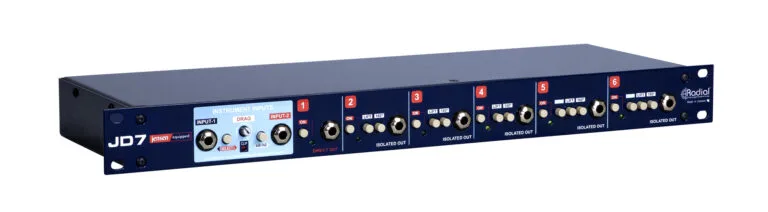
Drag Control is the one tonal control. It is a load correction circuit, and Radial is explicit about its limits: Drag only works on magnetic pickups, not active EMG pickups4. On the related JD7, Radial adds that Drag control is designed for passive pickups, so any effect on active circuits will be very minimal7.
Power: two 9V inputs to a 15V Tonebone output
Power is where the SB-15 differs from most buffers. Radial specifies dual 9VDC 400mA supplies for optimal performance, and notes the pedal may be used with a single 9VDC 100mA supply to power the buffer only13. Asked directly whether one 9V supply is enough, Radial's answer is:
"Yes, absolutely. Using a single 9V power supply will offer you about 98dB of headroom."4
The measured difference shows up in the dynamic range: 104dB with a dual 9V supply and 98dB with a single 9V supply3. The 15V output is rated at +15V DC 400mA1, and the original Tailbone press material notes the higher voltage and double the average current of 400 milliamps increases headroom and dynamic range for Tonebone pedals5.
The connectors matter if you are wiring a board: the 9V inputs use a standard 2.1mm barrel with center negative, while the 15V output uses a standard 2.1mm barrel with center positive13. That polarity flip is part of the conversion Radial built in13.
A single 9V supply runs the buffer, but the 15V Tonebone output only works with both 9V inputs connected14.
Specifications
| Specification | Value |
|---|---|
| Audio circuit type | Class A FET buffer3 |
| Frequency response | 20Hz to 30Khz3 |
| Dynamic range | 104dB with dual 9V supply; 98dB with single 9V supply3 |
| Clip level | +16dBu3 |
| Total harmonic distortion | 0.01% @ 1kHz3 |
| Intermodulation distortion | 0.004%3 |
| Input impedance | 22K to 500K3 |
| Output impedance | 4.7K3 |
| Noise floor | -88dBu3 |
| Size (L x W x D) | 4.5" x 1.85" x 1.35" (114mm x 47mm x 34mm)3 |
| Weight | 0.55lb (0.25kg)3 |
| Conditions | For use in dry locations only between 5°C and 40°C3 |
The wide input impedance range of 22K to 500K reflects the Drag Control circuit: turning the knob changes the load the pickups see, which is how it tunes the feel of the signal3.
The Tailbone connection
The StageBug SB-15 is the continuation of the SB-15 Tailbone, and Radial describes it as a 100% discrete class-A signal buffer5. The product has been discontinued and is no longer shipping1. Its analog circuit carries the StageBug SB-15's specifications, including a frequency response of 20Hz to 30Khz and total harmonic distortion of 0.01% at 1kHz23.
Questions
Can the Radial StageBug SB-15 run on a single 9V supply?
Yes. Radial says a single 9VDC 100mA supply powers the buffer on its own, giving about 98dB of headroom. To also feed the 15V output for a Tonebone pedal, you need both 9VDC 400mA supplies, which raises the dynamic range to 104dB.
Does the SB-15 Drag Control work with EMG pickups?
No. Radial states that Drag Control only works on magnetic, passive pickups. On the related JD7, Radial notes that Drag is designed for passive pickups and its effect on active circuits like EMGs is very minimal.
Does the StageBug SB-15 add any gain or boost?
No. The buffer is set to unity gain, 0dB, with no level adjustment available. Radial describes it as what you put in, you will get out, only with more consistency. It is a buffer, not a boost pedal.
Is the Radial Tailbone the same as the StageBug SB-15?
The SB-15 Tailbone was the original name when Radial announced the pedal in April 2014 at $90 USD. It used the same class-A buffer as the Radial JD7 plus a Dragster load correction circuit, and the StageBug SB-15 carries that design forward.
Which Radial Tonebone pedals need a 15V supply?
The SB-15's 15VDC 400mA output is designed to supply Tonebone pedals, which Radial says require a 15VDC supply. The pedal converts two 9V 400mA outputs from a power brick into that 15V feed.
Sources (7)
- StageBug SB-15, Radial Engineering, 2024-11-07
- SB-15 Features, Radial Engineering, 2019-04-05
- SB-15 Specifications, Radial Engineering, 2019-04-05
- SB-15 FAQ, Radial Engineering, 2019-04-05
- Radial Engineering Introduces the SB-15 Tailbone, Premier Guitar, 2014-04-07
- StageBug SB-15 by Radial Engineering, RockBoard PedalPedia, 2026
- JD7 FAQ - Radial Engineering, Radial Engineering, 2018-05-14