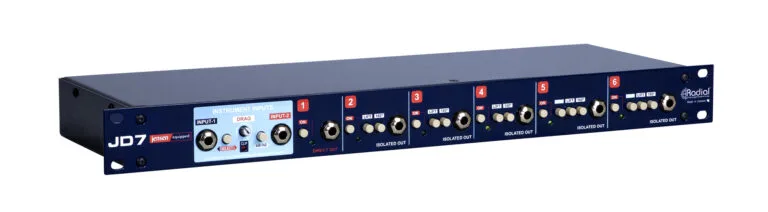
The Radial JD7, sold as the JD7 Injector, is a rackmount class-A guitar distribution center and splitter with a built-in Radial DI and Reamp, made by Radial. Its job is simple to describe: it takes one guitar signal and can drive up to seven amps or pedal chains simultaneously, which makes it a hub for players and techs running multiple amplifiers or large pedal setups on one stage1.
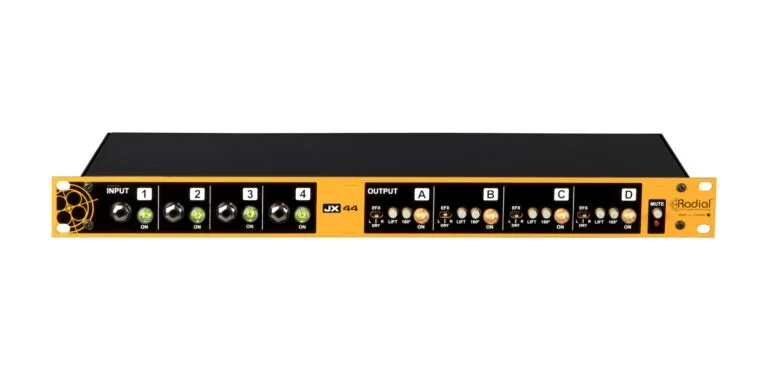
Radial describes the JD7 as a studio-centric design. The company says the JD7 utilizes Jensen transformers and calls it one step better than the JX44, Radial's guitar signal manager2. Players and techs have put it to work in serious rigs: Premier Guitar reported the JD7 is used by guitarists as diverse as Steve Vai, John Petrucci, Steve Lukather and many others3, and a later Premier Guitar release, quoting Radial's Peter Janis, listed Carlos Santana, John Petrucci, Steve Vai, Kerry King and Joe Perry among its users4.
What it does to your signal
The JD7 is built around a class-A buffer and Radial's Drag control load correction, the same circuit pair Radial later used in the JX-426. The buffer feeds a balanced low-Z direct box output through a Radial custom wound DI box transformer, designed to feed a mic preamp or mixing console5. That means a recording engineer or live tech can take a clean direct feed of the guitar at the same time as the amplifier feeds.
Radial describes the circuit this way:
"The JD7 employs 100% discrete components and class-A circuitry throughout to deliver the most natural tone."
The class-A design here has a family history at Radial: the company describes the JD7 as the origin of the basic class-A circuit design used in its power boosters, such as the Elevator7.
Noise, isolation and touring use
Because the JD7 sits between a guitar and several amplifiers, ground loops are the obvious risk. Radial addresses this two ways. The unit employs an external floating power supply, a wall wart style adapter, to help eliminate buzz and hum caused by ground loops5. Transformer isolation on the outputs then deals with the rest: Radial says the JD7 basically gets rid of problem noise, making it easier for the tech to set up the guitar rig each night5.
Reamping and related Radial gear
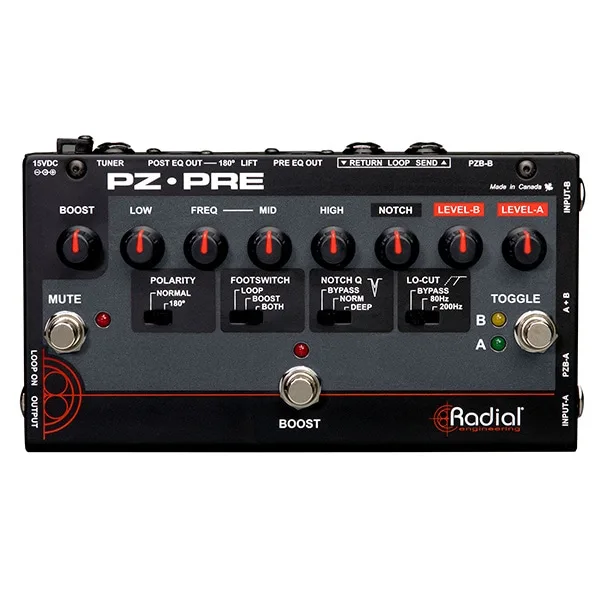
The built-in Reamp side of the JD7 puts it in Radial's reamping lineup. In Radial's own comparison of its reampers, the company says the Radial X-Amp or Radial JD7 Injector may be better suited for situations where you want to Reamp to more than one amp, positioning it against the single-output JCR8. The JD7 is also equipped with inputs to allow connecting a guitar via a preamp for distribution, which is how Radial describes using it with gear like the PZ-Pre9.
Radial describes the JD7 as the studio-centric option in its distribution lineup, one step better than the JX442. If your use is live signal management rather than studio distribution, the JX44 is the unit it sits above.
Videos
Perfecto De Castro
Questions
What does the Drag control on the Radial JD7 do?
Drag control is Radial's load correction circuit, designed to let the JD7 present the right load to a guitar's passive pickups so the tone stays natural when the signal is split to multiple outputs. Radial notes that Drag control is designed for passive pickups, so any effect on active circuits will be very minimal.
Does the Radial JD7 work with active pickups like EMGs?
Yes. Radial states that the Drag control is designed for passive pickups, so any effect on active circuits will be very minimal. In other words, the JD7 works with active pickups like EMGs, but the Drag control's load correction mainly matters for passive pickups.
What is the difference between the Radial JD7 and the JX44?
Radial describes the JD7 as the studio-centric version that utilizes Jensen transformers, one step better than the JX44. The JX44 is Radial's guitar signal manager, while the JD7 is aimed at studio and high-end distribution work with Jensen transformers.
Does the Radial JD7 use Jensen transformers?
Yes. Radial describes the JD7 as the studio-centric version that utilizes Jensen transformers, one step better than the JX44. The JD7's direct box output feeds a Radial custom wound DI box transformer, designed to feed a mic preamp or mixing console.
How is the Radial JD7 powered?
The JD7 employs an external floating power supply, a wall wart style adapter, to help eliminate buzz and hum caused by ground loops. Radial designed it this way so the unit can sit between a guitar and multiple amplifiers without introducing ground loop noise.
Is the Radial JD7 analog or digital?
The Radial JD7 is fully analog. Radial states that the JD7 employs 100% discrete components and class-A circuitry throughout to deliver the most natural tone.
Sources (9)
- Comparing Reampers, Radial Engineering, 2023-09-20
- JX44 FAQ, Radial Engineering, 2018-05-14
- Radial Engineering Introduces the SB-15 Tailbone, Premier Guitar, 2014-04-07
- Radial Elevator: Ultimate Buffer & Power Booster, Premier Guitar, 2014-03-11
- JD7 FAQ - Radial Engineering, Radial Engineering, 2018-05-14
- JX-42 FAQ, Radial Engineering, 2018-05-14
- Elevator FAQ, Radial Engineering, 2018-05-14
- JCR FAQ - Radial Engineering, Radial Engineering
- X-Amp FAQ, Radial Engineering, 2020-08-05