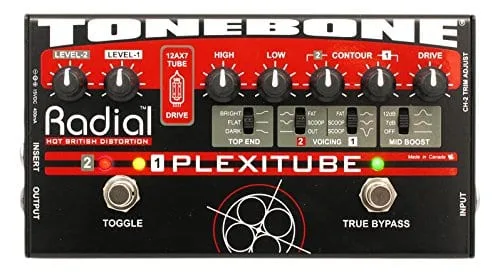


The Radial Tonebone Plexitube is a dual-channel tube distortion pedal from Radial Engineering, built around a 12AX7 tube working with a multi-stage solid-state drive circuit. Radial describes it as a high-gain, low-noise Plexi-style tube distortion pedal, and Guitar World's 2007 review said it was revered for its ability to accurately create the tones of a modified "Plexi" stack12. The two channels are set up for a foot-switch move between rhythm and lead settings, with the lead channel voiced for higher gain32.
The pedal is discontinued: Radial states it is no longer shipping1. It was released in May 2007 as a more feature-laden British-style pedal in the Tonebone line, recreating the sound of the original Hot British pedal while adding a second high-gain channel, more distortion control, voicing options and an effects loop insert on channel 22.
How the circuit works
The Plexitube creates its distortion through a hybrid design. The 12AX7 tube is used to generate harmonics and warm up the signal path, and it is combined with three gain stages to create the pedal's rich distortion5. Guitar World described the result as an onboard 12AX7 preamp tube working with a specially designed multistage solid-state drive circuit to produce its range of Brit-style distortion2.
Radial credits the build with low noise: components are soldered to a double-sided circuit board with a full-surface ground plane, which the company says makes it one of the quietest pedals in its class4. The outer case is heavy-duty 14-gauge steel to eliminate stress on the circuit board and help prevent premature part failure, and high-lifecycle footswitches combine with steel-shafted potentiometers for durability4. A vent provides air ventilation to keep the tube running cool6.
The two channels
The two channels are voiced for different jobs. Channel 1 is optimized for rhythm, with chunk rhythm tones and scooped-out mids, while channel 2 is the lead channel, optimized for razor-sharp cut on solos and sustaining mids32. A single foot stomp on the toggle switch moves between them6.
Channel 2 also carries the pedal's effects insert: a standard 1/4" TRS insert jack lets you add effects such as a delay to channel 2, so toggling to the solo channel automatically brings the delay in with it62.
The controls
Radial's feature page breaks down each control6:
| Control | What it does |
|---|---|
| Level 1 & 2 | Adjusts the overall output of each channel, acting like a master volume on a guitar amp |
| EQ | A two-band passive-interactive equalizer for tone shaping while retaining natural sound |
| Top End | 3-position switch shaping the overall EQ dark, flat or bright, to compensate for humbuckers or single coils |
| Voicing | 3-position switch for each channel, with ultra scoop on the rhythm channel |
| Mid Boost | 3-position switch that increases the midrange on either channel for added cut when soloing |
| Toggle | Switches between channel 1 and channel 2 with a single foot stomp |
Guitar World's review adds the layout detail: a drive knob for both channels, global high- and low-frequency controls, independent output level controls, independent contour knobs for each channel's midrange, and switches for voicing, midboost and top-end response2. Radial also lists a boost function among the pedal's features4.
Power and the tube
The Plexitube runs on 15V DC at 400mA, and a 15-volt DC 400mA power adaptor is supplied with it45. The power supply input is internally regulated to properly heat the tube and power the rest of the circuit6. Note the polarity conflict: Radial's specification page lists the supply as center pole positive4, while RockBoard's listing gives it as center negative3; the two sources disagree, so check the pedal and its supplied adaptor before substituting another supply.
A standard 9V pedal supply will not run the Plexitube. Radial points to the Cioks DC10 power brick, which has a 15V outlet for Tonebone pedals, as a compatible option5. Whatever supply is used, it must deliver correct polarity and sufficient current for the pedal's 15V DC, 400mA requirement5.
The tube itself is a long-lived part. Radial says the tube can last upwards of 10 years, that changing it only affects the sound slightly, and that the shipped tube is typically a Ruby Tube 12AX7, though this can change due to supply5. Radial suggests changing the tube only if the tone is lacking or the output is down from when you first plugged the pedal in, and complete instructions with pictures are in the user guide5.
What reviewers said
Guitar World reviewed the Plexitube in May 2007, testing it with a Burstbucker-loaded Les Paul into a Fender Vibro-King2. The review found the two channels offered modern, edgy distortion that was very lively2.
"The Plexitube's two channels offered modern edgy distortion that was very lively."
In Delicious Audio's 2024 guide to Plexi-style pedals, Matthew Wang wrote:
"This pedal sounds really rich and beefy with a lot of range for you to play with in the mids department."
Using it with bass
Radial says the Plexitube can absolutely be used with bass, but notes that with distortion on bass it is typically preferred to run the pedal in parallel to retain the full low-end frequencies of the instrument, mixing the distorted signal with the original bass tone5. Players building a bass pedalboard will want a parallel mixing solution rather than running the pedal straight in series.
Troubleshooting channel 2
If channel 2 loses signal, the cause is usually the insert jack. Channel 2 is normalled through the insert jack on the pedal, and if that jack typically goes unused it may need to be exercised from time to time. Working a guitar plug in and out of the jack a handful of times should restore the signal5.
Where it sits in the Tonebone line
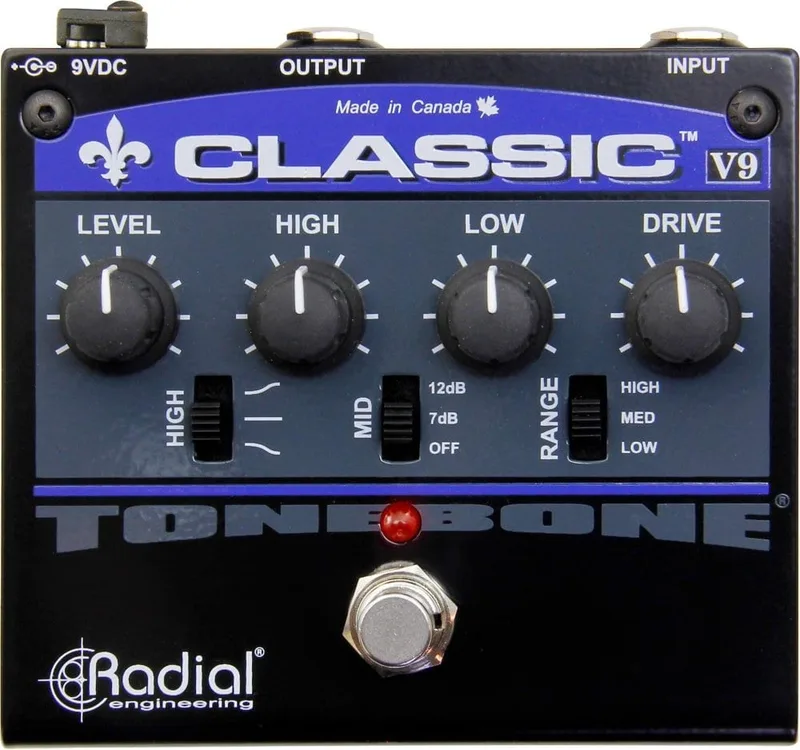
The Plexitube grew out of the original Hot British pedal, whose sound it recreates while adding the second high-gain channel, more distortion control, voicing options and the channel 2 effects insert2. Radial later took the Tonebone line in a different direction with compact, tubeless versions: the Tonebone Classic V9 and the Hot British V9, both smaller 9V-powered pedals that drop the 12AX7 tube. The Plexitube, by contrast, keeps the tube and the 15V supply, which is part of why it stands apart from those later pedals.
Videos
ProGuitarShopDemos
G-System Videos
POLAR - Integrated Solutions & Pro Audio
Questions
Can the Radial Plexitube run on 18V?
Radial says it can be run from an 18V power brick, but warns this may shorten the lifespan of the internal voltage regulators. If you do it, the supply must deliver the correct polarity and sufficient current. The pedal is designed around its supplied 15V DC 400mA adaptor, so 15V remains the intended operating voltage.
Is the Radial Plexitube discontinued?
Yes. Radial Engineering states the product has been discontinued and is no longer shipping. It was released in May 2007 as a more feature-laden British-style pedal in the Tonebone line, and units now turn up only on the used market.
Does the Plexitube work with bass?
Radial says it can absolutely be used with bass, but notes that with any distortion pedal on bass it is typically preferred to run the effect in parallel so the full low-end frequencies of the instrument are retained, mixing the distortion with the original clean bass tone.
How do I fix signal loss on channel 2 of the Plexitube?
Channel 2 is normalled through the insert jack on the pedal. If that jack usually goes unused, it may need exercising from time to time. Radial's advice is to plug a guitar plug into the insert jack and work it a handful of times, which should restore the channel 2 signal.
Is the Radial Plexitube true bypass?
Yes. Radial describes it as a true-bypass, dual-channel tube distortion pedal with true-bypass switching to retain your tone, and Guitar World's 2007 review also noted true-bypass operation when the pedal is turned off.
Does the Plexitube run on a 9V power supply?
No. It requires 15V DC at 400mA, and a 15-volt DC 400mA adaptor is supplied with it. Radial notes the Cioks DC10 power brick has a 15V outlet suitable for Tonebone pedals. A standard 9V supply cannot properly heat the tube and power the circuit.
Sources (7)
- Plexitube, Radial Engineering, 2024-01-30
- Radial Engineering Tonebone Plexitube distortion, Guitar World, 2007-05-14
- Plexitube by Radial Engineering, RockBoard PedalPedia, 2026
- Plexitube Specifications, Radial Engineering, 2018-04-18
- Plexitube FAQ, Radial Engineering, 2018-11-27
- Plexitube Features, Radial Engineering, 2018-04-18
- 2024 Best Plexi Pedals & Marshall-Style Distortions: A Buyer's Guide, Delicious Audio, 2024-09-16