

The Radial Tonebone Hot British V9 is a compact distortion pedal from Radial Engineering, an updated, smaller version of the company's tube-powered Hot British plexi-voiced pedal12. Where the original was, in Radial's words, a "High-gain double-stack 'plexi-in-a-box'" fashioned from a modified Marshall double-stack Plexi2, the V9 packs what the press called the same soul and character into a pedalboard-friendly chassis that runs on standard 9V pedalboard power supplies3.
The biggest change is under the hood. The original Hot British drove its circuit with a real 12AX7 tube21; in the V9, as Radial puts it, "The tube has been surgically removed and replaced with a new tube-emulating tone circuit"1. The result is a solid-state, Class-A discrete design4 that Radial says retains the tonal characteristics of the original1. It was announced in February 2017 at $169.995 and reported shipping the following month6.
What it does: plexi-style amp-in-a-box distortion
The Hot British line has always been about Marshall-style high gain in a stompbox. Radial describes the original as delivering "five decades of brute power for everything from scooped-out chunky rhythm to screaming sizzling hot lead tones"2, and an independent product page called it "literally 50 years worth of Marshall tube distortion in one little stompbox"8. The V9 carries that plexi-style voicing forward: Delicious Audio described it as "the updated plexi-style V9 Hot British unit"3 and grouped it with Radial's V9 amp-in-a-box stompboxes from the Tonebone series, which it said "are getting a really good reception from the community of pedal lovers"3.
Once engaged, three tone-shaping stages provide what Radial calls a high degree of control over the resulting sound, "from subtle tube saturation textures to high-gain over-the-top distortion"4. The Drive control sets the overall distortion amount and input level, so a player can apply a touch of grit and tube-like saturation or crank it up for screaming lead tones43.
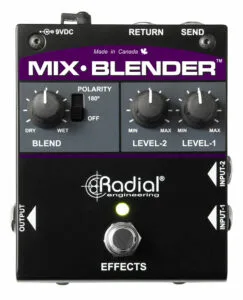
For players using a clean or tight-sounding amp, the original Tonebone was described as "a welcome addition to their arsenal and will only broaden their sound palette"8. Radial also notes the V9 can be used with bass, though it says running a distortion pedal in parallel is typically preferred to retain the full low-end frequencies of the instrument, and suggests Radial's Mix-Blender for mixing in the desired amount of distortion alongside the original bass tone1.
The controls
The control layout follows the original Hot British's multi-stage tone shaping3, with drive and post-distortion EQ sections:
| Control | What it does |
|---|---|
| Drive | Adjusts the overall amount of input gain and distortion7 |
| Contour | Alters the character of the distortion; clockwise for more high frequencies, counter-clockwise for a warmer tone7 |
| Level | Sets the output volume of the pedal7 |
| Low | Post-distortion EQ control7 |
| Top-End switch | 3-position switch controlling the high frequency response7 |
| Bypass footswitch | Latching switch that bypasses the effects7 |
The original Hot British took a similar approach with control pots for high, low, filter and drive, plus switches for top end, mid boost and drive gain, letting a player push "from a classic plexi-drive to an all-guns-blazing, pure Hot and British high-gain"89. The V9's Contour knob changes the character of the distortion itself rather than just its amount4, which is the distinction players will notice most when dialing it in.
Buffering and build
The Hot-British V9 is not true bypass. Radial's FAQ answers the question directly: "No. The Hot-British V9 employs Radial's class-A buffer"1. The maker says the Class-A buffering circuit "provides the same feel as true-bypass, but allows you to run long cables and pedal chains with ease"4. Delicious Audio framed the trade-off in practical terms: the buffer gives "the feel of a true-bypass pedal with the added benefits of greater noise rejection and lower impedance, allowing you to drive pedal chains and longer cable runs efficiently"3. This differs from the original Tonebone Hot British, which Vintage Guitar's 2004 review noted used true-bypass on/off stomp switches9.
The build is heavy for a compact pedal. The V9 is housed in an ultra-durable 14-gauge steel chassis4, which Delicious Audio described as "built extremely rugged, with heavy-duty components and a 14-gauge steel enclosure"3. It is built in Canada6 and ships with Radial's 3-year transferable warranty4.
The V9 cannot run on a battery. Radial says its Class-A circuitry "is power hungry and will drain a battery in no time"1. The power input is regulated, and Radial says it can be left on with very little current draw1. Power it with 9 to 12V and a minimum of 40mA of current1; the connector is 9V DC, center-pin negative7.
Versions and editions
The Hot British story starts with the original tube version. Radial describes it as "fashioned from a modified Marshall double-stack Plexi"2, an analog distortion pedal8 whose Contour switch enables a passive-interactive EQ for what the maker calls "huge, musically rich tones"2. It drew 400mA8. Radial has since discontinued it: the maker's legacy page states "This product has been discontinued and is no longer shipping"2.
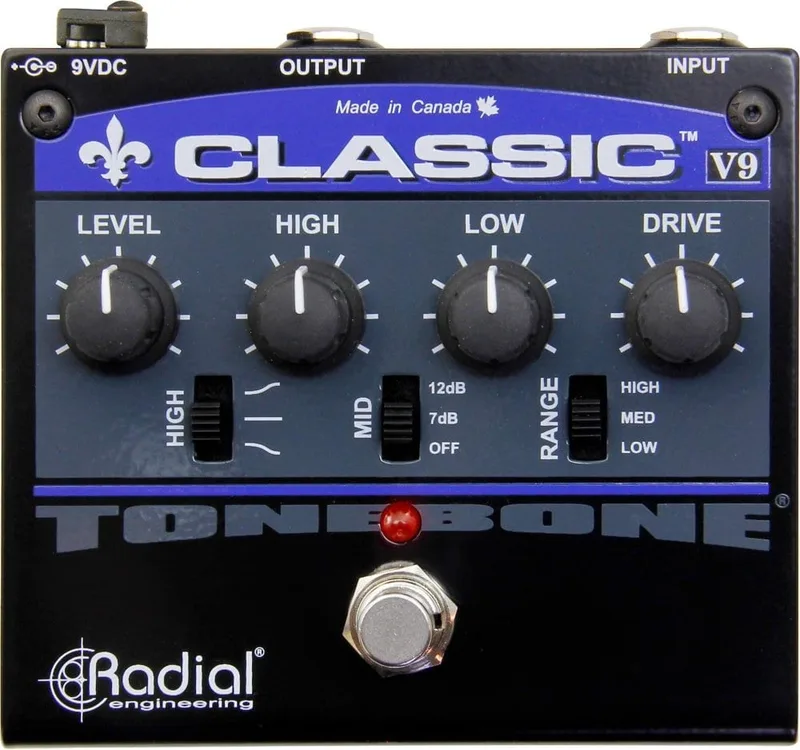
The V9 generation began with the Tonebone Classic V9, which Radial calls a "next generation" version of the original Classic that is "both smaller and easier to power"10. The Hot-British V9 followed, announced as now shipping in a pedalboard-friendly compact chassis with "the ability to be powered by standard 9V pedalboard power supplies"63. Radial says the tube has been removed and replaced with a new tube-emulating tone circuit21.
| Original Hot British | Hot-British V9 | |
|---|---|---|
| Circuit | Triple gain stage with a real 12AX7 tube2 | Solid-state Class-A discrete, tube-emulating41 |
| Power | 15V DC, center negative8 | 9V DC center-pin negative, minimum 40mA71 |
| Current draw | 400mA8 | Minimum 40mA1 |
| Bypass | True bypass9 | Buffered, Class-A buffer1 |
| Status | Discontinued2 | Shipping as of March 20176 |
What reviewers and the press said
Reactions to the V9's tubeless redesign were mixed. When Gearnews covered the announcement, its author wrote: "I imagine that it will be well made. It will boil down to how it sounds compared to the original version"11. Delicious Audio's coverage was more positive on paper, reporting that the V9 "retains the same soul and character of the original" in its compact chassis3.
The strongest published verdicts concern the Classic V9, the sibling pedal that shares the V9 platform. Guitar Interactive Magazine reported that it "is responsive like a real guitar amplifier, boasts an incredibly powerful post distortion EQ and is both quiet and pop free"10, and quoted Radial's claim that the original Tonebone Classic "is likely the best tube distortion pedal ever made"10. MusicRadar's reviewer Trevor Curwen found the Classic V9's tone controls "highly effective" at focusing the sound into the right tonal area12, noting post-gain EQ consisting of High and Low knobs plus two three-way switches, one rolling off or boosting top end to suit the amp and the other providing +7dB and +12dB midrange boosts at 500Hz12.
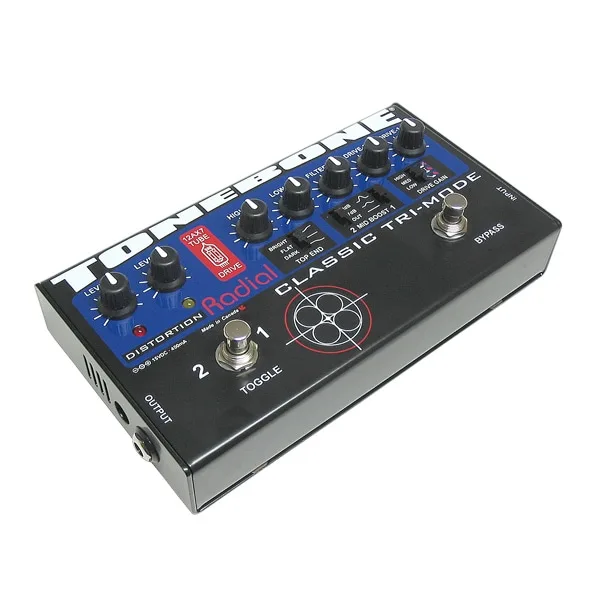
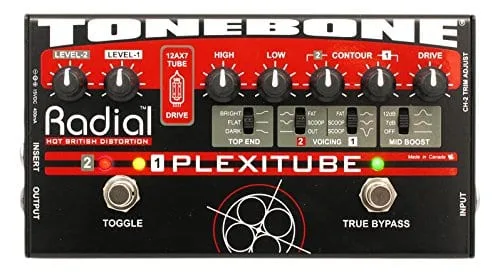
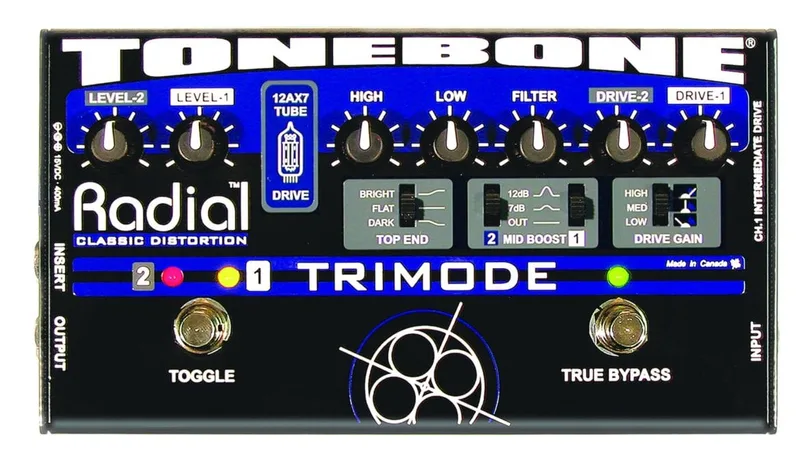
For players comparing British-voiced Radial options, the Tonebone line also included the tube-driven Plexitube, released in 2007 with a second high-gain channel, more distortion control, voicing options and an effect loop insert on channel 2 [dated event, S13-era], and the Trimode. Radial's Bones series offered further British and Hollywood distortion voicings in smaller enclosures, including the Bones London Distortion and Bones Hollywood Distortion.
Videos
ProGuitarShopDemos
theperfectguitar
Wall of Sound
Questions
Does the Hot British V9 have a tube in it?
No. The original Hot British used a real 12AX7 tube in a triple gain stage, but the V9 removes the tube entirely and replaces it with a tube-emulating tone circuit built around Class-A discrete solid-state design. Radial says the V9 retains the tonal characteristics of the original.
Is the Tonebone Hot British V9 true bypass?
No. The Hot-British V9 uses a buffered bypass built on Radial's Class-A buffer rather than true bypass. Radial says the buffer provides the same feel as true bypass while letting you run long cables and pedal chains, with greater noise rejection and lower impedance.
What power supply does the Hot British V9 need?
It runs on a standard 9V DC supply with a center-pin negative connector, drawing a minimum of 40mA, and Radial says it also accepts 9 to 12V. It works with a multi-pedal power brick. It cannot run on a battery, because the Class-A circuitry drains one quickly.
Does the Hot British V9 sound like the original Hot British?
Radial says yes, that the V9 retains the tonal characteristics of the original Hot-British. The press described it as plexi-style and as retaining the same soul and character of the original in a pedalboard-friendly compact chassis. Some reviewers wanted A/B tests against the original before judging.
Does the original Radial Hot British have a tube?
Yes. The original Hot British is a 12AX7 tube distortion pedal with a triple gain stage that combines solid-state control and dynamics with the warmth and harmonic generation of a real 12AX7 tube. Radial has since discontinued it.
Sources (12)
- Hot-British V9 FAQ, Radial Engineering, 2018-06-11
- Hot British, Radial Engineering, 2021-03-17
- Radial ToneBone Hot-British V9 Distortion, Delicious Audio, 2017-12-20
- Hot-British V9 Specifications, Radial Engineering, 2018-04-10
- Radial cooks up Hot-British V9 distortion pedal, MusicRadar, 2017-02-28
- Radial Update Hot-British V9 Tube Distortion Pedal, Guitar Interactive Magazine, 2017-03-20
- Hot-British V9 Features, Radial Engineering, 2018-06-19
- Tonebone Hot British by Radial Engineering, RockBoard (www.rockboard.de), 2026
- Radial Engineering Tonebone Classic, Hot British, and Switchbone, Vintage Guitar magazine, 2006-02-23
- Radial's Updated Tonebone Pedal, the Classic V9 Now Shipping, Guitar Interactive Magazine, 2016-10-17
- Radial Hot British V9 and Texas Pro pedals announced, sans valves, gearnews.com, 2017-02-11
- Radial Engineering Tonebone Classic V9 review, MusicRadar, 2017-05-27