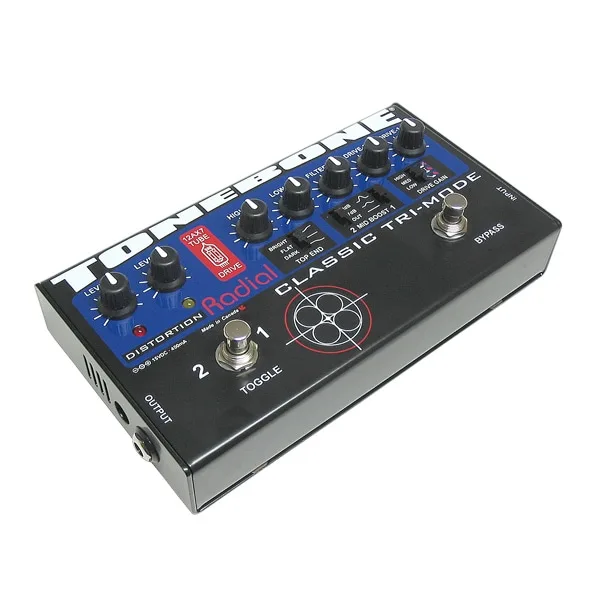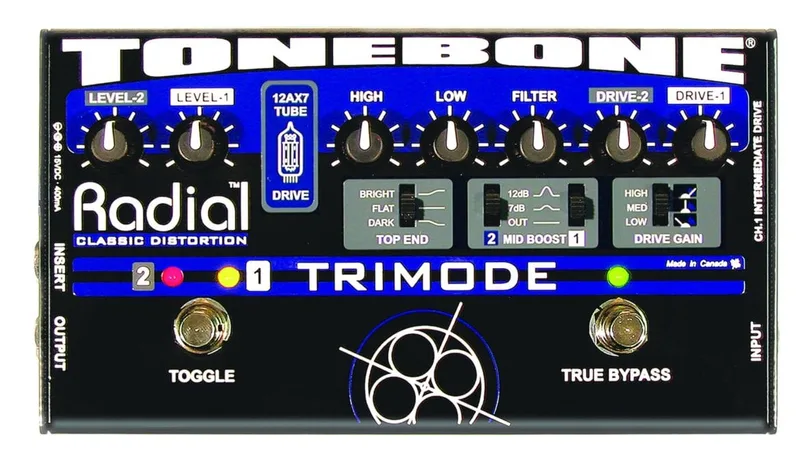


The Radial Tonebone Trimode is a true-bypass, dual-channel tube distortion pedal from Radial Engineering that uses a 12AX7 tube to deliver what the maker calls "a wide array of American-style distortion tones"12. It packs clean, rhythm and lead channel switching into one pedal, with post-distortion EQ controls and an insert loop on channel 2 for other effects2. Radial positions it as a hybrid: a dual-stage solid-state front end feeding the tube stage, which the maker says generates "warmth and natural even harmonics"3.
Radial states that the Trimode "has been discontinued and is no longer shipping"2. It remains available on the used market, and Radial's support pages on tubes, power and the insert jack are still published.
What it is and what it does
The Trimode is a floor pedal built to fit on most pedalboards, in a 14-gauge steel enclosure with a baked enamel finish3. Radial describes it as tremendously powerful, covering ground from slight overdrive to full-on distortion; that range is how Andy Timmons, on Radial's artist page, sums up the pedal: "The Trimode tube distortion takes you from slight overdrive to full-on distortion"36.
"The Trimode tube distortion takes you from slight overdrive to full-on distortion."
The gain structure is a hybrid rather than an all-tube design. A dual-stage solid-state front end handles the gain control, and the 12AX7 tube stage adds the harmonic character3. Radial says the tube is "starved" with low voltage, which means it runs cool and lasts a long time4. Construction is old-school: full-size discrete parts, hand inserted and soldered to a double-sided circuit board with a full-surface ground plane, which Radial claims makes it "the quietest pedal in its class"3. High-lifecycle footswitches and steel-shafted potentiometers are used for durability3.
Channels, controls and the insert jack
The Trimode gives you clean, rhythm and lead channel switching in one pedal, with what Radial calls powerful post-distortion EQ controls2. Channel 2 carries the insert loop for effects pedals2.
| Control | What it does |
|---|---|
| Drive 1 & 2 | Used with the drive gain switch to adjust the overall amount of gain to the overdrive circuit3 |
| Filter | Reduces high-frequency content, compensating for overly bright amplifiers3 |
| Top end (3-position switch) | Sets the overall tonal character to match the amp and guitar3 |
| EQ / Boost | Listed among the pedal's features3 |
The insert jack is a standard 1/4" TRS jack that lets you add effects such as a delay to channel 25. Channel 2 is normalled through the insert jack, so with nothing plugged in the signal simply passes through4. The loop sits post-distortion, so anything you connect there comes after the distortion stage rather than driving it4. Radial highlights a practical trick: the solo channel setup "lets you toggle to the solo channel and have your delay automatically go on"5. For a player, that means one stomp can bring up a lead level and a delay at the same time, instead of tapping two switches.
Power
The Trimode runs on a 15VDC 400mA supply with center pole positive polarity3. Radial says the high-output 15-volt supply delivers more than twice the power of a typical 9V PSU, and that the supply is internally regulated and filtered to eliminate noise3. This rules out a standard 9V pedal supply and most daisy chains.
The power details differ between listings. Radial's specification page lists 15VDC 400mA, center pole positive3, while RockBoard's PedalPedia entry lists 15V DC, center negative, with a 500mA current draw1. Verify the polarity of any supply you use with a used unit before plugging it in.
Radial recommends a 15V outlet from a multi-power supply brick4. If you use 18V from a power brick, Radial says to ensure you supply the correct polarity and sufficient current4. The pedal is specified for use in dry locations only, between 5°C and 40°C3.
Tube changes and ventilation
The 12AX7 is mounted on its side to lower the pedal profile for easy footswitch access3. Radial says the tube is typically a Ruby Tube 12AX7, though the brand can change with supply4. Because the circuit runs the tube at low voltage, the tube never gets very hot and lasts a long time4.
Swapping tubes is a small tweak rather than a rebuild. Radial's own answer on the subject is blunt:
"Changing the tube will only affect the sound slightly."
Ventilation is handled by the enclosure itself: "The air vents on the side panel provide sufficient ventilation to keep the Trimode running cool"4. Radial points players to the Plexitube user guide for complete tube-changing instructions with pictures4.
Where it sits in the Tonebone line
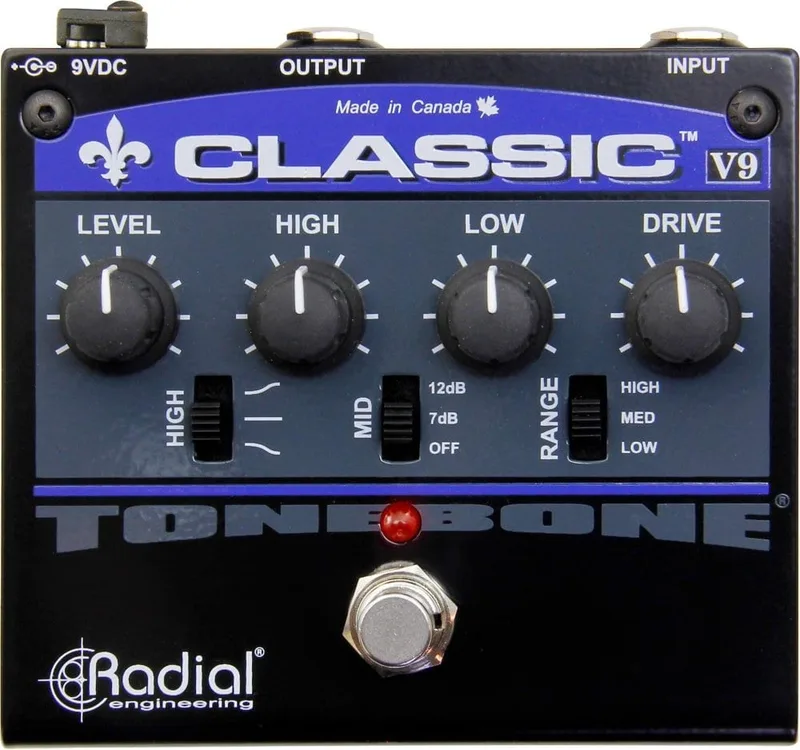
The Trimode belongs to Radial's Tonebone family of tube distortion pedals. Related pages on this site cover the Tonebone Classic-V9, the Tonebone Hot British Tube Distortion, the Tonebone Hot British V9 and the Tonebone Plexitube. Like the Trimode, the Plexitube is a two-channel tube distortion pedal with an effect loop insert on channel 2, where channel 2 is normalled through the insert jack and the loop sits post distortion45. Radial also made compact versions of the Classic and Hot British, the V9 pedals3.
Specifications
| Specification | Value |
|---|---|
| Audio circuit type | Hybrid tube / proprietary circuit3 |
| Input impedance | 1 meg Ohm at input jack3 |
| Output impedance | 10K Ohm3 |
| Construction | 14-gauge steel, baked enamel finish3 |
| Size (L x W x D) | 8.12 x 4.25 x 2.12" (207 x 108 x 54mm)3 |
| Weight | 2.55lb (1.16kg)3 |
| Power | 15VDC 400mA, center pole positive3 |
| Operating conditions | Dry locations only, 5°C to 40°C3 |
| Warranty | Radial 3-year, transferable3 |
| Made in | Canada3 |
For a player shopping used, the Trimode's appeal comes down to its feature set: three channels in one box, a post-distortion insert for time-based effects, true bypass, and a real 12AX7 in the circuit. The trade-offs are the 15V center-positive power requirement, which needs the right supply or brick outlet, and the fact that Radial no longer builds it, so parts and support come from Radial's published documentation rather than a current product line24.
Videos
ProGuitarShopDemos
gearwire
James Mulvaney
Sources (6)
- ToneBone Trimode by Radial Engineering, RockBoard PedalPedia, 2026
- Trimode - Radial Engineering, Radial Engineering, 2022-07-22
- Trimode Specifications, Radial Engineering, 2018-04-26
- Trimode FAQ, Radial Engineering, 2018-11-27
- Trimode Features, Radial Engineering, 2018-04-26
- Andy Timmons, Radial Engineering, 2018-09-18