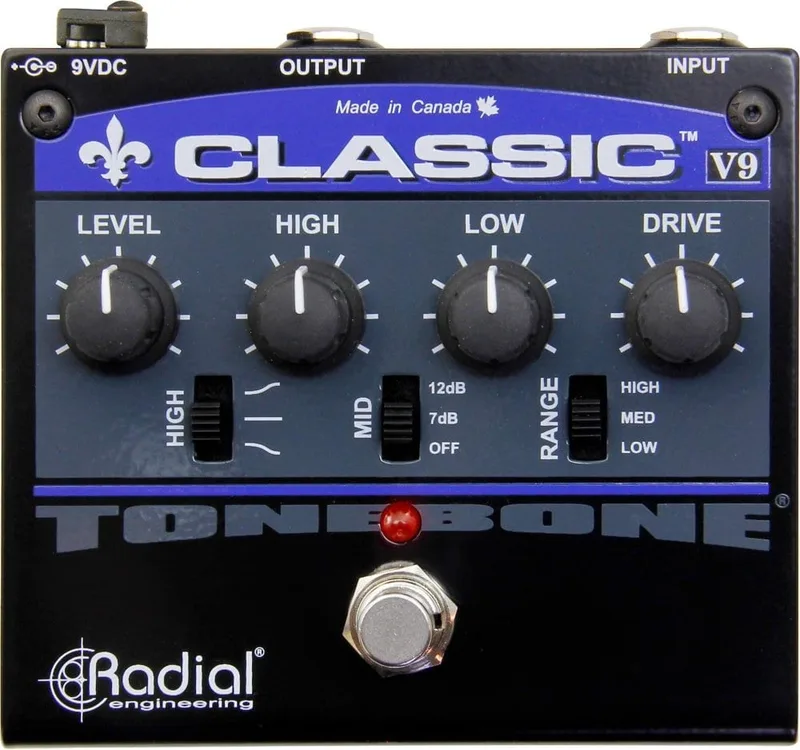


The Radial Tonebone Classic-V9 is a compact distortion pedal from Radial Engineering, introduced in October 2016 as a next generation, solid-state version of the company's tube-driven Tonebone Classic12. Where the original Classic got its overdrive from a 12AX7 tube and needed 15-volt power, the V9 drops the tube for a tube-emulating tone circuit, shrinks the enclosure, and runs on a standard 9V supply34.
Radial describes the Classic-V9 as a versatile distortion circuit that accommodates all play styles, with an ultra-sensitive post-distortion EQ and a class-A buffer to reject noise and drive multiple pedals1. The maker says it "cleans up like a tube amp and captures the feel and dynamics of your playing," suiting blues, country or rock1.
Radial's product page states the Classic-V9 "has been discontinued and is no longer shipping"1. The original tube-driven Tonebone Classic is also discontinued4. Both pedals are found on the used market.
From tube Classic to V9
The original Tonebone Classic was a 12AX7 tube distortion pedal designed, in Radial's words, "to deliver the tone, feel and dynamics of a real tube guitar amplifier"4. MusicRadar's Trevor Curwen notes it was "a valve-driven distortion pedal used by Eric Johnson, among others, but its larger footprint and the 15-volt power needed to drive the valve meant that it got a bit out of kilter with recent stompbox trends"3.
The V9 answered that. Radial announced it on 12 October 2016 at $169.9923, and Guitar Interactive Magazine reported it shipping on 17 October 20168. In Radial's own FAQ wording, "The tube has been surgically removed and replaced with a new tube-emulating tone circuit"5. The new version is more compact than the original and is powered by 9V instead of the original's higher-voltage requirement5. Gearnews reported at launch that it "can run off of a single 9V battery"2.
The change drew mixed early reactions. Gearnews' Jef wrote:
"I am surprised that Radial have dropped the tube for the sake of adding battery power. It almost feels like a step backwards."2
MusicRadar's later review took a different view of the circuit itself, reporting that the V9 "is said to offer the same sound via FET and IC circuitry in a smaller, more pedalboard-friendly format that can run from a standard nine-volt supply"3.
The controls
The Classic-V9 carries four knobs and three preset switches, the same switch count as the original2. The signal path starts with a gain-stage selector, then drive, then a two-band EQ that sits after the distortion rather than before it, which is what lets it shape the distorted tone directly7.
| Control | What it does |
|---|---|
| Drive | Fine tunes the drive to suit your playing style7 |
| Level | Sets the overall output level7 |
| EQ (High and Low) | Dual band post-distortion EQ, used to set the distortion tone7 |
| Range | 3-position switch used to set the gain stage7 |
| Mid | 3-position mid-boost, flat / +7dB / +12dB, to accentuate the signal for solos or fatten up a single coil pickup7 |
MusicRadar's review describes the two three-way switches in use: one "either rolls off or boosts the top-end to suit the type of amp you are using, and the other providing two levels (+7dB and +12dB) of midrange boost at 500Hz"3. Guitar Interactive adds that the mid boost can "fatten up the tone of single coil pickups for sounds reminiscent of Jeff Beck, or to enhance solos for more sustain," and that a top-end switch compensates for overly bright amps like early Marshalls or enhances harmonics with more distorted tones8.
The post-distortion EQ is the pedal's defining feature. Guitar Interactive called it "an incredibly powerful post distortion EQ" and said "This post distortion EQ lets you truly carve out the tone so that it best matches the amplifier"8. In his review, Curwen found the tone controls "highly effective" at focusing the sound into the right tonal area3.
How it sounds
What a pedal sounds like is a matter for the people who have published on it. Radial says the Classic-V9 "cleans up like a tube amp and captures the feel and dynamics of your playing"1. Guitar Interactive reported it "is responsive like a real guitar amplifier, boasts an incredibly powerful post distortion EQ and is both quiet and pop free"8.
MusicRadar's review found the low gain setting particularly convincing: "Low finds the sounds of the signal just breaking up and, true to the original, it sounds very organically valve amp-like"3. The same review notes the pedal "delivers dirt from a whisper to a scream"3.
Bypass and buffering
The original Tonebone Classic used true-bypass switching with photocells that ramped the effect on and off to eliminate clicking and popping4, and Vintage Guitar's reviewers confirmed both it and its sibling used "true-bypass on/off stomp switches"9. The Classic-V9 changes approach: it uses Radial's class-A buffer rather than true bypass5. Radial says the class-A buffering circuit "gives you the feel of a true-bypass pedal with the added benefits of greater noise rejection and lower impedance," and that the buffer rejects noise and drives multiple pedals1.
Specifications
| Specification | Value |
|---|---|
| Gain | 0dB to +48dB6 |
| Output impedance | 12kΩ6 |
| Noise floor | -78dBu6 |
| Frequency response | Shaped for guitar use6 |
| Audio circuit | Class FET buffer and audio grade ICs6 |
| Construction | 14-gauge steel6 |
| Size (L x W x D) | 4.25" x 4" x 2"6 |
| Weight | 1.35lb6 |
| Power | 9VDC, center pin negative6 |
| Current draw | 60mA per Radial's specifications page; 200 milliamp per its features page67 |
| Operating conditions | Dry locations only, 5°C to 40°C6 |
| Warranty | Radial 3-year, transferable6 |
The two current-draw figures come from different pages of Radial's own site and disagree: the manual states a 200 milliamp draw7, while the specifications page lists 60mA at 9VDC76.
Where it was made and what came around it
The Classic-V9 is made in Canada from 14-gauge steel for added durability8. It is the next generation, solid-state version of the venerable Tonebone Classic tube distortion, with the tube replaced by a new tube-emulating tone circuit15. Radial says the V9 incarnation offers the same sound via FET and IC circuitry in a smaller, more pedalboard-friendly format that can run from a standard nine-volt supply3.
For a player today, the Classic-V9 is a discontinued, Canadian-built, buffered-bypass distortion pedal whose post-distortion EQ and mid-boost switches are its working tools, and whose tube-emulating circuit was the trade that made it small and easy to power.
Videos
Abel Franco
Peter Candlish
Abel Franco
Questions
Does the Radial Classic-V9 have a tube?
No. The original Tonebone Classic used a 12AX7 tube, but in the Classic-V9 the tube was removed and replaced with a new tube-emulating tone circuit built from FET and IC circuitry. Radial describes it as the next generation, solid-state version of the original.
Does the Tonebone Classic V9 run on a battery?
It was announced as being able to run off a single 9V battery, and it operates on a standard 9V power supply. Radial's specifications list a 9VDC center-pin-negative power connection, so a normal pedalboard supply works.
Is the Radial Tonebone Classic V9 discontinued?
Yes. Radial's product page states the Classic-V9 has been discontinued and is no longer shipping. The original tube-driven Tonebone Classic is also discontinued. Both are found on the used market.
Is the Tonebone Classic true bypass?
The original Tonebone Classic used true-bypass switching with photocells that ramped the effect on and off to eliminate clicking and popping. The Classic-V9 instead uses Radial's class-A buffer, which Radial says gives the feel of true bypass with greater noise rejection and lower impedance.
Where is the Radial Classic-V9 made?
It was made in Canada, in a 14-gauge steel enclosure measuring 4.25 by 4 by 2 inches and weighing 1.35 pounds. Radial Engineering is a Canadian company.
Is the Radial Classic-V9 true bypass?
No. The Classic-V9 uses a buffered bypass built on Radial's class-A buffering circuit rather than true bypass. Radial says this gives the feel of a true-bypass pedal with the added benefits of greater noise rejection and lower impedance.
Sources (9)
- Classic-V9, Radial Engineering, 2021-03-17
- Radial Tonebone Classic V9: What, no tube?, gearnews.com, 2016-10-13
- Radial Engineering Tonebone Classic V9 review, MusicRadar, 2017-05-27
- Classic - Radial Engineering, Radial Engineering, 2021-03-17
- Classic-V9 FAQ, Radial Engineering, 2018-06-11
- Classic-V9 Specifications, Radial Engineering, 2018-04-10
- Classic-V9 Features, Radial Engineering, 2018-06-19
- Radial's Updated Tonebone Pedal, the Classic V9 Now Shipping, Guitar Interactive Magazine, 2016-10-17
- Radial Engineering Tonebone Classic, Hot British, and Switchbone, Vintage Guitar magazine, 2006-02-23