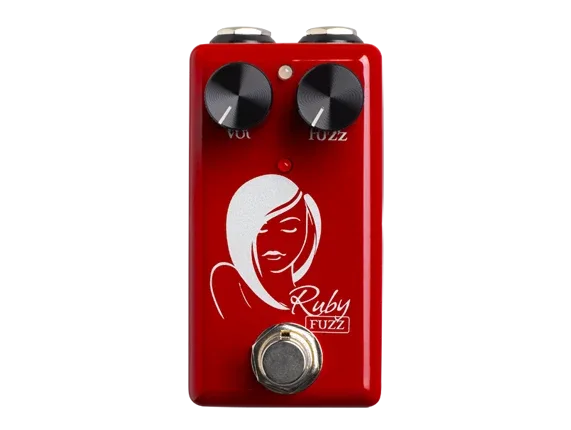



The Red Witch Seven Sisters Ruby is a compact analog fuzz pedal built around silicon transistors. It is one of the seven small-format pedals in Red Witch's Seven Sisters range, each sharing the same enclosure, rechargeable battery system and two-knob control layout. Red Witch describes its character as sitting "between silky soft fuzz and an all consuming tidal wave of sonic saturation," and says it is voiced closer to its sister Ivy than to any of the other sisters1.
MusicRadar's reviewer Trevor Curwen called it "a red-hot fuzz pedal that's great for tight spaces," and summed up the appeal as "Plenty of attitude in the tones. Battery is a good backup."2
A silicon fuzz with a soft-to-heavy range
The Ruby is a silicon transistor fuzz, which distinguishes it from germanium designs and gives it a consistent, temperature-stable fuzz character. Where it sits on the gain spectrum is the point: Red Witch's own description is that it "can dance the line between silky soft fuzz and an all consuming tidal wave of sonic saturation," so a player can back the Fuzz control off for a softer edge or push it for full saturation1.
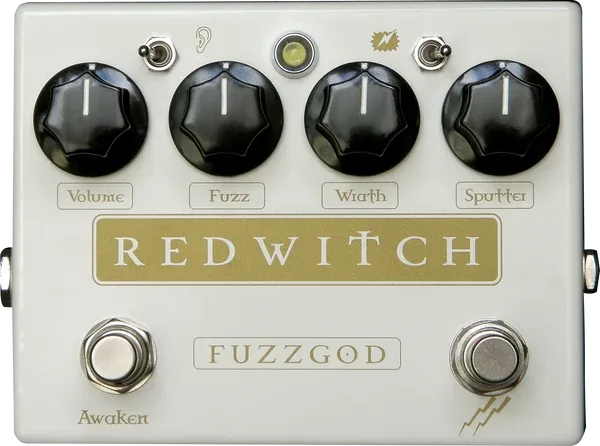
For players who know Red Witch's other fuzzes, MusicRadar gives a useful reference point: Curwen found the Ruby is "voiced somewhat like sister model the Fuzz God II with its sputter knob fixed at around 2 o'clock"2. In other words, it covers a slice of the Fuzz God II's territory with that voicing locked in, trading flexibility for a tiny footprint and a two-knob interface.
The controls
The Ruby keeps it simple with two knobs, which Premier Guitar notes is the pattern across the range: "Each Sister has two knobs for adjusting tone parameters"3.
| Control | What it does |
|---|---|
| Fuzz | Sets the amount of fuzz, from soft to full saturation1 |
| Volume | Sets the output level1 |
MusicRadar's review confirms the practical picture: "Volume and fuzz knobs dial in the sound"2. There is no tone control, no bias or sputter knob, and no switchable modes. Players who want to shape the fuzz character further will need to do it from the guitar's volume knob or elsewhere in the chain.
Power: 9V, 110mA, or the rechargeable battery
The Ruby runs from either an internal rechargeable battery or a standard 9V DC wall wart supply1. The battery is the headline feature of the Seven Sisters line: Red Witch says to "charge her for four hours and Voila! 300 hours of actual use!"1, and MusicRadar's review confirms the 300-hour figure from a single charge of the lithium battery2.
Premier Guitar's review adds detail on charging: "plug it into the left-hand power socket for four hours (12 hours the first time)"3. The 2011 launch announcement for the range said the pedals accept any DC adapter between 9 and 18 volts, and that an overnight charge would be "good for 1-2 weeks worth of gigging"4.
The maker's current product page specifies a standard 9V DC wall wart supply1, while the 2011 launch announcement said any DC adapter between 9 and 18 volts could be used4. The current-draw figure of 110mA1 is high for a pedal this size, so a dedicated supply rather than a shared daisy chain is the safer choice when running it from a wall wart.
Where it sits in the Seven Sisters range
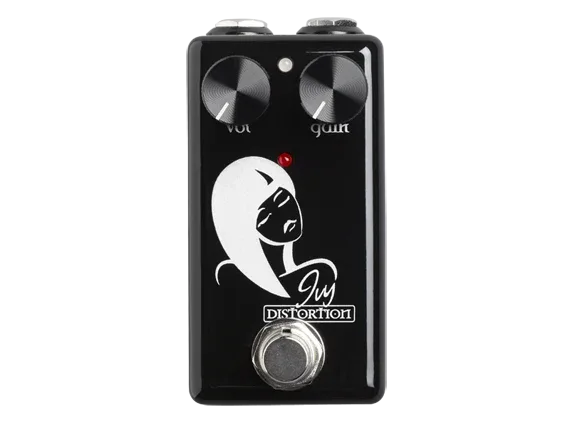
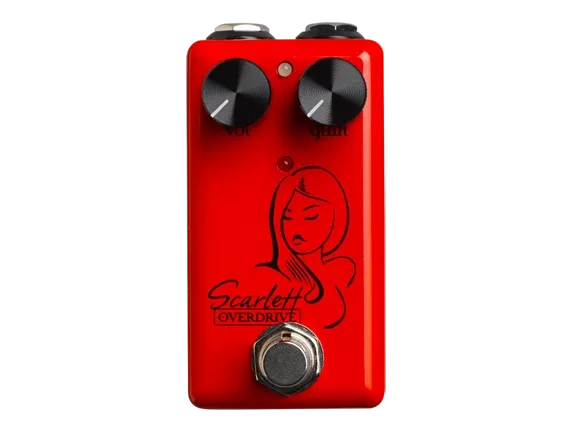
The Seven Sisters range holds seven pedals, each a different effect in the same small enclosure: Ivy Distortion, Lily Boost, Grace Compressor, Ruby Fuzz, Violet Delay, Scarlett Overdrive and Eve Tremolo5. All are true bypass, all run from the same rechargeable lithium battery system, and all mount their jack sockets on the top side of the enclosure so they sit close together on a pedalboard1.
The range was designed by Ben Fulton of Red Witch Pedals3, a New Zealand firm316. The 2011 launch announcement described the enclosure as "our proprietary, custom made diecast enclosure" with a jack socket at the top4, and MusicRadar's Amps Expo 2014 coverage noted the Sisters use "a Lithium Ion cell (like that found in your cell phone or digital camera) and internal charging circuitry," offering "professional level features at an entry level"7.
Battery life varies across the range even though the charging system is shared: the Ruby is rated at 300 hours from a four-hour charge1, while the Scarlett Overdrive and Eve Tremolo are rated at 120 hours and the Ivy Distortion at 220 hours from the same four-hour charge89.
The Seven Sisters Ruby is listed as sold out at Red Witch's own store as of 26 October 20261. Red Witch also makes a larger Ruby Fuzz as a separate product.
Videos
Red Witch Pedals
Gearfacts
Guitar Mastery Method
Questions
Is the Red Witch Seven Sisters Ruby true bypass?
Yes. Red Witch lists the Seven Sisters Ruby Fuzz as true bypass, and Premier Guitar's review of the Seven Sisters pedals describes them as having a sturdy true-bypass switch, so the pedal's circuit is out of the signal path when it is off.
How long does the Seven Sisters Ruby battery last?
Red Witch says a four-hour charge of the internal rechargeable battery gives 300 hours of actual use. MusicRadar's review confirms the 300-hour figure from a single charge of the lithium battery. Premier Guitar notes the first charge should be 12 hours, with four hours for later charges.
How is the Ruby different from the Fuzz God II?
MusicRadar's reviewer describes the Ruby as voiced somewhat like the Fuzz God II with its sputter knob fixed at around 2 o'clock. So the Ruby covers similar fuzz territory in a fixed voicing, in a much smaller enclosure with two knobs instead of the Fuzz God's control set.
Where are the jacks on the Seven Sisters Ruby?
The jack sockets are mounted on the top side of the enclosure, not the sides. Red Witch's product page lists this layout for the Seven Sisters pedals, and the 2011 launch announcement described a jack socket at the top of the custom diecast enclosure.
Sources (9)
- Seven Sisters Ruby Fuzz, Red Witch Pedals
- Red Witch Seven Sisters Ruby review, MusicRadar, 2014-05-12
- Comprehensive Review of Red Witch Guitar Pedals, Premier Guitar, 2011-12-20
- NAMM 2011: Red Witch debut Seven Sisters pedals, MusicRadar, 2011-01-17
- Red Witch Lily, Grace & Ivy Pedals Review, Premier Guitar, 2011-12-27
- Red Witch Seven Sisters Grace review, MusicRadar, 2014-04-12
- Red Witch Eve, MusicRadar, 2014-05-15
- Seven Sisters Scarlett Overdrive, Red Witch Pedals
- Seven Sisters Ivy Distortion, Red Witch Pedals