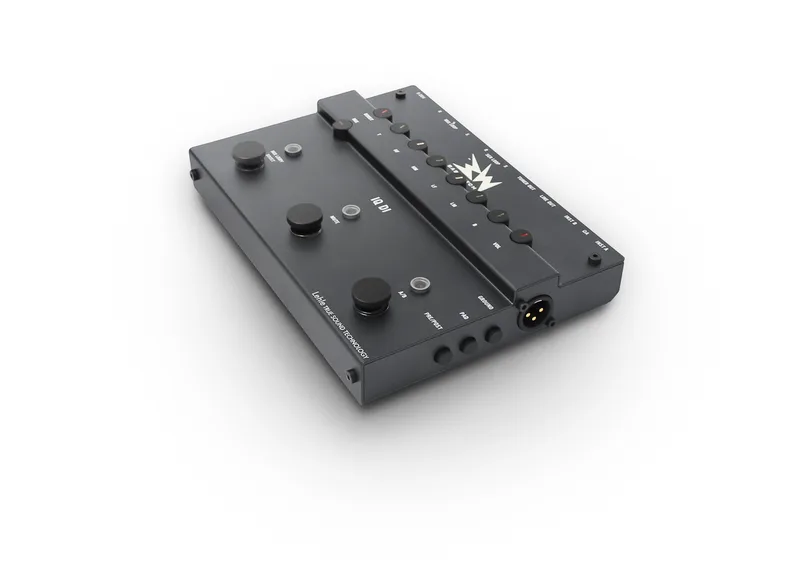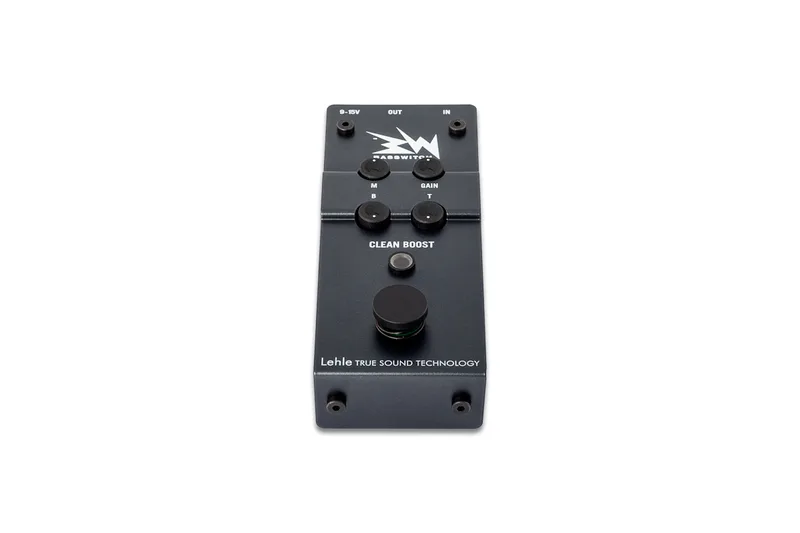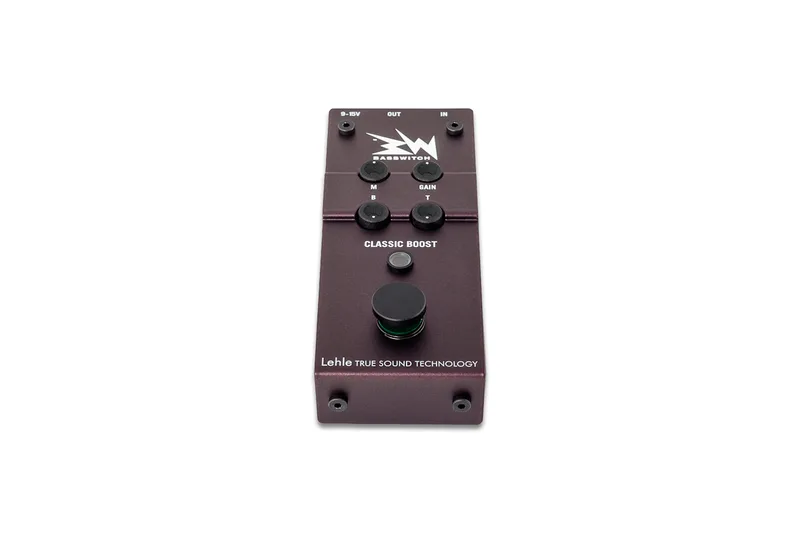
The RMI Classic Boost is a compact bass preamp that combines the boost circuit from the BASSWITCH IQ DI with a 3-band EQ voiced especially for vintage basses1. It sits in the boost pedal family, but it is really three tools in one box: a booster with an adjustable EQ, a stand-alone preamp, and a tone shaper for passive instruments. Lehle lists it as discontinued1.
The design brief was specific. As the maker puts it:
"When we designed the BASSWITCH CLASSIC BOOST we had in mind classic passive P, JJ and PJ basses."1
The manual describes the same idea in its own words, calling it a "high-end bass preamp gently voiced for passive P, JJ and PJ type basses"2. For a player with a passive Precision or Jazz-style bass looking to add gain and EQ shaping without changing the instrument's basic character, that is the niche this pedal was built for.
What it does and how it sounds
The primary application, per the manual, is as a booster with an adjustable EQ2. The gain control adjusts the volume of the unit, boosting or cutting the signal, with a neutral position at 12 o'clock and a maximum of +/-15 dB2. The maker also specifies a dynamic range of over 110 dB with very little noise, which it describes as more than studio standard1.
The EQ is a 3-band design. The bass control gives +15/-11 dB at 45 Hz on a peaking curve21. The treble control is unusual: it combines a passive high-frequency reduction with an active high-frequency boost, so it can cut or lift the top end from a single knob1.
Bass Musician Magazine's Jake Wolf reviewed it in 2016 alongside the RMI Clean Boost and Sonic Spark, and found the Classic Boost had "a little more shape to its tone profile" than the Clean Boost, designed to complement passive or traditional style basses3. He also wrote:
"I felt that it helped pocket the sound of my P bass even more effectively than the Clean Boost."3
How it compares with other boost pedals
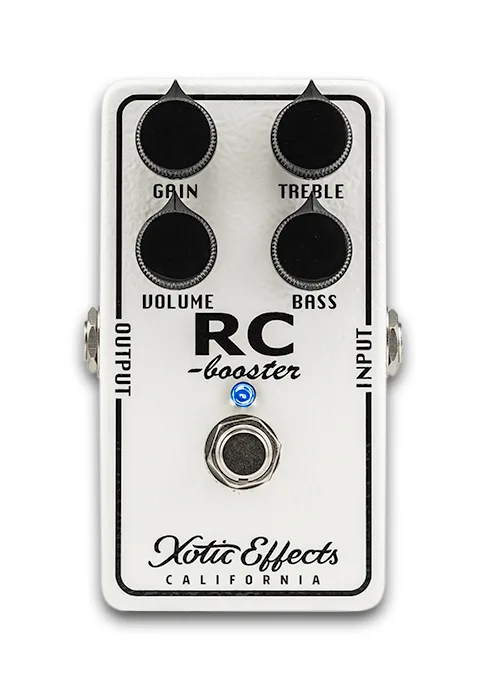
Against a straightforward clean boost like the RMI Clean Boost, the Classic Boost trades some neutrality for EQ shaping, which is the point for passive basses3. Against a guitar-oriented boost with EQ such as the Xotic RC Booster Classic, the differences are clear from the makers' own specs: the Xotic offers a 2-band active EQ of +/-15 dB and a 20 dB+ clean boost4, while the RMI gives a 3-band EQ voiced for bass frequencies, with the bass band centered at 45 Hz21. The Xotic runs on 9 to 18 V DC only5; the RMI accepts AC as well, which matters on boards powered by AC supplies.
Power and connections
The Classic Boost is flexible about power. It works internally at 18 V but accepts any external supply between 9 and 15 V, AC or DC1. The manual calls for a supply delivering at least 60 mA; the input is internally rectified, filtered, stabilized and brought up to 18 V2.
The Classic Boost cannot run on batteries. The manual states plainly that its power consumption is too high to run it satisfactorily on batteries2. Plan on a pedalboard power supply or a wall adapter.
Build and board mounting
The maker describes an extremely robust construction with protected controls and an indestructible switching mechanism, built around LEHLE True Sound Technology with a discrete JFET input stage and gold-plated relay switching1. For pedalboard use, the manual notes the ultra-flat base and removable rubber feet, which allow the unit to be attached securely with Velcro2.
Who makes it
The product page lists Lehle GmbH as the manufacturer1. The manual carries the name Ruppert Musical Instruments, of Schouweiler, Luxembourg, the builder behind the RMI (Ruppert Musical Instruments) Basswitch line2. The two names reflect the same operation as presented in each document.
Questions
Is the RMI Classic Boost still in production?
No. Lehle lists the RMI Classic Boost as discontinued on its product page. It was part of the RMI Basswitch line of bass preamps and boosters, and secondhand units are the way players find one today.
Who makes the RMI Classic Boost?
The product page lists Lehle GmbH as the manufacturer, while the manual credits Ruppert Musical Instruments of Schouweiler, Luxembourg. RMI stands for Ruppert Musical Instruments, the Luxembourg builder behind the Basswitch line.
What basses is the RMI Classic Boost designed for?
It was designed with classic passive P, JJ and PJ basses in mind. The manual describes it as a high-end bass preamp gently voiced for passive P, JJ and PJ type basses, and a reviewer found it helped pocket the sound of a P bass.
Can the RMI Classic Boost run on AC power?
Yes. It accepts any power supply between 9 and 15 V, AC or DC, through a standard 5.5 x 2.1 mm connector drawing at least 60 mA. The input is internally rectified, filtered, stabilized and raised to 18 V inside the unit.
Can the RMI Classic Boost be used as a preamp in front of a bass cab?
Yes. Lehle describes three uses: a stand-alone booster, teamed with the BASSWITCH IQ DI for more options, or as a compact standalone preamp in front of an active monitor or bass cab.
How much boost or cut does the RMI Classic Boost give?
The gain control adjusts the volume by up to +/-15 dB, with a neutral 12 o'clock position. The bass control offers +15/-11 dB at 45 Hz, and the treble control combines a passive high cut with an active high boost.
Sources (5)
- RMI CLASSIC BOOST (DISCONTINUED), Lehle GmbH
- Lehle-RMI-Basswitch-Classic-Boost_Manual_EN.pdf, Ruppert Musical Instruments, 2023
- RMI Sonic Spark, Clean Boost, and Classic Boost Reviews, Bass Musician Magazine, 2016-07-17
- RC Booster Classic, Xotic
- RC Booster Classic, Xotic California