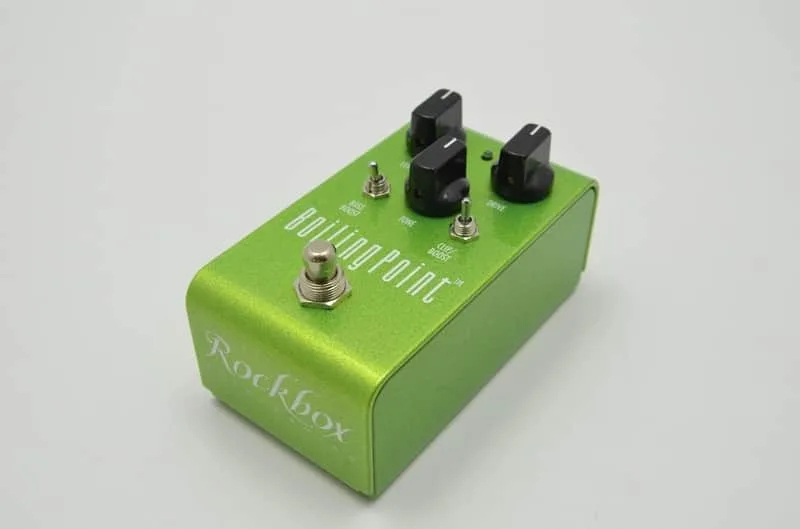


The Rockbox Boiling Point is an overdrive and clean boost pedal built around a three-position diode selector. In the Plexi mode the pedal has what its maker describes as a very Marshall-like response; the symmetrical overdrive mode uses a true symmetrical clipping arrangement; and the middle toggle position takes the diodes out of the circuit entirely, acting as a clean boost and, per the technical discussion, the loudest of the three settings1.
What it does
The pedal's Drive control sets the amount of drive, and the three-way clipping switch is what gives the Boiling Point its range. The maker's description, quoted in the Guitar FX Layouts write-up, calls the diode selector a route to "a nearly endless variety" of drive tones1.
The three toggle positions work like this:
| Toggle position | What it does |
|---|---|
| Plexi | Very Marshall-like response, per the maker1 |
| Symmetrical overdrive | True symmetrical clipping arrangement1 |
| Middle (diodes out) | Clean boost, the loudest of the three settings1 |
For players who ride their guitar's volume knob, the write-up notes the pedal cleans up well1:
"If you are a volume knob player, you will love how this pedal will clean up for a thick, creamy clean rhythm sound"
Where the circuit came from
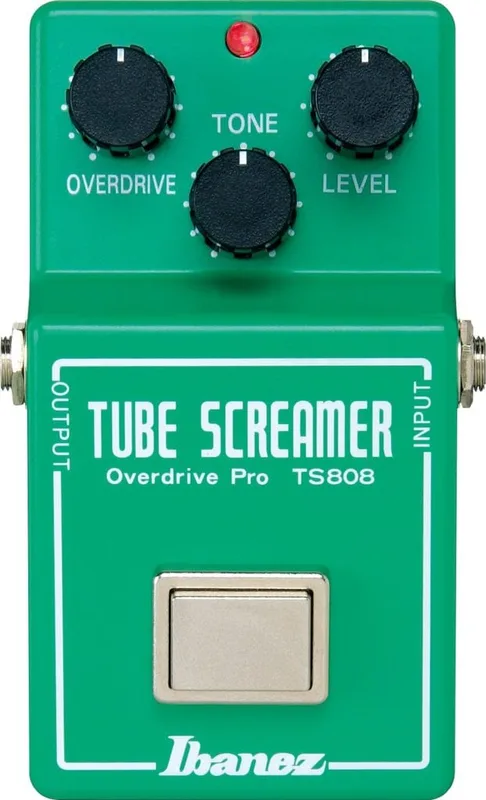
The Boiling Point is not a straight Tube Screamer copy, though the lineage is close. Builders examining the layout observed it resembles the Ibanez TS808 layout, and one described it as "basically a Landgraff Dynamic Overdrive with an additional switchable option and a couple of value changes"1. The added switchable diode option is the main departure. For context on the Tube Screamer family it sits near, see the Boss SD-1 vs Ibanez TS9 comparison.
Power and the op-amp
The circuit runs at 9V and can be run at 18V, provided the 100u filter cap and the 100n cap next to Q2 are rated for at least 25V1. The op-amp is a 4558 on a socket; the maker preferred the RC4558P but said it could ship with any chip the customer preferred1.
Running the circuit at 18V depends on the capacitor ratings: the 100u filter cap and the 100n cap next to Q2 must be rated at least 25V1.
On players' boards
Guitarist Linda Taylor's pedalboard, featured by Strymon in 2016, includes the Boiling Point, and she described it as a fixture2:
"The Boiling Point rarely gets changed out, and when I do, I usually regret it"
DIY layout
The DIY community has kept the Boiling Point on the bench long after its release: a builder verified the Rev2 stripboard (vero) layout working, reporting "Hi Segoy, Rev2. is ok, I've built it ;-)"1. That kind of continued building and verification reflects the pedal's standing among players, too. On Taylor's board it "rarely gets changed out, and when I do, I usually regret it"2.
Videos
ProGuitarShopDemos
ProGuitarShopDemos
Prymaxe
Questions
Can the Rockbox Boiling Point run at 18V?
Yes. According to the technical discussion on Guitar FX Layouts, the circuit can be run at 18V with no problem, provided the 100u filter cap at the bottom right and the 100n cap next to Q2 are both rated for at least 25V. Builders should check those two capacitor ratings before running the circuit above 9V.
What op-amp does the Rockbox Boiling Point use?
The Boiling Point uses a 4558 chip on a socket, so it can be swapped. The maker stated a preference for the RC4558P in most builds, saying it could ship with any other chip a customer prefers. A socketed op-amp makes trying alternatives straightforward for players who open their pedals.
Is the Rockbox Boiling Point a Tube Screamer clone?
Not exactly. Builders discussing the layout noted it resembles the Ibanez TS808 layout, but the circuit is described as basically a Landgraff Dynamic Overdrive with an additional switchable option and a couple of value changes. Its three-position diode selector also sets it apart from a standard Tube Screamer-style circuit.
Is there a DIY layout for the Rockbox Boiling Point?
Yes. Guitar FX Layouts published a stripboard (vero) layout of the Boiling Point in September 2012, which a builder verified working that October, and a compact Rev2 layout was added on 4 September 2014. A builder confirmed the Rev2 layout works in 2019.
Sources (2)
- Guitar FX Layouts: Rockbox Boiling Point, Guitar FX Layouts (tagboardeffects.blogspot.com), 2012-09-26
- Pedalboard Feature: Linda Taylor, Strymon (www.strymon.net), 2016-09-15