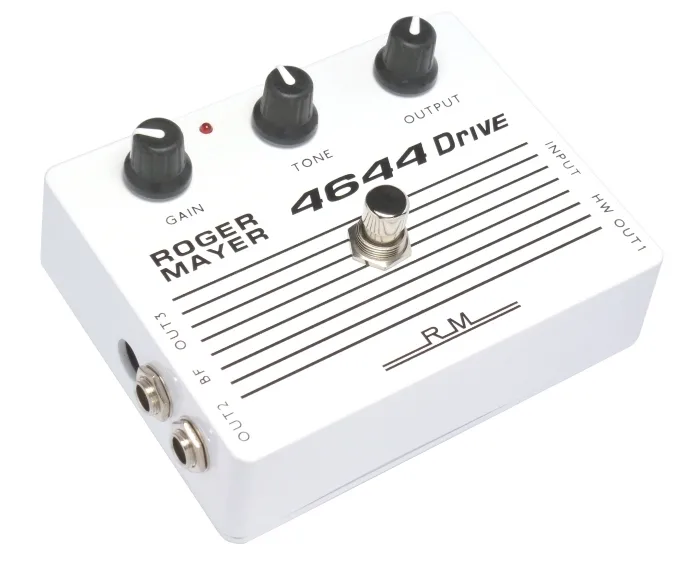


The 4644 Drive is an overdrive pedal for guitar made by Roger Mayer. What sets the 4644 apart from most overdrives is its circuit: Roger Mayer describes it as an "ULTRA WIDEBAND DISCRETE DESIGN" that "produces transparency and detail that cannot be obtained from conventional op-amp designs," with harmonics generated by a proprietary feed forward design with zero phase and no time delay.1
What it does to your sound
Roger Mayer's own description of the pedal's character is that "ULTIMATE DYNAMIC RESPONSE AND MUSICAL HARMONICS GIVE PLAYERS A UNIQUE EXPERIENCE."1 The maker's claim is that the discrete, op-amp-free topology keeps the guitar's detail intact in a way conventional op-amp designs cannot, and that the feed forward design generates harmonics without phase shift or time delay.1 For players comparing overdrive circuits, it sits apart from the common op-amp driven designs; see Overdrive Pedals for the wider field, or the Boss SD-1 vs Ibanez TS9 Tube Screamer comparison for two well known op-amp based alternatives.
Controls
| Control | What it does |
|---|---|
| DRIVE | Set once on the pedal; the maker suggests then using the guitar's volume control for performance control, "making it very performance friendly"1 |
| TONE | A passive tone circuit optimized for both single coil and humbucker pickups, to adjust harmonic content1 |
| OUTPUT | Sets the overall gain of the pedal to provide a significant boost where desired1 |
The intended playing approach is to dial in the drive level and leave it, then ride the guitar's volume knob from clean to driven.1
Outputs and pedalboard use
The 4644 Drive has a multi-output arrangement that is unusual on an overdrive1:
- A true hard wire output, with hard wire bypass
- Two buffered outputs that can drive long cable lengths with no high frequency loss
- The buffered outputs disconnect when the hard wire output is used1
The jack sockets sit in the conventional position, which Roger Mayer says makes pedalboard integration efficient. A TC Version of the pedal offers a further reduction in footprint for crowded boards.1
Power
The pedal runs on a 9V battery, with Roger Mayer specifying 150 hours or more from a premium grade alkaline type. For adapter power, it takes an external AC adapter, which is not supplied, through a standard DC power jack with a 2.1mm center pin, using the standard negative center pin protocol used by many leading manufacturers. Current draw is specified at 50mA or more.1
With a 50mA or more current draw, check the rating of any daisy chain or low output supply you plan to use; a supply rated below the pedal's draw is not suitable.
Videos
楽器好きにはたまらない! フーチーズ 渋谷店 / Guitar Shop Hoochie's
Guitar Village
Questions
How long does a battery last in the Roger Mayer 4644 Drive?
Roger Mayer states the 4644 Drive runs 150 hours or more on a premium grade alkaline 9 Volt battery. That figure comes from the maker's own product page, so actual life will depend on the battery brand and how often the pedal is used, but it suggests the circuit is economical enough that battery power is a practical option rather than a fallback.
Is the 4644 Drive true bypass?
Yes. The pedal uses a hard wire bypass, and its main output is described by Roger Mayer as a true hard wire output. The pedal also offers two buffered outputs for driving long cable lengths, and those buffered outputs disconnect when the hard wire output is in use, so the bypassed signal path stays untouched.
What power supply does the Roger Mayer 4644 Drive need?
It takes an external AC adapter, which is not supplied, through a standard 2.1mm centre pin DC power jack. The pedal uses the standard negative centre pin connection protocol common to many manufacturers, and Roger Mayer specifies a current draw of 50mA or more, so a supply rated above that figure is advisable.
Is the 4644 Drive op-amp based?
No. Roger Mayer describes the 4644 Drive as an ultra wideband discrete design, not op-amp based, and says this produces transparency and detail that cannot be obtained from conventional op-amp designs. The harmonics are generated by the maker's proprietary feed forward design with zero phase and no time delay.
Sources (1)
- Guitar Effects Pedals & Recording by Roger Mayer, Roger Mayer