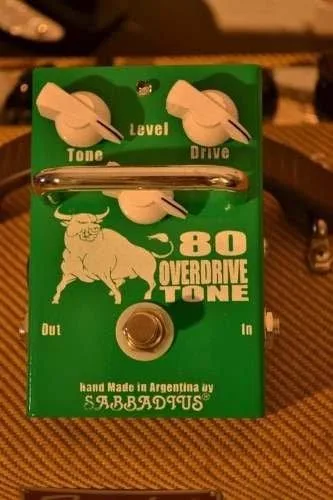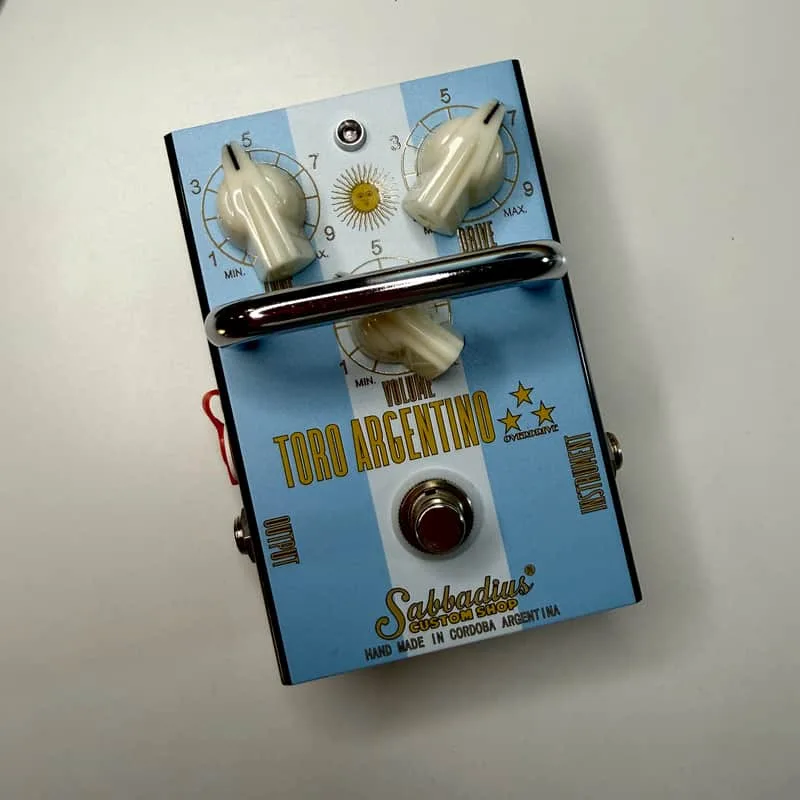

The Sabbadius El Toro Overdrive is a compact overdrive pedal from the Argentinian company Sabbadius, and it is the company's own take on the Tube Screamer circuit, the design Ibanez introduced as the TS-808 Tube Screamer Overdrive Pro. Delicious Audio's Paolo De Gregorio describes it as a pedal "based on the well-known Tubescreamers but with much more output impulse." The key difference is in the clipping: the El Toro uses NOS (New Old Stock) Toshiba 1S1588 diodes, which give it "a glassier tone," and it "also offers more output than the original green" drives, in the character of the classic "GLASSY TONES" of Texas Blues.12
How it sounds and where it came from
Sabbadius has built a solid reputation for modern takes on classic vintage circuits, and the El Toro, covered by Delicious Audio in July 2021, follows that pattern: it keeps the Tube Screamer foundation but aims for more output and a glassier edge.1 The Tube Screamer itself dates back to Ibanez's TS-808 Tube Screamer Overdrive Pro in the narrow box series with square switch.2
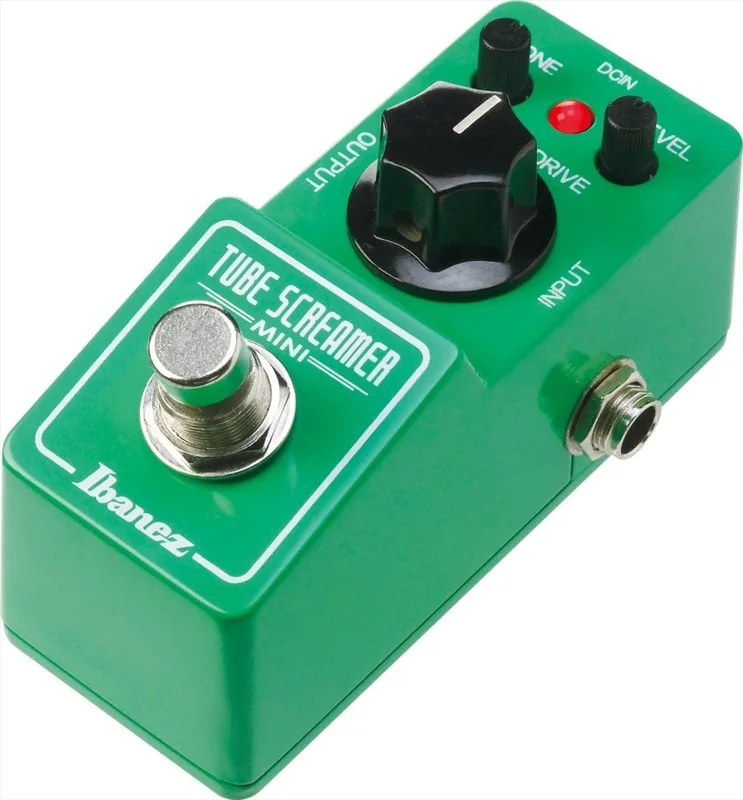
If you are weighing the El Toro against more mainstream takes on the same circuit, the Ibanez Tube Screamer Mini is the compact modern version, though MusicRadar's reviewers noted that "more versatile overdrives are available" in that format.3 For a broader look at the category, see the site's guide to Overdrive Pedals, or the comparison of the Boss SD-1 and Ibanez TS9, another pair of green drives.3
Controls
The El Toro keeps the classic three-knob layout of the circuit it is based on.1
| Control | What it does |
|---|---|
| VOLUME | Controls the output volume of the effect. |
| DRIVE | Sets the amount of drive (saturation), with changes in sound, color and sustain from minimum to maximum. |
| TONE | Tints the tone of the effect, from the lowest and warmest tones to the most screeching and glassy. |
Power and build
The El Toro can be powered two ways, and both are straightforward:
- Battery: a 9 volt battery, housed behind the 3PDT footswitch, between the switch and the back base plate where it is marked BAT.1
- Adapter: a regulated and stabilized 9 volt, 100mA supply with a 2.1mm negative center pin, the same as BOSS pedals.1
The pedal draws 100mA, so a low-current daisy-chain output may not be enough on its own; give it a supply output rated for at least 100mA.1
The pedal's enclosure is 100% aluminum, and Sabbadius lists the weight as approximately 380 grams.1
Videos
R.J. Ronquillo
Questions
Is the Sabbadius El Toro Overdrive true bypass?
Yes. The El Toro uses a 3PDT mechanical footswitch wired for true bypass, according to Delicious Audio's product page. That means the pedal's circuit is taken completely out of the signal path when it is switched off, so your clean tone passes through unchanged.
Does the El Toro Overdrive take a battery?
Yes. The pedal can run on a 9 volt battery, which is housed behind the 3PDT footswitch, between the switch and the back base plate where it is marked BAT, according to Delicious Audio.
What power supply polarity does the El Toro Overdrive use?
The El Toro uses a 2.1mm negative center pin connector, the same arrangement as BOSS pedals, and wants a regulated and stabilized 9 volt supply rated for 100mA, according to Delicious Audio.
What diodes does the El Toro Overdrive use?
The clipping is handled by NOS (New Old Stock) Toshiba 1S1588 diodes. Delicious Audio reports these give the pedal a glassier tone and more output than the original green drives.
Where is the Sabbadius El Toro made?
The El Toro is a 100% handmade pedal built in Córdoba, Argentina, by Sabbadius, an Argentinian company that has built a reputation for modern takes on classic vintage circuits, according to Delicious Audio.
How big is the El Toro Overdrive pedal?
Delicious Audio lists the El Toro at 120mm long by 90mm wide, including the input and output jacks, and weighing approximately 380 grams. The same page also gives a height of 55mm including knobs and kickstands.
Sources (3)
- Sabbadius El Toro Overdrive, Delicious Audio, 2021-07-20
- TONEHOME, TONEHOME (tonehome.de)
- Best overdrive pedals: Find new inspiration, MusicRadar, 2022-05-25