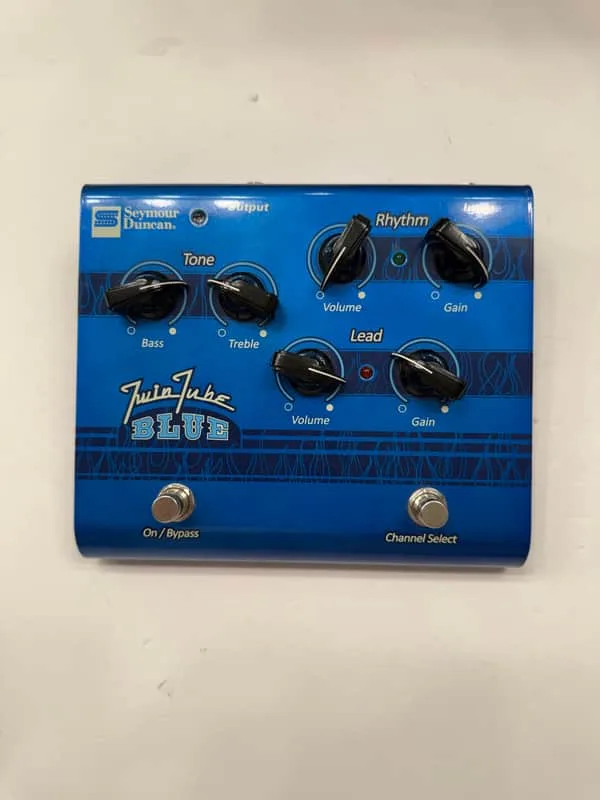

The Seymour Duncan SFX-11 Twin Tube Blue is a dual-channel tube overdrive pedal, the third in a series of Twin Tube stompboxes, each built around a different subminiature triode tube. The "Blue" uses the 6111 military spec tube, hence the SFX-11 designation1. It gives a player two switchable overdrive voices, Rhythm and Lead, each with its own Gain and Volume, plus a master Tone section, in a steel enclosure weighing 3 lb1.
The controls and footswitches
The Twin Tube Blue carries two footswitches, On/Bypass and Channel Select. The On/Bypass switch sits at the lower edge of the chassis, which Premier Guitar's reviewer called brilliantly located, so it can be actuated easily with a toe. When the light is out, the unit is in true-bypass mode1.
The top panel splits into three areas:
| Control | What it does |
|---|---|
| Rhythm Volume, Rhythm Gain | Separate Volume and Gain knobs for the Rhythm channel1 |
| Lead Volume, Lead Gain | Separate Volume and Gain controls for the Lead channel1 |
| Master Bass, Master Treble | Tone section affecting both Rhythm and Lead channels equally, not affecting the bypass signal1 |
| Channel Select footswitch | Allows either the rhythm channel or the lead channel to enter the signal path, but not both1 |
| On/Bypass footswitch | Engages the effect or returns to true bypass1 |
One detail worth noting: the Volume control does not start at the volume of the input guitar but can be used to lower the volume instead, which changes tone and character at two levels1.
How the two channels differ
The Rhythm and Lead channels are voiced differently. Premier Guitar's reviewer found the Lead channel has more top and a bit less bottom than the Rhythm channel, and that the rhythm channel sounded very transparent, easily duplicating the bypass sound when dialing in less gain and more volume1. The unit outputs 2 Volts at max before clipping1.
"The unit became somewhat microphonic at high-gain settings, causing particularly the bypass switch to 'clank' loudly when actuated."
Power: 16V AC, 560mA
The Twin Tube Blue takes a 16V 560mA AC power supply from a wall wart, which is the only way of powering the unit. There is no battery operation1. The 1/4" instrument input and a like output into the amp (or other device) sit on the rear of the blue cover1.
The 16V AC, 560mA requirement rules out a battery, and the wall wart supply is the only way of powering this unit. Plan for that supply when fitting this pedal to a board.
Build and circuit
All components, both inside and out, are mounted to a fiberglass printed circuit board except the footswitches. The tubes run at normal (high) plate voltages. The 6111 tubes have wires extending from their bases soldered to tabs and are held horizontally with a removable metal clamp cushioned by silicon or Teflon tabs1. The pots and switches are labeled "Alpha," described by the reviewer as a reliable brand1.
The enclosure is painted a metallic blue with well-done graphics and labels in contrasting colors. The bottom cover is black with a corrugated rubber slip strip and slotted vent openings on each side, and the beefy steel top and bottom are held by four screws1. The instruction manual was described as very well-written1.
Warranty
The unit is covered for one year, except the tubes, which are covered for 90 days1.
Where it sits among Seymour Duncan overdrives
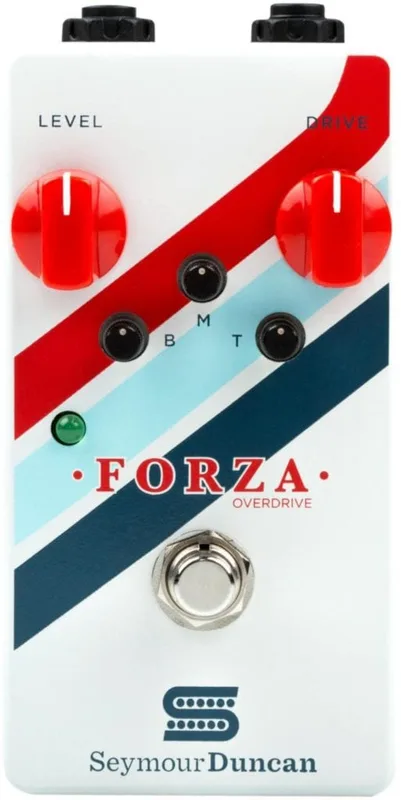
The Twin Tube Blue belongs to a series of Twin Tube stompboxes, each using a different subminiature triode tube1. Seymour Duncan has since built out its drive lineup with pedals like the Seymour Duncan Forza, and players comparing tube-driven designs with chip-based circuits can see the wider field on the Overdrive Pedals and Distortion Pedals pages.
Videos
BUZZBEE TV
Questions
Can the Seymour Duncan Twin Tube Blue run on a battery?
No. According to Premier Guitar's review, the 16V 560mA AC wall wart power supply is the only way of powering the unit, so there is no battery option. The high current draw of the tube circuit also means a standard pedalboard power supply output will not run it; players need the supply the unit was designed for.
Is the Twin Tube Blue true bypass?
Yes. Premier Guitar's reviewer noted that when the light is out, the unit is in true-bypass mode, so the pedal passes your guitar's signal to the amp without its circuitry in the way when switched off.
Does the Twin Tube Blue run its tubes at high plate voltage?
Yes. Premier Guitar's review states that the tubes are run at normal (high) plate voltages, which is part of how the pedal gets its tube character from the 6111 military spec tube rather than running the tube starved of voltage.
What warranty does the Twin Tube Blue have?
Premier Guitar's review reports the unit is covered for one year, except the tubes, which are covered for 90 days. That is worth knowing because the 6111 tubes are the heart of the circuit and are the part most likely to need replacing over time.
What was the original price of the Seymour Duncan Twin Tube Blue?
The MSRP was $325, as listed in Premier Guitar's review of the pedal.
Sources (1)
- Seymour Duncan SFX-11 Twin Tube Blue Review, Premier Guitar, 2009-07-08