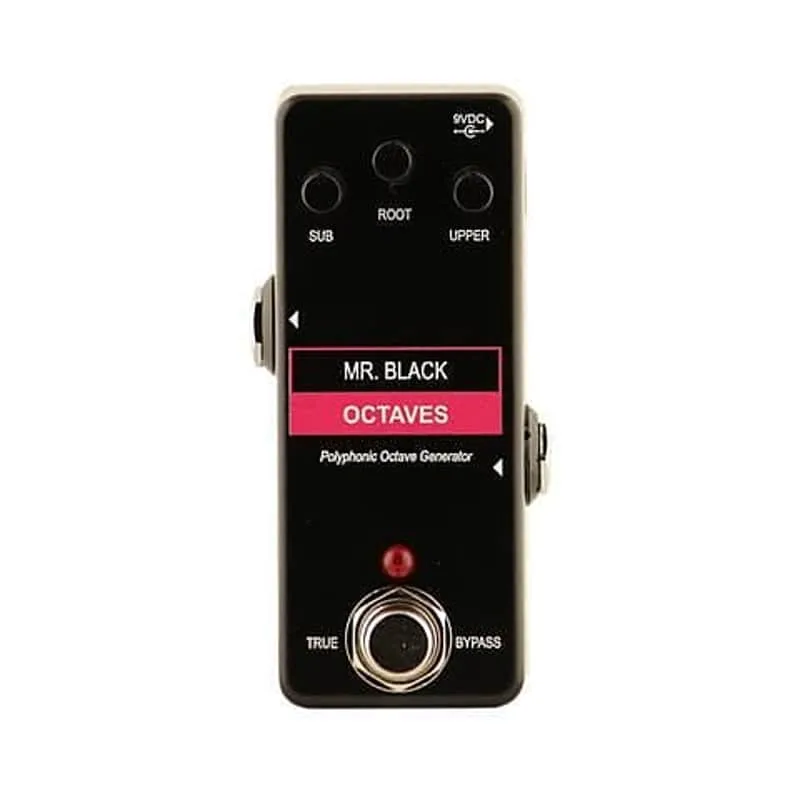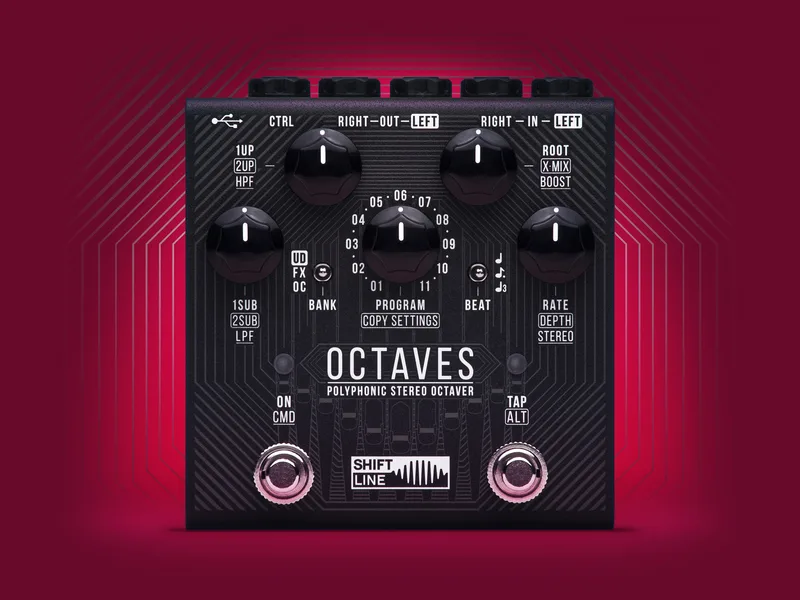


The Shift Line Octaves is a polyphonic stereo octaver pedal for guitar and bass. It generates four polyphonic octaves, two up and two down, from the incoming signal, and offers 22 algorithms that include classic octavers, organ-like sounds, polyphonic octafuzzes and octadrives with a clean blend1. It sits in the broader field of octave and pitch pedals, alongside simpler analog-style units such as the Mr. Black Mini Octaves.
Shift Line's product page offers a Notify Me option for the device1.
What it does
The Octaves tracks your incoming note and builds up to four polyphonic octaves from it, two above and two below, so you can stack octave-up and octave-down voices together or use them separately depending on the algorithm. Shift Line groups its 22 algorithms into families: classic octavers, organ-like sounds, polyphonic octafuzzes and octadrives with a clean blend1. The octafuzz and octadrive algorithms put distortion-style textures under the shifted voices, in the same territory players explore with fuzz pedals and overdrive pedals.
For presets, the pedal holds 33 programs split into 3 banks, along with a Quick Access function for calling up sounds directly1.
Stereo path and bypass
Shift Line describes the Octaves as having a fully fledged stereo path with individual channel processing, which allows you to use it anywhere in a stereo signal chain1. Connections are made on separate mono jacks rather than TRS:
| Jack | Details |
|---|---|
| LEFT IN / RIGHT IN | 6.3 mm mono unbalanced, 1 MOhm input impedance; LEFT IN is the main mono input; no TRS support1 |
| LEFT OUT / RIGHT OUT | 6.3 mm mono unbalanced, 100 Ohm output impedance; LEFT OUT is the main mono output; no TRS support1 |
| CTRL | 6.3 mm stereo, for external control sources1 |
The pedal uses active bypass with VCA-based dry/wet mixing rather than true bypass. Shift Line says this eliminates extra noises when turning the pedal on, and that the dry signal does not go through AD/DA conversion1.
External control and MIDI
The CTRL input accepts several kinds of controller, which is unusual on a compact octaver1:
- Normally open momentary button1
- MIDI Type A1
- 5 V analog trigger (S-Trigger/V-Trigger)1
- Passive expression pedal, TS or TRS, 10 to 25 kOhm1
Shift Line's support article explains that an expression pedal in this mode controls one of the pedal's knobs, with RATE as the default, and notes that TS (mono) connections are preferable, since TRS connections may result in a non-linear response1.
MIDI is handled through the same CTRL jack with a MIDI Type A connection. The pedal's MIDI channel is set in the USER.SET configuration file shipped with firmware Ver. 1.0. Shift Line's support article instructs: "Set the value in the 1 to 16 range (depending on the channel you want the pedal to respond to)." The default is channel 12.
Power
The Octaves cannot be battery-powered, so a DC supply is required1. Specifications from Shift Line:
| Power item | Specification |
|---|---|
| Voltage | Universal power intake, 9 to 12 VDC1 |
| Current draw | 200 mA at 9 V DC; 160 mA at 12 V DC1 |
| Connector | Center negative1 |
Shift Line describes this as a relatively low current draw of 160 to 200 mA1, though it is well above what a typical compact analog pedal needs. An isolated supply output rated for at least 200 mA is the safe choice, and a daisy chain shared with other digital pedals is not.
Size and mounting
The pedal comes in a compact and lightweight aluminum enclosure with top-mounted jacks, which Shift Line points out saves space on a pedalboard1. It measures 110 x 104 x 56 mm (4.3 x 4.1 x 2.2 inches) and weighs 350 g (0.77 lbs)1.
Videos
Mike Hermans
Brett Kingman
Nikita Demchenko
Questions
Does the Shift Line Octaves run on a battery?
No. Shift Line states plainly that the pedal cannot be battery-powered. It needs an external DC supply at 9 to 12 V with a center-negative connector, drawing 200 mA at 9 V or 160 mA at 12 V. A standard isolated pedalboard supply that can deliver at least 200 mA on that output will run it.
Is the Shift Line Octaves true bypass?
No, it uses active bypass with VCA-based dry/wet mixing rather than true bypass. Shift Line says this design eliminates extra noise when turning the pedal on. Importantly, the dry signal does not pass through AD/DA conversion, so the analog dry path is preserved while the shifted signal is processed digitally.
Can the Shift Line Octaves be controlled with MIDI?
Yes. The pedal responds over MIDI, and its channel is set in the USER.SET config file: the default is MIDI channel 1, and you can set any value in the 1 to 16 range depending on which channel you want the pedal to respond to. MIDI can be connected through the CTRL jack using a MIDI Type A adapter, alongside expression pedals and analog triggers.
Is the Shift Line Octaves a stereo pedal?
Yes. Shift Line describes it as a fully fledged stereo path with individual channel processing, so it can sit anywhere in a stereo signal chain. It has separate LEFT and RIGHT inputs and outputs on 6.3 mm mono jacks with no TRS support, and the LEFT input and output serve as the main mono connections.
What power supply does the Shift Line Octaves need?
A 9 to 12 V DC supply with a center-negative plug. Current draw is 200 mA at 9 V DC or 160 mA at 12 V DC. Because the pedal cannot run on a battery and draws a relatively high current for a compact pedal, use an isolated supply output rated for at least that draw rather than a daisy chain.
Sources (2)
- Shift Line Octaves, Shift Line, 2026
- Shift Line Octaves, Shift Line, 2026