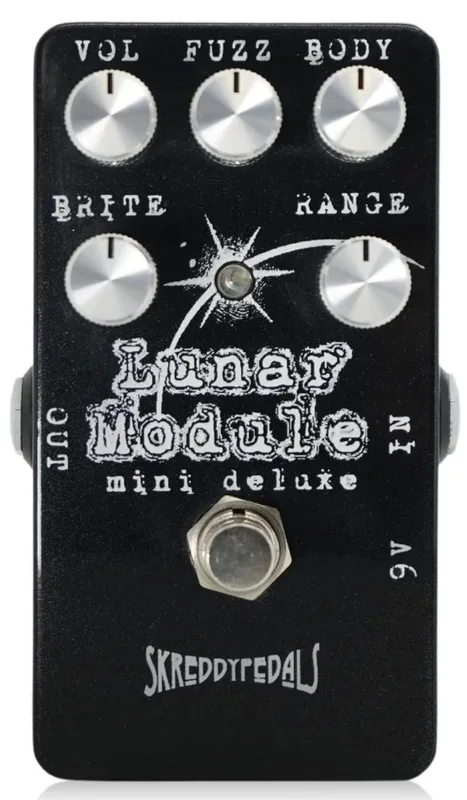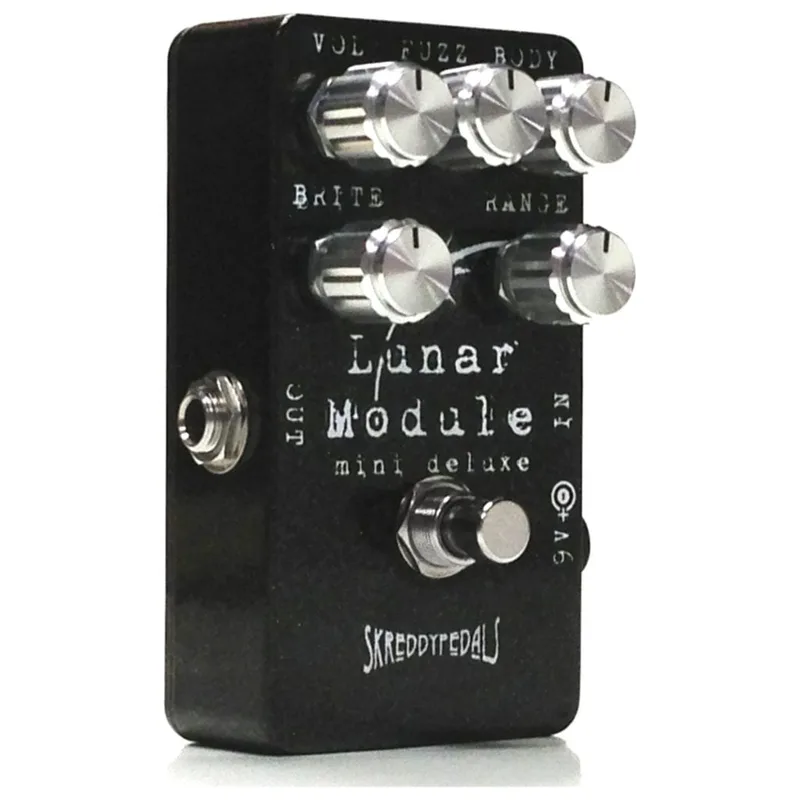


The Skreddy Lunar Module Mini Deluxe is a silicon fuzz pedal from Skreddy Pedals, designed by Marc Ahlfs. Skreddy describes it as a "versatile yet aggressive silicon fuzz" with a huge range that covers clean, overdrive and distortion territory1. The design is Marc's take on the silicon Fuzz Face circuit, voiced for the fuzz solo on a best-selling 1973 album: the "Time" solo, the David Gilmour tone that has made the Lunar Module family one of Skreddy's best-known pedals12.
The Mini Deluxe is the current version of the pedal, built to order with a wait time of approximately 2 weeks to 1 month, and listed at $301 USD (shown discounted to $270.90 on Skreddy's site)34. Demand for the Lunar Module and the earlier Lunar Module Deluxe has, at times, well exceeded supply, with waiting lists2.
Silicon fuzz voiced for the "Time" solo
Marc designed the pedal for what he calls "that" certain silicon fuzz tone guitar solo he fell in love with on a best-selling 1973 album1. Premier Guitar's review of the Lunar Module Deluxe identifies the lineage plainly: it is based on the silicon Fuzz Face circuit, and it was Skreddy-mastermind Marc Ahlfs' second attempt at perfecting Gilmour's Fuzz Face sound, following the first Lunar Module2.
The Deluxe added two front-panel knobs over the standard version, which carried only Volume, Fuzz and Body. On the standard Lunar Module, Brite and Range were available only as internal trim pots; the Deluxe brought them out as knobs, and the Mini Deluxe keeps all five on top12.
Premier Guitar also described the Deluxe as a Fuzz Face-style silicon fuzz/treble booster that "bowled over Dark Side of the Moon tone obsessives"6.
The controls: Volume, Fuzz, Body, Brite and Range
All five controls come from Skreddy's own product page1.
| Control | What it does |
|---|---|
| Volume | Sets the output volume, adjustable to roughly the same level as your bypass signal (unity gain) or as a boost for a fatter tone. |
| Fuzz | Takes you from gritty, touch-sensitive overdrive all the way to liquid, infinite-sustaining fuzz. Skreddy warns it can get noisy at high settings. |
| Body | Dials in the amount of bass going into the fuzz section, for everything from tight overdrive to thick, full-voiced fuzz. Can get noisy at low settings. |
| Brite | Adds brilliance and "hair," or makes the tone darker and smoother, to suit your amp and taste. Premier Guitar calls it a presence control. |
| Range | Sets the gain of the input transistor. Higher is fuzzier, more aggressive and noisier; lower is darker and tamer. Premier Guitar calls it a pre-gain control. |
The Range knob is the control that most changes the pedal's character, because it adjusts the gain of the input transistor itself. Premier Guitar noted the Deluxe's variable-gain input transistor as a key feature2. An independent technical analysis at Guitar FX Layouts points out that this kind of design, adding a resistor between the base and collector to reduce the apparent gain of the transistor, is how the Skreddy circuit tames a silicon Fuzz Face7.
Noise at high Fuzz settings
Both the Fuzz and Range knobs carry noise warnings from the maker: Fuzz can get noisy at high settings, Body at low settings, and Range is at its noisiest wide open, where the input transistor's gain is highest1. Premier Guitar's reviewer found the same behavior in the Deluxe:
"In loud settings this thing can still get raucous and verge on squealy. Be prepared to use your guitar's volume knob judiciously."
The practical fix is the one both the maker and the reviewer point to: back off the guitar's volume knob, or run Range lower and make up the aggression with Fuzz and Body21.
Power and bypass
The Mini Deluxe is true bypass with an LED indicator and DC power input1. It accepts the industry-standard 9V DC plug, 5.5mm barrel x 2.1mm center coax, negative tip, and Skreddy recommends a quality regulated, filtered supply1.
The pedal takes a 9V battery, but the battery is not included, and the input cable must be unplugged when the pedal is not in use to prevent the battery draining1.
Videos
Bedroom Level Tones
Kieran Smith guitar
The Tone Unknown
Questions
Is the Lunar Module Mini Deluxe true bypass?
Yes. Skreddy lists the pedal as true bypass, with an LED indicator and DC power input. Premier Guitar's review of the Lunar Module Deluxe also describes it as a true bypass fuzz/overdrive pedal.
What does the Range knob do on the Lunar Module?
Range sets the gain of the input transistor. Turned up, the pedal is fuzzier, more aggressive and noisier; turned down, it is darker and tamer. Premier Guitar describes it as a pre-gain control, and on the standard Lunar Module it was available only as an internal trim pot.
Does the Lunar Module Mini Deluxe take a battery?
Yes, it accepts a 9V battery, which is not included. Skreddy notes that you should unplug the input cable when the pedal is not in use, otherwise the battery will drain. It also runs from a 9V DC adapter.
Why is my Lunar Module noisy at high Fuzz settings?
Skreddy warns that the Fuzz knob can get noisy at high settings, and the Range knob is noisier still when wide open because it raises the input transistor's gain. Premier Guitar found the Deluxe could get raucous and verge on squealy in loud settings, and suggested using the guitar's volume knob judiciously.
Sources (7)
- Fuzz | Lunar Module Mini Deluxe | Skreddy Pedals, Skreddy Pedals
- Skreddy Pedals Lunar Module Deluxe Pedal Review, Premier Guitar, 2011-10-18
- Overdrive, Skreddy Pedals
- Fuzz | Martian Tarantula | Skreddy Pedals, Skreddy Pedals
- Fuzz | Pink Flesh | Skreddy Pedals, Skreddy Pedals
- Skreddy Little Miss Sunshine Phaser Review, Premier Guitar, 2013-11-22
- Guitar FX Layouts: Analogman Sunface BC108, Guitar FX Layouts (tagboardeffects.blogspot.com), 2013-03-01