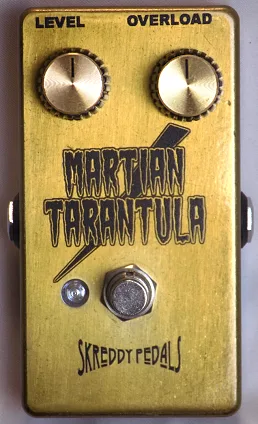


The Skreddy Martian Tarantula is a fuzz pedal from Skreddy Pedals, described by the maker as a "well-behaved Tonebender Mk1 fuzz"1. It is built on the Tonebender Mk1 circuit, which Skreddy's Marc calls "the earliest fuzz pedal design"1. The pedal is sold as a preorder, built to order, with a stated wait time of "approximately 2 weeks to 1 month"1.
The circuit and where it comes from
The Tonebender Mk1 sits at the root of a long fuzz family tree. Coda Effects' history of fuzz circuits notes that the Sola Sound Tonebender designs "has been also been copied by many brands: Marshall Supafuzz, Vox Tonebender are examples of fuzz 'heavily inspired'" by it4. The original design's character is described by another maker building the same circuit type as having "a raw, primitive fuzz character which fits the early design of the original"5. Coda Effects describes the Tonebender sound as "a more classic fuzz sound, loud and powerful, with quite a lot of saturation"4.
Skreddy's take keeps that lineage but swaps the transistors. "I designed this using silicon transistors for temperature sensitivity and consistency from unit to unit," Marc says on the product page1. That is the "well-behaved" part of the description: silicon parts hold their character as temperatures change and are more consistent between pedals than the old germanium units the circuit was originally built with.
Skreddy describes the resulting tone as an "angry sounding fuzz, nice authoritative voice"1, and describes the early Tonebender-style tone generally as having "an interestingly bright sustaining sound on the high strings, and surprisingly good chord articulation" for something so grindy and fuzzy1.
The Overload control
The Martian Tarantula's single knob is a rework of the original Mk1's bias-style Attack control. "I changed it completely, made it useful (but still not a gain control), and renamed it 'OVERLOAD' instead," Marc says1. It is a bias-style texture control rather than a drive level, and Skreddy maps out its three zones:
| Overload setting | What Skreddy says it does |
|---|---|
| All the way down | Extra dry and gated, slightly cold-biased1 |
| Middle | Balanced and fairly tight1 |
| Full up | Extra fat and woofy, slightly saggy1 |
The pedal also cleans up with the guitar's volume control: Skreddy describes "a decent amount of guitar volume cleanup; gets more polite and defined" as you roll back1, which makes it usable at lower gain levels than a fuzz at full tilt.
Buying one
The Martian Tarantula is listed at $259 plus shipping on its product page1. The maker's site also shows it at $259 with a discounted price of $233.103, so the price you pay may depend on when you order. It is built to order as a preorder, with the wait time given above1. Skreddy hosts a manual for the pedal as a PDF on its own site, linked from the product page1.
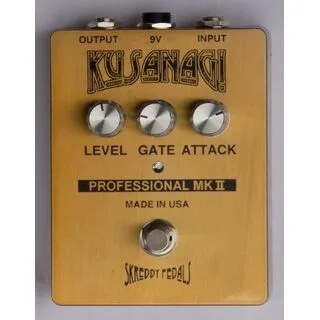
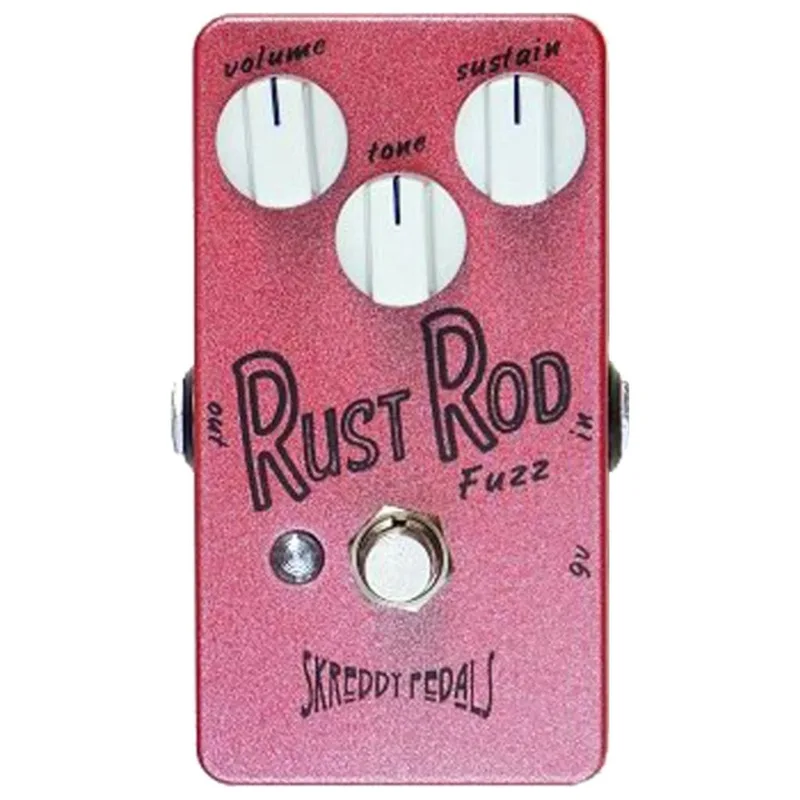
Skreddy builds a range of fuzzes around different classic circuits, including the Skreddy Kusanagi, another Tone Bender-based design, and the Skreddy Rust Rod, modeled after '70s Big Muff pedals2.
Videos
Skreddy Pedals
Alex Wong
Questions
What is the Skreddy Martian Tarantula based on?
Skreddy describes the Martian Tarantula as a well-behaved Tonebender Mk1 fuzz, based on what the maker calls the earliest fuzz pedal design, the TBMk1. The Tonebender lineage was widely copied: Coda Effects notes that fuzzes like the Marshall Supafuzz and Vox Tonebender were heavily inspired by the Sola Sound original. Skreddy's version redesigns the original bias-style Attack control into a renamed Overload knob.
Is the Martian Tarantula a germanium or silicon fuzz?
It uses silicon transistors, tuned to sound like old germanium units. Skreddy's Marc says he designed it with silicon for temperature sensitivity and consistency from unit to unit, which addresses the unit-to-unit and weather-related variability germanium fuzzes are known for. The tone is still aimed at the early Tonebender Mk1 character.
What does the Overload knob do on the Martian Tarantula?
The Overload knob is a redesign of the original Tonebender Mk1's bias-style Attack control. Skreddy says he changed it completely, made it useful, though still not a gain control, and renamed it Overload. All the way down it is extra dry and gated; in the middle it is balanced and fairly tight; at full up it is extra fat and woofy and slightly saggy.
How long does a Skreddy Martian Tarantula take to arrive?
The Martian Tarantula is sold as a preorder, built to order. Skreddy's stated wait time is approximately 2 weeks to 1 month, as of the maker's product page dated October 2026. The price is $259 plus shipping.
Is there a manual for the Skreddy Martian Tarantula?
Yes. Skreddy hosts a manual for the Martian Tarantula on its own site as a PDF, linked from the pedal's product page. It covers the pedal's single Overload control and its operation.
Sources (5)
- Fuzz | Martian Tarantula | Skreddy Pedals, Skreddy Pedals
- ToneBender variants, Skreddy Pedals
- Delay | Echo Vintage | Skreddy Pedals, Skreddy Pedals
- Coda Effects, Coda Effects, 2015-08
- Tone Splendor MK1S, Mod Electronics (modkitsdiy.com), 2026