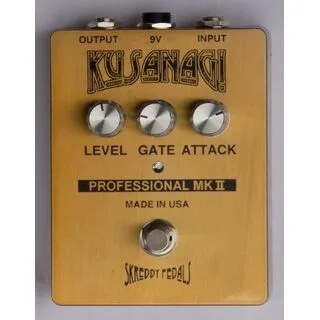
The Skreddy Kusanagi is a fuzz pedal from Skreddy Pedals, built as a Tone Bender MkII made with NPN germanium transistors1. It was announced in June 2015 as Skreddy's take on the 1966 Tone Bender circuit, and Skreddy creator Marc Ahlfs described it as patterned after a specific player's sound: Jimmy Page's sustaining, synthy, frizzy fuzz tones from the late Yardbirds and early Led Zeppelin23. The pedal is no longer in production: Skreddy's product page lists it as no longer available and states it cannot be purchased1.
The original Sola Sound Tone Bender MkII that inspired it has a documented Page connection. Guitar Player's history of the pedal notes that "Page, who used a MkII, continued to slather Tone Bender fuzz all over his early recordings with Led Zeppelin"4. Ahlfs had built historically accurate Tone Bender clones before designing his own version of the circuit for the Kusanagi2.
A germanium Tone Bender MkII in the Jimmy Page mold
The Kusanagi stays close to the circuit it copies. Delicious Audio's review noted that it "remains true to the original circuit design (circa 1966)," and that the build uses larger carbon resistors, axial capacitors and germanium transistors, part types chosen to match a vintage unit7. The announcement made the same point: the fuzz "uses many of the same high-voltage part types you'll find in a historic specimen," laid out on a PCB inspired by the design of the 1960s perfboard units2.
The target sound is specific. Premier Guitar's announcement described the pedal as:
"Patterned after Jimmy Page's sustaining, synthy, frizzy fuzz tones from the late Yardbirds and early Led Zeppelin."
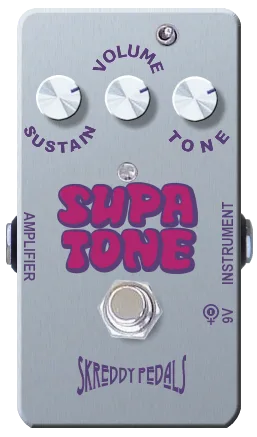
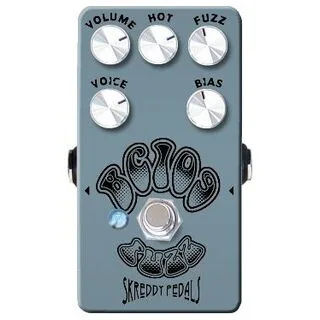
Page's own Tone Bender use is well documented across the fuzz's history. He was photographed with a Tone Bender during the Yardbirds years, and the gray Tone Benders associated with his Yardbirds and early Led Zeppelin work are thought to be either the MK1.5 or MKII circuit. Guitar Player's account places a MkII on his early Led Zeppelin recordings489. The Kusanagi is Skreddy's MkII-style entry in that lineage, sitting alongside the maker's other vintage-circuit fuzzes such as the Skreddy Supa Tone and the Skreddy BC109 Fuzz.
The controls: Level, Attack and Gate
The Kusanagi has three controls, and their names map onto the three-stage germanium circuit in a way players of vintage-style fuzzes will recognize72.
| Control | What it does |
|---|---|
| Level | Adjusts the output volume7 |
| Attack | Serves as input gain, setting how hard the circuit is driven7 |
| Gate | Adjusts the bias and fine-tunes the fuzz sound7 |
The Gate control is the one that sets this pedal apart from a straight reproduction. Skreddy describes it as a range rather than a single behavior27:
"Adjustable Gate control lets you dial in the optimal response, from smoother fuzz that cleans up with the guitar volume to nastier fuzz that goes silent when you aren't playing."
In practice that means one end of the Gate range gives you a smoother, more responsive fuzz that reacts to your guitar's volume knob, while the other end biases the transistors for a harsher, gated sound that cuts off when you stop playing. Delicious Audio's reviewer described the Gate as adjusting the bias and allowing fine-tuning of the fuzz sound7.
Power, bypass and pedalboard use
The Kusanagi was designed to avoid the headaches vintage-style germanium fuzzes are known for. It uses negative-ground power with a DC adapter jack and a 9v battery clip2, and Delicious Audio's reviewer called it "pedalboard-friendly negative-ground power," noting it can be run off of the adapter or a 9v battery7.
Because the Kusanagi is negative-ground, it can share a standard daisy chain or multi-output supply with other negative-ground pedals. Many vintage-circuit germanium fuzzes use positive ground and need isolated power, so this is a practical difference for pedalboard builders7.
Other practical details from the announcement and review:
- True bypass switching27
- Top-mounted input and output jacks in a solid enclosure7
- Hammond 1590BB enclosure, a larger box than a standard 1590B2
- Works with both single-coil and humbucking pickups2
What reviewers said
Delicious Audio reviewed the Kusanagi at launch and framed it as "a fresh take on a classic design," pointing to the part choices, the axial capacitors and germanium transistors, and the top-mounted jacks as the details that made it a practical version of a 1966 circuit7. Premier Guitar's announcement concluded that the pedal "has that special magic and occupies a rightful place in the Tone Bender pantheon"2.
Videos
Marc Ahlfs
Questions
Is the Skreddy Kusanagi still made?
No. Skreddy Pedals lists the Kusanagi as no longer available, and the product page states it is currently out of stock and cannot be purchased. It was introduced in June 2015 at an introductory price of $249, and the maker later listed it at $385 before it left the lineup.
Does the Skreddy Kusanagi run on a 9V battery?
Yes. The Kusanagi shipped with a 9v battery clip inside, and reviewers noted it can be run off of an adapter or a 9v battery. It also has a DC adapter jack, so you can power it either way.
Is the Skreddy Kusanagi true bypass?
Yes. The Kusanagi uses true bypass switching, confirmed both in the announcement press release and in the Delicious Audio review, so the pedal passes your clean signal untouched when it is off.
Does the Kusanagi clean up with the guitar volume knob?
It can. The Gate control sets the bias, and Skreddy describes a range from smoother fuzz that cleans up with the guitar volume to nastier fuzz that goes silent when you are not playing. Where it sits on that range depends on how you set the Gate.
Does the Kusanagi work with humbuckers?
Yes. The announcement stated the pedal works great with both single-coil and humbucking pickups, so it is not limited to the single-coil setups often recommended for vintage-style germanium fuzz.
Can the Kusanagi share a power supply with other pedals?
Yes. The Kusanagi uses negative-ground power, which reviewers called pedalboard-friendly, so it can share a standard daisy chain or multi-output supply with other negative-ground pedals instead of needing an isolated supply like some vintage-style fuzzes.
Sources (9)
- Fuzz | Kusanagi | Skreddy Pedals, Skreddy Pedals
- Skreddy Pedals Announces the Kusanagi, Premier Guitar, 2015-06-11
- Evil Eye MKIII by Minotaur Sonic Terrors, RockBoard (www.rockboard.de), 2026
- The Sola Sound Tone Bender and the Early Evolution of the Fuzz Pedal, GuitarPlayer (www.guitarplayer.com), 2020-07-27
- ToneBender variants, Skreddy Pedals
- ToneBender variants, Skreddy Pedals
- Skreddy Kusanagi Fuzz, Delicious Audio, 2015-06-16
- SolidGoldFX Communication Breakdown review, Guitar World, 2020-10-07
- NAMM 2020: Communication Breakdown is a 2-in-1 Led Zeppelin-style fuzz box, gearnews.com, 2020-01-09