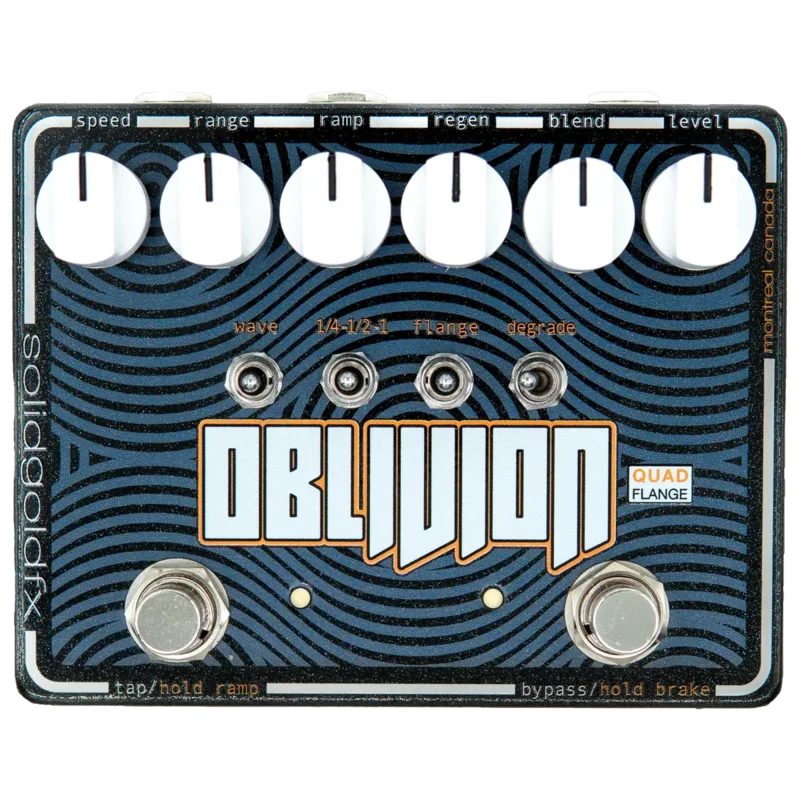


The SolidGoldFX Oblivion Quad Flanger is a multi-mode, tap tempo flanger pedal with through-zero capability, made in Montreal, Canada1. Announced in July 2020 and released in April 2021, it packs three distinct flange modes into one box: a classic through-zero flanger, a bi-flange running two independent delay lines, and a quad-flange swirling four delay lines123. SolidGoldFX describes the range as running from subtle, classic tones to "massive swooshing tsunamis of ominous textures"2.
For a player comparing flanger pedals, the Oblivion stands out for how much control it gives over the modulation itself: multiple low-frequency oscillator waveforms, tap tempo, speed ramping, LFO braking, a lo-fi Degrade toggle, and an assignable expression/CV input14.
Three flangers in one: classic thru-zero, bi-flange and quad-flange
The Flange toggle selects between the three modes2:
| Flange switch position | Mode | What it does |
|---|---|---|
| Left | Classic through-zero flanger | A single-delay-line flanger that passes through zero delay time, the point where the modulated signal crosses the dry signal2 |
| Center | Bi-flange | Modulates two independent delay lines2 |
| Right | Quad-flange | Swirls four independent delay lines2 |
MusicRadar's Rob Laing noted that SolidGoldFX's Thru-Zero mode "evolves the classic flanger"4, and the quad-flange mode adds the four independent delay lines responsible for those "massive swooshing tsunamis of ominous textures"3. Each mode also has its own Degrade setting, so the lo-fi character changes with the flange mode you are in2.
The controls
Alongside the traditional Speed, Range and Regen controls1, the Oblivion adds a Ramp knob and two multi-function footswitches2:
| Control | What it does |
|---|---|
| Speed | Adjusts the speed of the flanger, from low and slow to warble fast; can also be manipulated by an expression pedal per dipswitch settings2 |
| Range | One of the traditional flanger controls1 |
| Regen | Controls the amount of feedback; at higher clockwise levels the Oblivion begins to self-oscillate; can also be manipulated by an expression pedal2 |
| Ramp | A momentary feature: hold the tap tempo switch to speed up or slow down the flanger. Off at center, ramps down below noon and up above noon, with distance from noon setting the ramp speed2 |
| Flange toggle | Selects between the three flange modes2 |
| Degrade toggle | Switches on the lo-fi mode when set to the right; each flanger setting has its own lo-fi mode varying the level of signal degradation2 |
The two footswitches carry several duties between them5:
- Bypass/Hold Brake: turns the effect on and off; hold it down while the effect is on to momentarily pause the LFO until released2
- Tap/Hold Ramp: provides tap tempo; hold it down and the speed or depth ramps up or down depending on the Ramp knob setting2
Pedal of the Day's reviewer observed that the two footswitches' duties include Tap Tempo, Speed Ramping and LFO Braking, and marveled at how SolidGoldFX "manage to consistently pack so many options into these smaller-sized enclosures"5.
Degrade mode
The Degrade toggle introduces a lo-fi character unique to each mode, adding textures reminiscent of ring modulators and other glitchy effects2. Guitar World described each setting's respective Degrade mode as "for conjuring lo-fi sounds reminiscent of ring mods or robotic overtones"3. Because the level of signal degradation varies with the flange mode, the same Degrade setting sounds different in thru-zero, bi-flange and quad-flange.
Expression, CV and the internal dipswitches
The EXP jack is an assignable expression/CV input1. Plugging in an expression pedal takes over certain knob functions depending on the internal dipswitch settings, and the jack is also usable for 0 to 5V CV operation with a special cable: a mono 1/8" or 1/4" to 1/4" TRS cable with the ring disconnected for most applications2.
The internal dipswitches set what the expression pedal or CV signal controls26:
| Dipswitch setting | What expression/CV controls |
|---|---|
| Down/Down | Speed6 |
| Down/Up | Depth2 |
| Up/Down | Feedback6 |
| Up/Up | Speed and depth26 |
Guitar World highlighted the pedal's expression and CV capabilities among its key features at launch3.
Power and connections
The Oblivion runs on a 9V DC power supply, center negative, with a 60 mA current draw1. There is no option for a battery2.
No battery option means the pedal needs a 9V DC supply on your board. The 60 mA draw is modest, but the center negative polarity is the standard Boss-style convention, so most pedalboard power supplies will work.
Jacks are top-mounted, which MusicRadar noted takes less width real estate on your pedalboard4. The In jack takes your instrument or another pedal, and the Out jack feeds your amplifier or the next pedal2.
Where it came from and what reviewers said
SolidGoldFX announced the Oblivion in July 2020, with gearnews and Guitar World covering the launch and a UK RRP of GBP 24536. Delicious Audio reported the pedal as released in April 20212. At the time of MusicRadar's coverage it was sold out at solidgoldfx.com but available to order from select dealers worldwide4.
Pedal of the Day reviewed it in October 2021 and concluded that "the Oblivion Quad Flanger really steps up the modulation game, setting the bar extremely high for future flange offerings from other builders"5.
Videos
Knobs
The Pedal Zone
AndyDemos
News
Questions
Does the Oblivion Quad Flanger take a battery?
No. There is no option for a battery. The pedal is powered by a 9V DC power supply with a center negative 2.1 mm barrel connector, drawing about 60 mA, so you need a pedalboard power supply or a dedicated adapter.
Is the SolidGoldFX Oblivion true bypass?
Yes. SolidGoldFX specifies soft touch true bypass switching, and press coverage describes it as soft touch-relay true bypass. Holding the bypass footswitch while the effect is on also momentarily pauses the LFO until you release it.
What does Degrade mode do on the Oblivion?
The Degrade toggle switches on a lo-fi mode when set to the right. Each of the three flange settings has its own lo-fi mode with a different level of signal degradation, adding textures reminiscent of ring modulators and other glitchy effects.
Can the Oblivion Quad Flanger self-oscillate?
Yes. The Regen knob controls the amount of feedback in the flanger, and at higher clockwise settings the Oblivion begins to self-oscillate. Regen can also be handed over to an expression pedal depending on the internal dipswitch settings.
Is the Oblivion Quad Flanger discontinued?
No indication of discontinuation appears in the coverage. The pedal was announced in July 2020, released in April 2021, and SolidGoldFX still lists it on its product page as of late 2026, made in Montreal, Canada.
Sources (6)
- OBLIVION, SolidGoldFX
- SolidGoldFX Oblivion Quad Flanger, Delicious Audio, 2021-04-16
- SolidGoldFX takes flanger pedals to new extremes with the Oblivion Quad Flange, Guitar World, 2020-07-17
- Can SolidGold FX's Oblivion Quad change the perception of flanger pedals?, MusicRadar, 2020-07-20
- SolidGoldFX Oblivion Quad Flanger, Pedal of the Day, 2021-10-17
- The new SolidGoldFX Oblivion Quad Flanger gives you complete control, gearnews.com, 2020-07-16