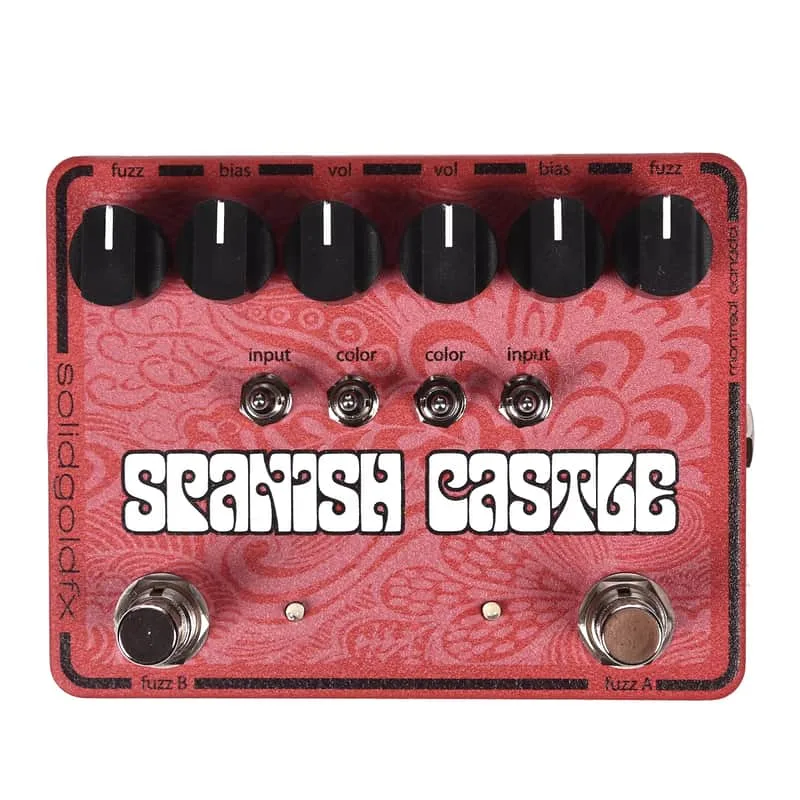


The SolidGoldFX Spanish Castle Dual Fuzz is a dual fuzz pedal that packs two of the company's If 6 Was 9 circuits into one enclosure, each with its own knobs, toggles and footswitch. Delicious Audio's Paolo De Gregorio described it as "Packed to the turrets with fuzz spread across two separate and footswitchable If 6 Was 9 circuits," aimed at "noise seekers who aren't quite satisfied with one fuzz at a time."1
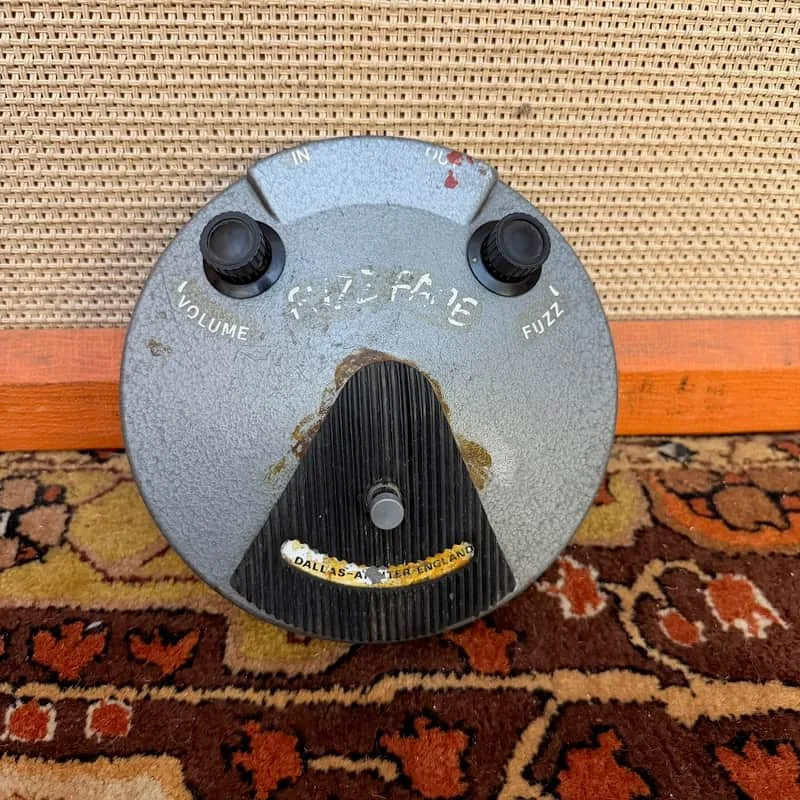
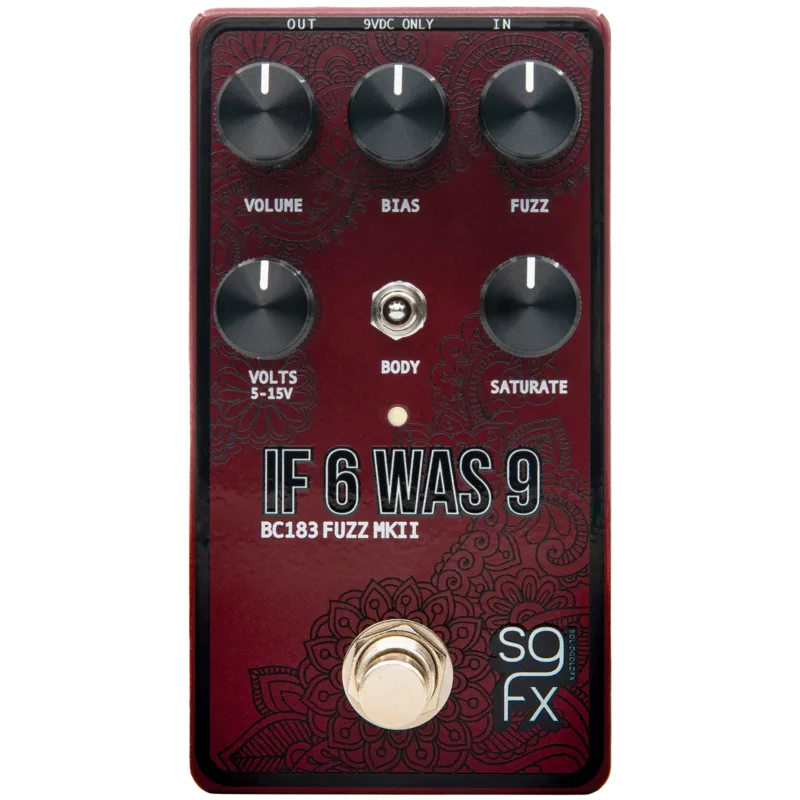
The two circuits are inspired by the 1969 Dallas-Arbiter Fuzz Face switch from germanium to silicon transistors. As De Gregorio put it, "Combining both Fuzz Face eras with a little contemporary magic is what we do around here": the Spanish Castle pairs a pre-1969 germanium-style low-gain silicon voice with a post-1969 higher-gain silicon voice.1 The If 6 Was 9 line itself is based on the Dallas-Arbiter Fuzz Face circuit, and SolidGoldFX's current If 6 Was 9 uses two BC183 transistors in each unit.2
The two sides
The two fuzzes are independent from each other, with dedicated knobs, toggles and footswitches, and you can play them one at a time or stacked.1
| Right side (Fuzz A) | Left side (Fuzz B) | |
|---|---|---|
| Position in chain | First | Second |
| Transistors | Low-gain silicon (BC183 side) | Higher-gain silicon (BC109 side) |
| Voice | Warmer, emulating the rich character of germanium with more stable and consistent operation | "More buzzsaw-like grind," from ripping gated fuzz textures to full-bodied snarl |
| Extras | Bias circuit, strong cleanup | Metal film resistors for tighter tolerances, extended bias range |
The right-side fuzz is first in the chain and has a warmer voice, "with low-gain silicon transistors that emulate the rich character of germanium with more stable and consistent operation."1 The left-side fuzz offers instead "higher-gain silicon transistors for a more buzzsaw-like grind, metal film resistors for tighter tolerances and an extended bias range for dialing in ripping gated fuzz textures as well as full-bodied snarl."1 Unlike the Fuzz Faces of old, the right-side circuit is equipped with a bias circuit to dial in just the right flavor, and cleans up well with the guitar's volume.1
Controls
Guitar Pedal X's Stefan Karlsson lists the control set as "2 x Fuzz, Bias, Volume, Input Gain, Color, Fuzz A Footswitch (BC183), Fuzz B Footswitch (BC109)."3 Each side carries its own set, so both fuzz voices get the same treatment:
- Fuzz (one per side): sets the fuzz amount for that side
- Bias: dials in the bias flavor of the circuit
- Volume: output level for that side
- Input Gain: gain feeding the circuit
- Color: three-position EQ toggle
- Footswitches: one for Fuzz A (BC183), one for Fuzz B (BC109)3
The Color toggle is a three-position switch that adjusts the EQ of its respective side, from flat EQ to two settings that shave off treble and mids, acting like a three-way low pass filter to tame highs and high-mids.1
The Input toggle is also a three-position switch, changing gain and bass values that make the Spanish Castle adapt better to rigs that include a wah and other finicky pedals.1
Bold and Comp modes
Each side contains an internal, under-the-hood switch that changes between Bold and Comp modes. Bold increases the output and midrange, while Comp offers a softer, more compressed tone.1 Because the switch sits inside the pedal, it is a set-and-forget voicing choice rather than a performance control.
Where it sits in the SolidGoldFX fuzz line
Videos
R.J. Ronquillo
Reverb
Mike Hermans
Questions
Can you run both fuzzes at the same time on the Spanish Castle?
Yes. The two fuzzes are independent from each other, with dedicated knobs, toggles and footswitches, and Delicious Audio notes you can play them one at a time or stacked together. Each side has its own footswitch, so you can switch between the warmer right-side fuzz and the higher-gain left-side fuzz, or engage both for a thicker combined fuzz voice.
Which fuzz comes first in the signal chain?
The right-side fuzz is first in the chain. According to Delicious Audio, it has a warmer voice, with low-gain silicon transistors that emulate the rich character of germanium with more stable and consistent operation. The left-side fuzz sits second in the chain and carries the higher-gain, buzzsaw-like voice.
What do the Bold and Comp modes do?
Each side of the Spanish Castle contains an internal, under-the-hood switch that changes between Bold and Comp modes. Bold increases the output and midrange, while Comp offers a softer, more compressed tone. Because the switch is internal, you set it with the back plate off rather than from the top panel.
Which transistors are in each side of the Spanish Castle?
The pedal uses four silicon transistors in total: two BC183 and two BC109, as Guitar Pedal X lists it. The right-side fuzz, first in the chain, uses low-gain silicon for a warmer, germanium-flavored voice, while the left-side fuzz uses higher-gain silicon transistors for a more buzzsaw-like grind.
What does the Input toggle do with a wah?
The Input toggle on each side is a three-position switch that changes gain and bass values. Delicious Audio describes it as making the Spanish Castle adapt better to rigs that include a wah and other finicky pedals, so you can tailor how the fuzz responds when a wah sits in front of it.
Sources (3)
- SolidGoldFX Unveils The Spanish Castle Dual Fuzz, Delicious Audio, 2018-10-17
- IF 6 WAS 9, SolidGoldFX
- Guitar Pedal X, Guitar Pedal X, 2024-03-11